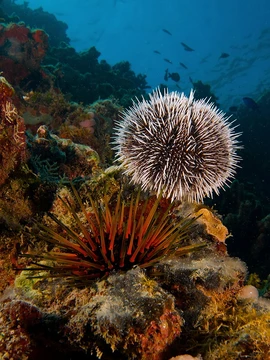
Red sea urchin
A keystone grazer and ecosystem engineer of temperate rocky reefs.
Last updated

Nandaro · CC BY-SA 3.0
It is the largest urchin species on the Pacific Northwest coast, with test diameters approaching 19 cm.[1]
Scientific classification
- KingdomAnimalia
- PhylumEchinodermata
- ClassEchinoidea
- OrderCamarodonta
- FamilyStrongylocentrotidae
- GenusMesocentrotus
- SpeciesMesocentrotus franciscanus
Named by (Aggasiz, 1863)
Sources: Wikipedia taxobox: Red sea urchin (CC BY-SA 4.0) · order, family and genus agree with WoRMS AphiaID 591102 (CC BY 4.0)
Where the red sea urchin has been recorded
Each dot is a place where the species has been observed and reported (497,277 records, half-degree grid) — not a modelled range. 33 inland records left out (institution coordinates).
Map: drawn by Codexery. Data: GBIF occurrence search (records CC0 / CC BY) · Natural Earth basemap (public domain) · place coordinates: Wikipedia (CC BY-SA 4.0)
Quick Facts
- Genus
- Mesocentrotus
- Species
- franciscanus
Facts from the source article.
Key facts and history
The red sea urchin lives from the low-tide line to over 280 m deep, typically on rocky shores near kelp.[2] Its calcareous shell, called a test, is covered by a thin epithelial tissue layer.[1] The mouth, located on the oral surface, contains a structure called Aristotle's lantern with five teeth.[3][1] Eggs are fertilized externally, and planktonic larvae settle after about a month.[4]
Red sea urchins can live over 100 years, with some individuals estimated to exceed 200 years.[5] Giant kelp (Macrocystis pyrifera) and bull kelp (Nereocystis leutkeariu) are among the seaweeds and algae that this species scrapes from the seafloor as its main food.[3][1] When alternative nourishment is scarce, adult red sea urchins can eat plankton, specifically Lithothamnion sp. and Bosiella sp.[3][1] In southern British Columbia, the reproductive season for spawning is highest from June through September, whereas urchins at Point Loma, CA, release gametes throughout the entire year.[4][1]
Young urchins, after metamorphosis, find adult red sea urchins by sensing chemical signals and then hide beneath the adults' longer spines until they grow to about 40 mm in diameter.[4][1]
What the cited sources add
The Animal Diversity Web account notes that red sea urchins are among the dominant members of rocky reef communities from the low intertidal zone to about 90 m.[1] Their spines are fine, measuring no more than 1.27 cm in diameter.[1] The tube feet are chemo-receptive, allowing detection of food and predators.[1] Feeding rates depend on water temperature, with an optimum near 16°C.[1]
Spiny lobsters and California sheepshead are main predators, and sea otters have dramatic effects on urchin populations.[1] Red sea urchins create rocky pits by boring holes in the substrate, possibly contributing to bioerosion.[1]
References
- Bartholomew, E., & Hursky, E. (n.d.). Strongylocentrotus franciscanus. Animal Diversity Web. https://animaldiversity.org/accounts/Strongylocentrotus_franciscanu. facts only, no text reused. animaldiversity.org
- Wikipedia, "Red sea urchin" (CC BY-SA 4.0), which cites: Lowe, "Urchin Searchin’: Red urchins and drift kelp found at 284 m in the mesophotic zone", Ciencias Marinas, 2020-12-18, p. 283–296–283–296; Britton-Simmons, "Spatial subsidy in the subtidal zone: utilization of drift algae by a deep subtidal sea urchin", Aquatic Biology, 2009-05-19, p. 233–243; Harrold and Reed, "Food availability, sea urchin grazing, and kelp forest community structure.", Ecology, 1985, p. 1160–1169 (original not read by us) en.wikipedia.org
- Wikipedia, "Red sea urchin" (CC BY-SA 4.0), which cites: Bartholomew, E., & Hursky, E. (n.d.). Strongylocentrotus franciscanus. Animal Diversity Web. https://animaldiversity.org/accounts/Strongylocentrotus_franciscanu; Bartholomew, E., & Hursky, E. (n.d.). Strongylocentrotus franciscanus. Animal Diversity Web. https://animaldiversity.org/accounts/Strongylocentrotus_franciscanu; Richard R. Strathmann, "The feeding behavior of planktotrophic echinoderm larvae: mechanisms, regulation, and rates of suspension feeding", Journal of Experimental Marine Biology and Ecology, 1971, p. 109–160; Bartholom en.wikipedia.org
- Wikipedia, "Red sea urchin" (CC BY-SA 4.0), which cites: Nishizaki, "A secondary chemical cue facilitates juvenile‐adult postsettlement associations in red sea urchins.", Limnology & Oceanography, 2000, p. 354–362; Moberg, "Genetic heterogeneity among adult and recruit red sea urchins, Mesocentrotus franciscanus", Marine Biology, 2000, p. 773–784 (original not read by us) en.wikipedia.org
- Wikipedia, "Red sea urchin" (CC BY-SA 4.0), which cites: "Red sea urchins (Strongylocentrotus franciscanus) can live over 100 years: confirmation with A-bomb <sup>14</sup>carbon", Fishery Bulletin, 2003, p. 915–922; Harrold and Reed, "Food availability, sea urchin grazing, and kelp forest community structure.", Ecology, 1985, p. 1160–1169 (original not read by us) en.wikipedia.org
Each numbered sentence above was checked against the source it cites before publication. Sentences citing Wikipedia adapt text from the English Wikipedia article Red sea urchin (contributors), used under CC BY-SA 4.0; this entry is available under the same licence. Other sources were used for facts only; no text or images are copied from them.
More in Sea Urchins
Sources
Compiled from Wikipedia and the sources listed below. Text from Wikipedia is available under CC BY-SA 4.0; this entry is adapted from it.
- Wikipedia: Red sea urchin (CC BY-SA 4.0).
- Classification: the source article's taxobox; order, family and genus checked against WoRMS, the World Register of Marine Species (CC BY 4.0).
- Occurrence records: GBIF (CC0 / CC BY). Basemap: Natural Earth (public domain).
- Word definitions: the Codexery glossary, each quoted from its Wikipedia article.
Spotted an error? Know more?
Reader corrections go straight into our review queue. Suggest an edit · How this site is sourced