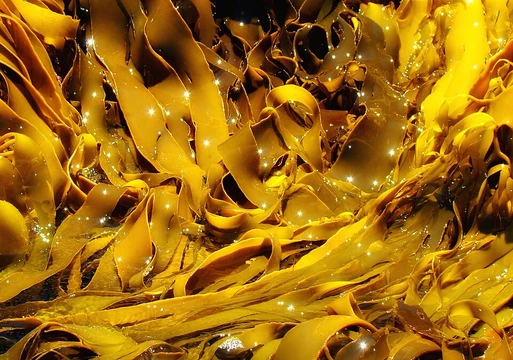
Macrocystis
The largest brown alga, forming vast kelp forests in cool oceans.
Last updated

Chad King / NOAA MBNMS · via Wikipedia: Macrocystis · Public domain
It is the largest of all brown algae, with individuals that can grow to over 45 meters long.[1][2][3] All species within the genus Macrocystis are now considered synonymous with the single species Macrocystis pyrifera, which is referred to by the common names giant kelp or bladder kelp.[4][1][5]
Scientific classification
- CladeEukaryota
- CladeSar<!-- Do not change Sar to SAR. The consensus was to use Sar in the taxonomy template. -->
- CladeStramenopiles
- ClassPhaeophyceae
- OrderLaminariales
- FamilyLaminariaceae
- GenusMacrocystis
- SpeciesMacrocystis pyrifera
Named by (L.) C.Agardh
Sources: Wikipedia taxobox: Macrocystis (CC BY-SA 4.0) · order, family and genus agree with WoRMS AphiaID 232231 (CC BY 4.0)
Where the macrocystis has been recorded
Each dot is a place where the species has been observed and reported (1,547,925 records, half-degree grid) — not a modelled range. 94 inland records left out (institution coordinates).
Map: drawn by Codexery. Data: GBIF occurrence search (records CC0 / CC BY) · Natural Earth basemap (public domain) · place coordinates: Wikipedia (CC BY-SA 4.0)
Quick Facts
- Species
- pyrifera
Facts from the source article.
Key facts and history
Macrocystis pyrifera is one of the fastest-growing organisms on Earth, growing at a rate of 60 cm per day.[6] Initially, 17 species were described within the genus, but modern molecular and morphological assessments demonstrate that Macrocystis is monospecific as M. pyrifera.[7] The sporophyte stage of Macrocystis is perennial, with individual organisms capable of surviving up to three years, while each individual frond typically lasts around 100 days.[1] Along the stipe, blades emerge at irregular positions, and each blade possesses a gas bladder, known as a pneumatocyst, located at its base.[1][2]
Near the holdfast, the macroscopic sporophyte bears specialized blades that contain sori; these sori house sporangia that release haploid spores.[8] When females release their eggs, they also secrete the pheromone lamoxirene, which induces the release of sperm from males.[9] On rocky substrates in the low intertidal zone, Macrocystis typically forms extensive beds and large floating canopies.[10]
What the cited sources add
An ABC News report by Kean describes Macrocystis as looking like rope, from which delicate blades stream off like flags.[11] The same source states that Macrocystis can grow 50 centimetres per day under ideal conditions.[11] Kean reports that Macrocystis thrives in nutrient-rich, cold, sub-Antarctic water that used to be a feature of Tasmania's coast.[11] According to Kean, most areas previously dominated by Macrocystis are now covered by common kelp (Ecklonia radiata), which is better at storing nitrogen in warmer waters.[11]
MacDonald reports that scientists built 28 artificial reefs off Maria Island on Tasmania's east coast to help restore giant kelp.[12] A VOA article lists Korea, Japan, New Zealand, Tasmania, Australia, South Africa, Chile, and North America as places where kelp forests are disappearing.[13]
References
- Wikipedia, "Macrocystis" (CC BY-SA 4.0), which cites: W.J. North (1971) The biology of giant kelp beds.; Rodriguez, "The importance of progressive senescence in the biomass dynamics of giant kelp ( Macrocystis pyrifera )", Ecology, August 2013, p. 1848–1858 (original not read by us) en.wikipedia.org
- Wikipedia, "Macrocystis" (CC BY-SA 4.0), which cites: Mondragon, Jennifer and Mondragon, Jeff (2003) Seaweeds of the Pacific Coast. Sea Challengers, Monterey, California.; I.A. Abbott and G.J. Hollenberg (1976) Marine Algae of California. Stanford University Press, California.; I.A. Abbott and G.J. Hollenberg (1976) Marine Algae of California. Stanford University Press, California.; A.B. Cribb (1953) Macrocystis pyrifera (L.) Ag. in Tasmanian waters Australian Journal of Marine and Freshwater Research, Vol 5, issue 1.; Kain, J M (1991) Cultivation of attached seaweeds in Guiry, M D and Blunden en.wikipedia.org
- Wikipedia, "Macrocystis" (CC BY-SA 4.0), which cites: Hoek, C van den; D G Mann & H M Jahns. (1995) Algae: An Introduction to Phycology. Cambridge: Cambridge University Press.; "Biology of the Macrocystis resource in North America", www.fao.org; Kain, J M (1991) Cultivation of attached seaweeds in Guiry, M D and Blunden, G (1991) Seaweed Resources in Europe: Uses and Potential. John Wiley and Sons.; "Biology of the Macrocystis resource in North America", www.fao.org (original not read by us) en.wikipedia.org
- Wikipedia, "Macrocystis" (CC BY-SA 4.0), which cites: Macaya, "DNA barcoding and genetic divergence in the Giant Kelp Macrocystis (Laminariales).", Journal of Phycology, August 2010, p. 736–742 (original not read by us) en.wikipedia.org
- Wikipedia, "Macrocystis" (CC BY-SA 4.0), which cites: C. van den Hoek, D.G. Mann and H.M. Jahns (1995) Algae An Introduction to Phycology. Cambridge University Press, Cambridge. (original not read by us) en.wikipedia.org
- Wikipedia, "Macrocystis" (CC BY-SA 4.0), which cites: Fenner, Bob The Brown Algae; White, L P & L G Plaskett, (1982) Biomass as Fuel. Academic Press.; I.A. Abbott and G.J. Hollenberg (1976) Marine Algae of California. Stanford University Press, California.; Cribb, A B. (1953) Macrocystis pyrifera (L.) Ag. in Tasmanian waters Australian Journal of Marine and Freshwater Research 5 (1):1-34.; Davis, Chuck. (1991) California Reefs. San Francisco, California: Chronicle Books. (original not read by us) en.wikipedia.org
- Wikipedia, "Macrocystis" (CC BY-SA 4.0), which cites: W.J. North (1971) Review of Macrocystis biology. In Biology of Economic Algae, I. Akatsuka (ed.). Hague: Academic Publishing, 447–527.; J.D. Hooker (1874) The Botany of the Antarctic Voyage of H.M. Discovery Ships Erebus and Terror. I. Flora Antarctica. London: Reeve Brothers.; Hay, "A new species of Macrocystis C. Ag. (Phaeophyta) from Marion Island, southern Indian Ocean", Phycologia, June 1986, p. 241–252; Demes, "Phenotypic plasticity reconciles incongruous molecular and morphological taxonomies: the Giant Kelp, Macrocystis (Laminariale en.wikipedia.org
- Wikipedia, "Macrocystis" (CC BY-SA 4.0), which cites: Graham, "Global ecology of the giant kelp Macrocystis: From ecotypes to ecosystems", Oceanography and Marine Biology: An Annual Review, 2007, p. 39–88 (original not read by us) en.wikipedia.org
- Wikipedia, "Macrocystis" (CC BY-SA 4.0), which cites: Maier, "Sexual Pheromones and Related Egg Secretions in Laminariales (Phaeophyta)", Zeitschrift für Naturforschung C, 1987-08-01, p. 948–954; Maier, "Stereochemical Specificity of Lamoxirene, the Sperm-Releasing Pheromone in Kelp (Laminariales, Phaeophyceae)", The Biological Bulletin, October 2001, p. 121–125 (original not read by us) en.wikipedia.org
- Wikipedia, "Macrocystis" (CC BY-SA 4.0), which cites: I.A. Abbott and G.J. Hollenberg (1976) Marine Algae of California. Stanford University Press, California.; Graham, "Global ecology of the giant kelp Macrocystis: From ecotypes to ecosystems", Oceanography and Marine Biology: An Annual Review, 2007, p. 39–88; Smith, G.M. 1955. Cryptogamic Botany. Volume 1. Algae and Fungi. McGraw-Hill Book Company, Inc. (original not read by us) en.wikipedia.org
- Kean, "These giant kelp forests were a boon for Tasmania's economy in the 60s and 70s. Now they're all but gone", ABC News, 27 February 2021. facts only, no text reused. abc.net.au
- MacDonald, "Scientists in race to save giant kelp off Tasmanian coast", ABC News, 5 February 2019. facts only, no text reused. abc.net.au
- "Scientists Work to Save Disappearing Kelp Forests", VOA, 20 August 2013. facts only, no text reused. voanews.com
Each numbered sentence above was checked against the source it cites before publication. Sentences citing Wikipedia adapt text from the English Wikipedia article Macrocystis (contributors), used under CC BY-SA 4.0; this entry is available under the same licence. Other sources were used for facts only; no text or images are copied from them.
More in Brown Macroalgae and Kelp
Sources
Compiled from Wikipedia and the sources listed below. Text from Wikipedia is available under CC BY-SA 4.0; this entry is adapted from it.
- Wikipedia: Macrocystis (CC BY-SA 4.0).
- Classification: the source article's taxobox; order, family and genus checked against WoRMS, the World Register of Marine Species (CC BY 4.0).
- Occurrence records: GBIF (CC0 / CC BY). Basemap: Natural Earth (public domain).
- Word definitions: the , each quoted from its Wikipedia article.
Spotted an error? Know more?
Reader corrections go straight into our review queue. Suggest an edit · How this site is sourced