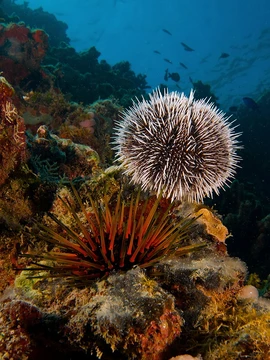
Stomopneustes
The sole living species in its family Stomopneustidae.
Last updated

Philippe Bourjon · via Wikipedia: Stomopneustes · CC BY-SA 3.0
Stomopneustes is a genus of sea urchin that contains a single living species, Stomopneustes variolaris, known as the black sea urchin or long-spined sea urchin. It is notable as the only extant member of its family Stomopneustidae, and is found throughout the tropical Indo-Pacific with a patchy distribution.
Scientific classification
- KingdomAnimalia
- PhylumEchinodermata
- ClassEchinoidea
- OrderStomopneustoida
- FamilyStomopneustidae
- GenusStomopneustes
- SpeciesStomopneustes variolaris
Named by (Lamarck, 1816)
Sources: Wikipedia taxobox: Stomopneustes (CC BY-SA 4.0) · order, family and genus agree with WoRMS AphiaID 212440 (CC BY 4.0)
Where the stomopneustes has been recorded
Each dot is a place where the species has been observed and reported (837 records, half-degree grid) — not a modelled range. 34 inland records left out (institution coordinates). 1 isolated far-off record not drawn.
Map: drawn by Codexery. Data: GBIF occurrence search (records CC0 / CC BY) · Natural Earth basemap (public domain)
Quick Facts
- Species
- Stomopneustes variolaris
- Family
- Stomopneustidae
- Common names
- black sea urchin, long-spined sea urchin
- Distribution
- tropical Indo-Pacific, from east African coast to Philippines
- Abundance note
- patchy distribution; particularly abundant in Sri Lanka
Facts from the source article.
Background
Stomopneustes variolaris is a rather big and strong regular sea urchin. Its spines are robust and sharp, black with sometimes a blue-greenish tinge depending on the light. A key identifying feature is the five grey sutures on the upper face, which exhibit a distinctive zig-zag pattern. The oral face is clearer, and juveniles are also clearer, ranging from black to pale brown, and often have strikingly asymmetrical spines due to their habit of using them to dig hiding holes in soft rocks.
This species can be confused with Diadematidae sea urchins, which have longer and more slender spines and an anal papilla, or with Echinometra mathaei, which also digs holes but is smaller, with shorter spines and never truly black. Stomopneustes variolaris is found on rock and damaged reefs, most often in shallow waters but never too close to wave action. It is particularly abundant in Sri Lanka.
More in Sea Urchins
Sources
Compiled from Wikipedia and the sources listed below. Text from Wikipedia is available under CC BY-SA 4.0; this entry is adapted from it.
- Wikipedia: Stomopneustes (CC BY-SA 4.0).
- Classification: the source article's taxobox; order, family and genus checked against WoRMS, the World Register of Marine Species (CC BY 4.0).
- Occurrence records: GBIF (CC0 / CC BY). Basemap: Natural Earth (public domain).
- Word definitions: the Codexery glossary, each quoted from its Wikipedia article.
Spotted an error? Know more?
Reader corrections go straight into our review queue. Suggest an edit · How this site is sourced