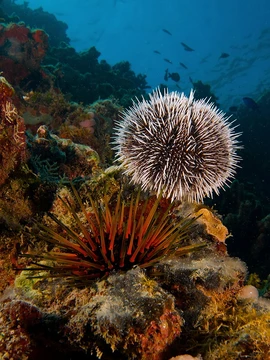
Meoma ventricosa
A large Caribbean urchin with dual symmetry and burrowing habits.
Last updated

Dornicke · via Wikipedia: Meoma ventricosa · CC BY-SA 4.0
The red heart urchin has a somewhat flattened, heart-shaped test made of calcium carbonate plates covered by short, dense, moveable spines.[1]
Scientific classification
- KingdomAnimalia
- PhylumEchinodermata
- ClassEchinoidea
- OrderSpatangoida
- FamilyBrissidae
- GenusMeoma
- SpeciesMeoma ventricosa
Named by (Lamarck, 1816)
Sources: Wikipedia taxobox: Meoma ventricosa (CC BY-SA 4.0) · order, family and genus agree with WoRMS AphiaID 367846 (CC BY 4.0)
Where the meoma ventricosa has been recorded
Each dot is a place where the species has been observed and reported (612 records, half-degree grid) — not a modelled range. 23 inland records left out (institution coordinates). 1 isolated far-off record not drawn.
Map: drawn by Codexery. Data: GBIF occurrence search (records CC0 / CC BY) · Natural Earth basemap (public domain) · place coordinates: Wikipedia (CC BY-SA 4.0)
Quick Facts
- Genus
- Meoma (echinoderm)
- Species
- ventricosa
Facts from the source article.
Key facts and history
The species was described by Lamarck in 1816.[2] There are two subspecies: Meoma ventricosa grandis and Meoma ventricosa ventricosa.[2] The urchin feeds by swallowing sediment to extract nutritive films of algae and bacteria.[3] This urchin can be found from the intertidal zone down to a depth of 200 meters.[4]
Adult individuals frequently surface on the seafloor during the night and rebury themselves the following day.[3] In Florida, the breeding season spans from August to February, with the highest activity from November through January.[3] A parasitic association with the crab Dissodactylus primitivus is common among mature individuals.[3]
What the cited sources add
A 1969 study by Chesher in the Bulletin of Marine Science details that the urchin's growth rate is limited by organic material and lack of oxygen in sediment.[3] This disturbance may benefit the urchin by increasing algae and bacteria growth on sediment particles.[3] A paper published in Diseases of Aquatic Organisms in 1999 documented that a 1997 die-off near Curaçao was linked to a Pseudoalteromonas bacterium.[5] Urchins that were affected shed their spines and subsequently perished.[5]
The outbreak was mostly restricted to a region down-current from Willemstad harbor.[5]
References
- Wikipedia, "Meoma ventricosa" (CC BY-SA 4.0), which cites: "Meoma ventricosa", Project Oceanica; Colin, "Marine Invertebrates and Plants of the Living Reef", T.F.H. Publications, 1978, p. 427–430; Handler, Gordon; Miller, John E.; Pawson, David L.; Kier, Porter M. 1995. Sea Stars, Sea Urchins, and Allies. Smithsonian Institution. Pages:243-245, 244 Fig.13; "Meoma ventricosa Lamarck, 1816", Smithsonian Tropical Research Institute (we also read that source) en.wikipedia.org
- Wikipedia, "Meoma ventricosa" (CC BY-SA 4.0), which cites: Kroh, Andreas, "Meoma ventricosa (Lamarck, 1816)", 2012 (original not read by us) en.wikipedia.org
- Wikipedia, "Meoma ventricosa" (CC BY-SA 4.0), which cites: Chesher, Richard H., "Contributions to the Biology of Meoma ventricosa (Echinoidea: Spatangoida)", Bulletin of Marine Science, 1969, p. 72–110 (original not read by us) en.wikipedia.org
- Wikipedia, "Meoma ventricosa" (CC BY-SA 4.0), which cites: Colin, "Marine Invertebrates and Plants of the Living Reef", T.F.H. Publications, 1978, p. 427–430 (we also read that source) en.wikipedia.org
- Wikipedia, "Meoma ventricosa" (CC BY-SA 4.0), which cites: "Sea urchin Meoma ventricosa die-off in Curaçao (Netherlands Antilles) associated with a pathogenic bacterium", Diseases of Aquatic Organisms, 1999, p. 71–74 (original not read by us) en.wikipedia.org
Each numbered sentence above was checked against the source it cites before publication. Sentences citing Wikipedia adapt text from the English Wikipedia article Meoma ventricosa (contributors), used under CC BY-SA 4.0; this entry is available under the same licence. Other sources were used for facts only; no text or images are copied from them.
More in Sea Urchins
Sources
Compiled from Wikipedia and the sources listed below. Text from Wikipedia is available under CC BY-SA 4.0; this entry is adapted from it.
- Wikipedia: Meoma ventricosa (CC BY-SA 4.0).
- Classification: the source article's taxobox; order, family and genus checked against WoRMS, the World Register of Marine Species (CC BY 4.0).
- Occurrence records: GBIF (CC0 / CC BY). Basemap: Natural Earth (public domain).
Spotted an error? Know more?
Reader corrections go straight into our review queue. Suggest an edit · How this site is sourced