Cidaridae
Basal sea urchin family with stout tests and massive spines.
Last updated
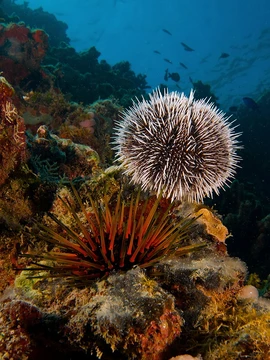
Cidaridae are a family of sea urchins with a stout, thick test and massive, often long spines that can be shaped like clubs, fans, or Christmas trees.[1] They are found in Antarctica and other deep-sea locations.[2]
Scientific classification
- KingdomAnimalia
- PhylumEchinodermata
- ClassEchinoidea
- OrderCidaroida
- FamilyCidaridae
Named by Gray, 1825
Sources: Wikipedia taxobox: Cidaridae (CC BY-SA 4.0)
Quick Facts
- Order
- Cidaroida
- Subfamilies
- Cidarinae
- Goniocidarinae
- Stereocidarinae
- Stylocidarinae
- Notable genera
- Eucidaris, Phyllacanthus
- Abandoned genus
- Cidarites
Facts from the source article.
Key facts and history
The test has massive perforated tubercles that are never crenulated, and no primary tubercles occur in the interambulacra.[1] The spines are thick, strong, and sometimes oddly shaped, including thorny or fan-like forms.[1] An abandoned genus, Cidarites, was used in the late 18th and early 19th centuries for both cidarid and echid species.[3] The family is divided into subfamilies such as Cidarinae and Goniocidarinae.[4]
Many cidarid species live in the deep sea.[2] The World Register of Marine Species lists the genera Cidaris, Eucidaris, and Goniocidaris among the many included in this family.[4]
What the cited sources add
The Echinoblog account notes that most people may not understand the technical terms used to describe cidarid morphology.[2] It specifies that cidarids belong to a group found in Antarctica and elsewhere, mostly in the deep-sea.[2]
References
- Wikipedia, "Cidaridae" (CC BY-SA 4.0), which cites: Mah, "The Echinoderm Christmas Tree?? Antarctic Cidaroid Sea Urchins!", Echinoblog, December 7, 2009; Mah, "Strange Urchin Spines! Past and Present!", Echinoblog, August 20, 2013; Mah, "What is Going on with cidaroid sea urchins and their WEIRD spines??", Echinoblog, May 20, 2015 (we also read that source) en.wikipedia.org
- Mah, "The Echinoderm Christmas Tree?? Antarctic Cidaroid Sea Urchins!", Echinoblog, December 7, 2009. facts only, no text reused. echinoblog.blogspot.fr
- Wikipedia, "Cidaridae" (CC BY-SA 4.0), which cites: "Cidarites auct.", WoRMS (original not read by us) en.wikipedia.org
- Wikipedia, "Cidaridae" (CC BY-SA 4.0), which cites: WoRMS : Cidaridae (original not read by us) en.wikipedia.org
Each numbered sentence above was checked against the source it cites before publication. Sentences citing Wikipedia adapt text from the English Wikipedia article Cidaridae (contributors), used under CC BY-SA 4.0; this entry is available under the same licence. Other sources were used for facts only; no text or images are copied from them.
More in Sea Urchins
Sources
Compiled from Wikipedia and the sources listed below. Text from Wikipedia is available under CC BY-SA 4.0; this entry is adapted from it.
- Wikipedia: Cidaridae (CC BY-SA 4.0).
- Word definitions: the Codexery glossary, each quoted from its Wikipedia article.
Spotted an error? Know more?
Reader corrections go straight into our review queue. Suggest an edit · How this site is sourced