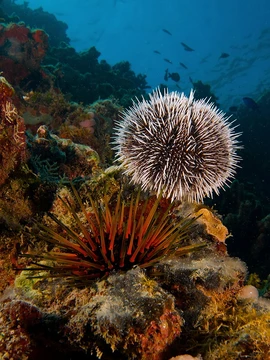
Cidaris blakei
A deep-sea urchin with distinctive fan-like spines.
Last updated

NOAA Okeanos Explorer · via Wikipedia: Cidaris blakei · Public domain
Its armor bears three spine types, including a distinctive extended fan-like form.[1] Belonging to the family Cidaridae, Cidaris blakei is a sea urchin species.[1] The scientific description of this species was first published by Alexander Agassiz in 1878.[1]
Scientific classification
- KingdomAnimalia
- PhylumEchinodermata
- ClassEchinoidea
- OrderCidaroida
- FamilyCidaridae
- GenusCidaris
- SpeciesCidaris blakei
Named by (Agassiz, 1878)
Sources: Wikipedia taxobox: Cidaris blakei (CC BY-SA 4.0) · order, family and genus agree with WoRMS AphiaID 422479 (CC BY 4.0)
Where the cidaris blakei has been recorded
Each dot is a place where the species has been observed and reported (85 records, half-degree grid) — not a modelled range. 1 inland record left out (institution coordinates).
Map: drawn by Codexery. Data: GBIF occurrence search (records CC0 / CC BY) · Natural Earth basemap (public domain)
Quick Facts
- First described by
- Alexander Agassiz
- Year first described
- 1878
- Family
- Cidaridae
- Depth found
- around 600 m (2,000 ft)
- Distribution
- Gulf of Mexico and deepwater areas off the Bahamas
Facts from the source article.
Key facts and history
The species was named after the USC&GS George S. Blake, the vessel that collected it.[2] Agassiz described Cidaris blakei from deep-sea dredgings in the Gulf of Mexico.[2] Specimens were collected from the seabed at depths around 600 m.[3] Larvae are planktotrophic and take four months to develop from egg to metamorphosis.[4]
Larvae feed on zooplankton and phytoplankton after the egg yolk is exhausted.[4] The specific name "blakei" was given in honor of the vessel USS Blake, which collected the specimen.[5] According to researchers, larvae probably cannot endure the warmer temperatures found higher in the water column.[4]
What the cited sources add
The Echinoblog notes that many cidaroid urchins have unusual spine morphologies.[5] The same source reports that epizoic organisms such as worm tubes and barnacles grow on the spines.[5] The Echinoblog also mentions that other cidaroid species can "seed" new areas with animals living on their spines.[5]
References
- Wikipedia, "Cidaris blakei" (CC BY-SA 4.0), which cites: Mah, "What is Going on with cidaroid sea urchins and their WEIRD spines?", The Echinoblog, 20 May 2015 (we also read that source) en.wikipedia.org
- Wikipedia, "Cidaris blakei" (CC BY-SA 4.0), which cites: Kroh, A. (2018). Cidaris blakei (Agassiz, 1878). In: Kroh, A. & Mooi, R. (2010) World Echinoidea Database. at the World Register of Marine Species.; "George S. Blake", NOAA History: Coast and Geodetic Survey Ships, 2006 (original not read by us) en.wikipedia.org
- Wikipedia, "Cidaris blakei" (CC BY-SA 4.0), which cites: Bennett, Kathleen, "The Complete Development of the Deep-Sea Cidaroid Urchin Cidaris blakei (Agassiz, 1878) With an Emphasis on the Hyaline Layer", 2009 (original not read by us) en.wikipedia.org
- Wikipedia, "Cidaris blakei" (CC BY-SA 4.0), which cites: "Larval development and metamorphosis of the deep-sea cidaroid urchin Cidaris blakei", Biological Bulletin, 2012, p. 105–117 (original not read by us) en.wikipedia.org
- Mah, "What is Going on with cidaroid sea urchins and their WEIRD spines?", The Echinoblog, 20 May 2015. facts only, no text reused. echinoblog.blogspot.fr
Each numbered sentence above was checked against the source it cites before publication. Sentences citing Wikipedia adapt text from the English Wikipedia article Cidaris blakei (contributors), used under CC BY-SA 4.0; this entry is available under the same licence. Other sources were used for facts only; no text or images are copied from them.
More in Sea Urchins
Test yourself
Three questions drawn from this entry’s sources. Pick an answer to check it.
Answers checked against the source article
Sources
Compiled from Wikipedia and the sources listed below. Text from Wikipedia is available under CC BY-SA 4.0; this entry is adapted from it.
- Wikipedia: Cidaris blakei (CC BY-SA 4.0).
- Classification: the source article's taxobox; order, family and genus checked against WoRMS, the World Register of Marine Species (CC BY 4.0).
- Occurrence records: GBIF (CC0 / CC BY). Basemap: Natural Earth (public domain).
- Word definitions: the Codexery glossary, each quoted from its Wikipedia article.
Spotted an error? Know more?
Reader corrections go straight into our review queue. Suggest an edit · How this site is sourced