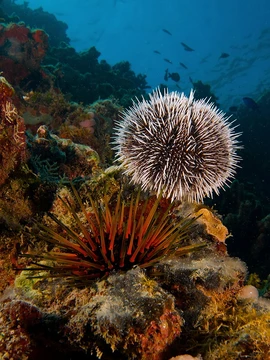
Arbacia lixula
A black sea urchin with uniform spines and an anal valve.
Last updated

Frédéric Ducarme · via Wikipedia: Arbacia lixula · CC BY-SA 3.0
Arbacia lixula is a small, regular sea urchin covered with densely implanted, smooth, pointed spines that do not exceed three centimeters in length.[1] It is always black in color and has a hemispherical shape.[1][2]
Scientific classification
- KingdomAnimalia
- PhylumEchinodermata
- ClassEchinoidea
- OrderArbacioida
- FamilyArbaciidae
- GenusArbacia
- SpeciesArbacia lixula
Named by (Linnaeus, 1758)
Close relatives
Other species of Arbacia with a Codexery entry.
- Arbacia nigra Arbacia nigra
- Arbacia punctulata Arbacia punctulata
Sources: Wikipedia taxobox: Arbacia lixula (CC BY-SA 4.0) · order, family and genus agree with WoRMS AphiaID 124249 (CC BY 4.0)
Where the arbacia lixula has been recorded
Each dot is a place where the species has been observed and reported (9,068 records, half-degree grid) — not a modelled range. 101 inland records left out (institution coordinates).
Map: drawn by Codexery. Data: GBIF occurrence search (records CC0 / CC BY) · Natural Earth basemap (public domain)
Quick Facts
- Size
- medium-sized
- Color
- deep black
- Depth range
- 0 to 30 m / 98 ft 5 in
- Habitat
- rocky shores
Facts from the source article.
Key facts and history
The species was first described by Carl von Linné in 1758 under the name Echinus lixula.[1] The genus name Arbacia was introduced by John Edward Gray in 1835, though its origin remains unclear.[1] The species name lixula may come from the Latin word for a small cake or food preparation made from flour, water, and cheese.[1] The test is flattened and almost always pink with ten red or brown bands that encircle the ambulacral zones in pairs.[1]
In water, the spines are all of similar length and stay upright, never appearing messy.[2] Four plates encircle the top anus, creating an anal valve.[2] Crustose red algae and small filamentous algae make up the majority of this species' diet.[3] Between 1983 and 1992, within a Mediterranean marine reserve, the density of this species rose from 8 to 100 individuals per square meter, a more than tenfold increase.[3]
What the cited sources add
The DORIS account notes that Arbacia lixula is a small regular urchin with spines not exceeding three centimeters.[1] The account also explains that A. lixula has a flattened test that is almost always pink with ten red or brown bands.[1] It reports an individual with only three flaps in its anal valve, a symmetry considered non-existent in the animal kingdom except for a handful of archaic fossils.[1]
References
- ZIEMSKI Frédéric, André Frédéric, in: DORIS, 15/5/2014: Arbacia lixula (Linnaeus, 1758).. facts only, no text reused. doris.ffessm.fr
- Wikipedia, "Arbacia lixula" (CC BY-SA 4.0), which cites: ZIEMSKI Frédéric, André Frédéric, in: DORIS, 15/5/2014: Arbacia lixula (Linnaeus, 1758). (we also read that source) en.wikipedia.org
- Wikipedia, "Arbacia lixula" (CC BY-SA 4.0), which cites: "A boom–bust phylum? Ecological and evolutionary consequences of density variations in echinoderms", Ecological Monographs, 2009, p. 3–24 (original not read by us) en.wikipedia.org
Each numbered sentence above was checked against the source it cites before publication. Sentences citing Wikipedia adapt text from the English Wikipedia article Arbacia lixula (contributors), used under CC BY-SA 4.0; this entry is available under the same licence. Other sources were used for facts only; no text or images are copied from them.
More in Sea Urchins
Sources
Compiled from Wikipedia and the sources listed below. Text from Wikipedia is available under CC BY-SA 4.0; this entry is adapted from it.
- Wikipedia: Arbacia lixula (CC BY-SA 4.0).
- Classification: the source article's taxobox; order, family and genus checked against WoRMS, the World Register of Marine Species (CC BY 4.0).
- Occurrence records: GBIF (CC0 / CC BY). Basemap: Natural Earth (public domain).
Spotted an error? Know more?
Reader corrections go straight into our review queue. Suggest an edit · How this site is sourced