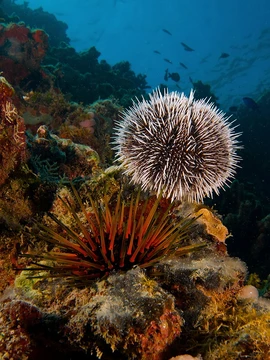
Echinothrix calamaris
A sea urchin with banded spines and a rudimentary visual system.
Last updated

Anders Poulsen, Deep Blue (colours.dk · via Wikipedia: Echinothrix calamaris · CC BY-SA 3.0
The test (shell) of the banded sea urchin is slightly oval and reaches a diameter of about 5 cm, while the entire animal can grow to 30 cm in diameter.[1][2] Two distinct spine types are present: short, slender, venomous spines that range from yellow to dark, and longer, thicker, often banded spines that are hollow and reach 10 to 15 cm.[2]
Scientific classification
- KingdomAnimalia
- PhylumEchinodermata
- ClassEchinoidea
- OrderDiadematoida
- FamilyDiadematidae
- GenusEchinothrix
- SpeciesEchinothrix calamaris
Named by Pallas, 1774
Close relatives
Other species of Echinothrix with a Codexery entry.
- Echinothrix diadema Echinothrix diadema
Sources: Wikipedia taxobox: Echinothrix calamaris (CC BY-SA 4.0) · order, family and genus agree with WoRMS AphiaID 213377 (CC BY 4.0)
How big is it?
Largest length in the source, 0.15 m, next to a 1.8 m person.
Diagram: drawn by Codexery, schematic shapes to scale (not a likeness). Length: Wikipedia: Echinothrix calamaris
Where the echinothrix calamaris has been recorded
Each dot is a place where the species has been observed and reported (3,192 records, half-degree grid) — not a modelled range. 54 inland records left out (institution coordinates).
Map: drawn by Codexery. Data: GBIF occurrence search (records CC0 / CC BY) · Natural Earth basemap (public domain) · place coordinates: Wikipedia (CC BY-SA 4.0)
Key facts and history
According to the DORIS account, young Diadema setosum and D. savignyi with banded spines can be mistaken for E. calamaris.[1] Only E. calamaris has an anal papilla marked with white dots.[1] This species is gonochoric, with separate male and female individuals.[1] Like all sea urchins, it moves using tube feet, each of which has a suction cup.[1]
Echinothrix calamaris has a lifespan of up to 6 years.[1] During daylight hours, this urchin stays hidden in crevices or under rocks, and it comes out at night to feed.[3][1] In Hawaiian waters, the symbiotic crab Echinoecus pentagonus is often found living on E. calamaris.[4]
What the cited sources add
The DORIS account describes the fine, dark ambulacral spines and the larger, light-colored, tubular, hollow interambulacral spines.[1] The large spines are usually white with dark bands, but sometimes they are entirely white.[1] Five blue or green lines, which may be more or less visible, radiate outward from the anal papilla.[1] The DORIS account notes that the fine ambulacral spines are venomous and can cause painful stings.[1]
Young E. calamaris look similar to the pencil urchin Heterocentrotus mammillatus, but they differ in color.[1]
References
- "Echinothrix calamaris (Pallas, 1774)", DORIS, 2010-11-27. facts only, no text reused. doris.ffessm.fr
- Wikipedia, "Echinothrix calamaris" (CC BY-SA 4.0), which cites: "Echinothrix calamaris (Pallas, 1774)", DORIS, 2010-11-27; "Echinothrix calamaris" (we also read that source) en.wikipedia.org
- Wikipedia, "Echinothrix calamaris" (CC BY-SA 4.0), which cites: "Echinothrix calamaris (Pallas, 1774)", DORIS, 2010-11-27 (we also read that source) en.wikipedia.org
- Wikipedia, "Echinothrix calamaris" (CC BY-SA 4.0), which cites: John P. Hoover, "Hawaiian Sea Creatures", Mutual Publishing, 2007 (we also read that source) en.wikipedia.org
Each numbered sentence above was checked against the source it cites before publication. Sentences citing Wikipedia adapt text from the English Wikipedia article Echinothrix calamaris (contributors), used under CC BY-SA 4.0; this entry is available under the same licence. Other sources were used for facts only; no text or images are copied from them.
More in Sea Urchins
Sources
Compiled from Wikipedia and the sources listed below. Text from Wikipedia is available under CC BY-SA 4.0; this entry is adapted from it.
- Wikipedia: Echinothrix calamaris (CC BY-SA 4.0).
- Classification: the source article's taxobox; order, family and genus checked against WoRMS, the World Register of Marine Species (CC BY 4.0).
- Occurrence records: GBIF (CC0 / CC BY). Basemap: Natural Earth (public domain).
- Word definitions: the Codexery glossary, each quoted from its Wikipedia article.
Spotted an error? Know more?
Reader corrections go straight into our review queue. Suggest an edit · How this site is sourced