
Polarizer
Optical filter that transmits only specific light polarization.

Reinraum · Public domain
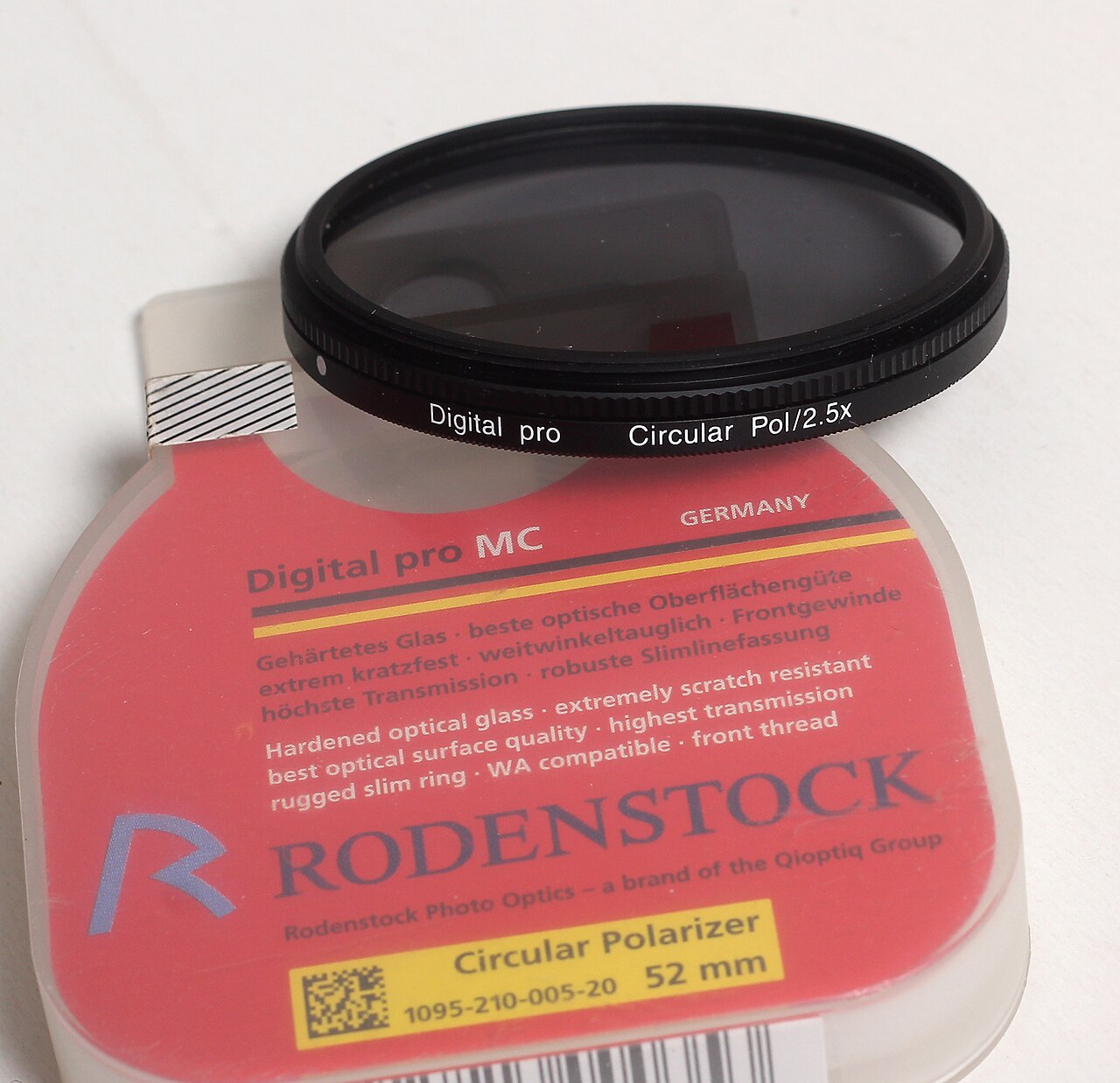
A polarizer is an optical filter that transmits only light waves with a specific polarization, blocking all others. It converts a beam of mixed or undefined polarization into a beam of well-defined polarized light. These devices are common in photography, LCD screens, and many other optical instruments. In photography, a polarizing filter helps eliminate reflections.
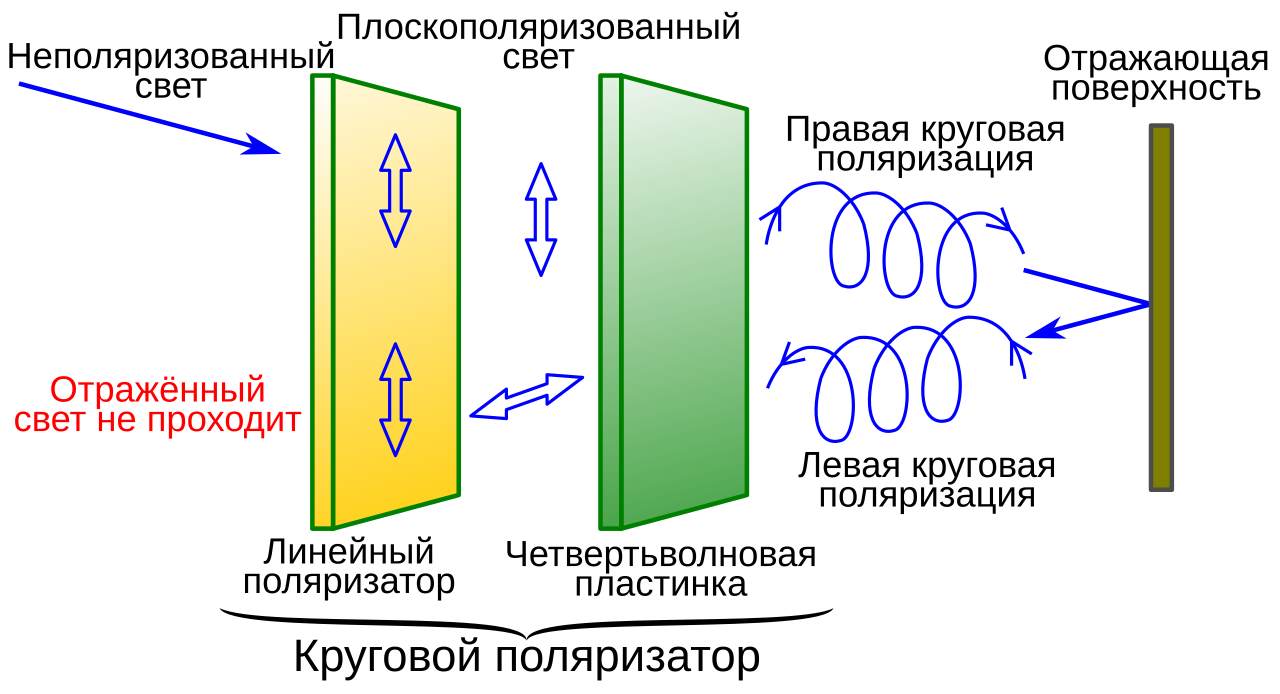
Polarizers come in two main types: linear and circular. They can also be made for other electromagnetic waves, such as radio, microwaves, and X-rays.
**Linear Polarizers**
Linear polarizers fall into two broad categories. Absorptive polarizers absorb the unwanted polarization states. Beam-splitting polarizers split an unpolarized beam into two beams with opposite polarization states. Polarizers that keep the same polarization axes regardless of the angle of incidence are called Cartesian polarizers—here, polarization vectors are described using simple horizontal vs. vertical coordinates, independent of the polarizer's surface orientation. When polarization states are defined relative to a surface (as in Fresnel reflection), they are labeled s and p. This distinction is often negligible but becomes important for high contrast and wide angular spreads of incoming light.
**Absorptive Polarizers**
Certain crystals exhibit dichroism—they preferentially absorb light polarized in specific directions—and can serve as linear polarizers. Tourmaline is a well-known example, but it is rarely used because its dichroic effect depends strongly on wavelength, giving the crystal a colored appearance. Herapathite is also dichroic and less colored, but growing large crystals is difficult.
A Polaroid polarizing filter works similarly on an atomic scale to a wire-grid polarizer. Originally made from microscopic herapathite crystals, its modern H-sheet form uses polyvinyl alcohol (PVA) plastic doped with iodine. During manufacturing, the sheet is stretched, aligning the PVA chains in one direction. Valence electrons from the iodine can move freely along the polymer chains but not across them. Consequently, incident light polarized parallel to the chains is absorbed, while light polarized perpendicularly is transmitted. Polaroid's durability and low cost make it the most common polarizer type, used in sunglasses, photographic filters, and liquid crystal displays.
A newer type of absorptive polarizer consists of elongated silver nanoparticles embedded in thin glass plates (≤0.5 mm). These are more durable than plastic Polaroid film and offer much better polarization, with ratios up to 100,000:1 and absorption of correctly polarized light as low as 1.5%. They perform best with long-wavelength infrared light and are widely used in fiber-optic communication.
**Beam-Splitting Polarizers**
Beam-splitting polarizers divide an incident beam into two beams with different linear polarizations. In an ideal polarizing beamsplitter, both output beams are fully polarized with orthogonal polarizations. However, in many common types, only one output beam is fully polarized; the other contains a mix of states. Unlike absorptive polarizers, these do not absorb and dissipate the energy of the rejected polarization, making them suitable for high-intensity beams like lasers. True polarizing beamsplitters are also useful when both polarization components need to be analyzed or used simultaneously.
**Polarization by Fresnel Reflection**
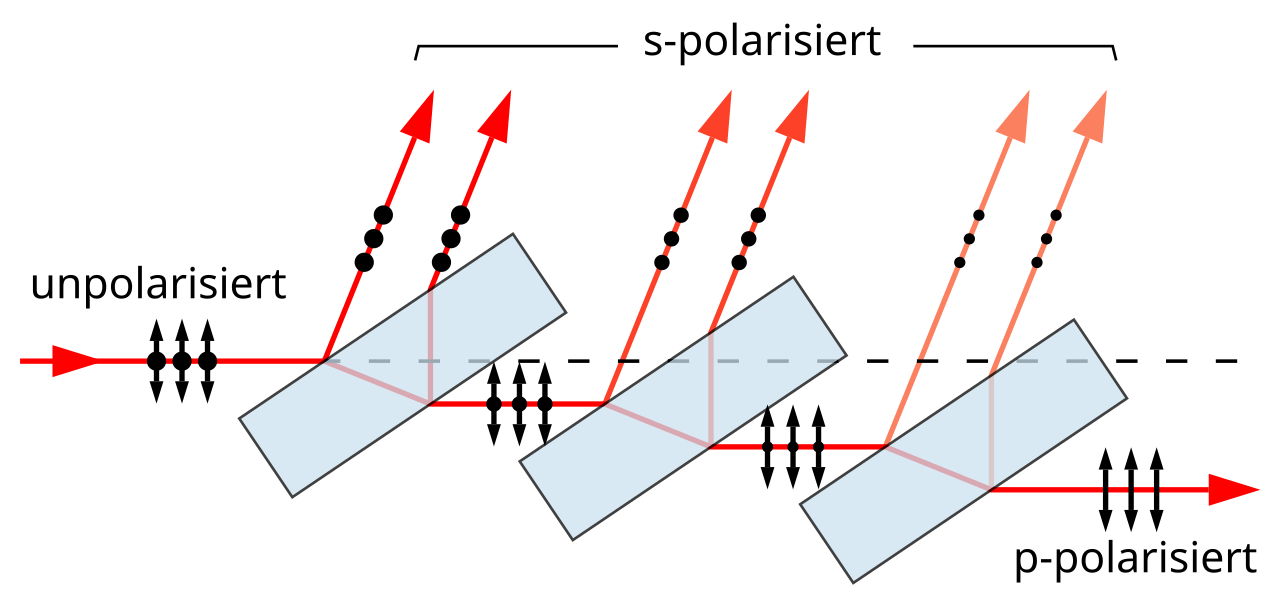
When light reflects at an angle between two transparent materials, the reflectivity differs for light polarized in the plane of incidence (p-polarized) and perpendicular to it (s-polarized). At Brewster's angle, no p-polarized light is reflected, so all reflected light is s-polarized. A simple linear polarizer can be made by tilting a stack of glass plates at Brewster's angle. Each reflection removes some s-polarized light from the beam, leaving more p-polarized light in the transmitted beam. For visible light in air and typical glass, Brewster's angle is about 57°, and about 16% of the s-polarized light is reflected at each air-to-glass or glass-to-air transition. Many plates are needed for even mediocre polarization; with 10 plates (20 reflections), only about 3% of the s-polarized light is transmitted. The reflected beam, though fully polarized, is spread out and often not useful. A more useful polarized beam can be obtained by tilting the stack at a steeper angle than Brewster's angle. Counterintuitively, using incident angles greater than Brewster's angle yields a higher degree of polarization in the transmitted beam, though overall transmission decreases. For angles steeper than 80°, the effect becomes even more pronounced.
- field
- Optics
- known_for
- Filtering light by polarization; used in photography, LCDs, and fiber-optic communication
- types
- Linear polarizers and circular polarizers
- common_materials
- Tourmaline, Herapathite, Polaroid film, silver nano-particles in glass, calcite, quartz
Lore & Background
Polarizers can be divided into linear and circular types. Linear polarizers include absorptive types, where unwanted polarization states are absorbed, and beam-splitting types, which split an unpolarized beam into two beams with opposite polarization states. Absorptive polarizers often use dichroic crystals such as tourmaline or herapathite, though the most common is Polaroid film, made from polyvinyl alcohol plastic with iodine doping. Stretching the sheet aligns polymer chains, allowing valence electrons from iodine to move linearly along the chains, absorbing light polarized parallel to them and transmitting perpendicular light.
Reader's Guide
Polarizers are significant for their ability to control light polarization, enabling applications from reducing glare in photography to functioning in liquid crystal displays. Beam-splitting polarizers, such as those based on Fresnel reflection or birefringent crystals, are essential for high-intensity laser applications because they do not absorb rejected energy. Birefringent polarizers like the Nicol prism, Glan–Thompson prism, and Wollaston prism exploit double refraction in crystals such as calcite to separate polarization states. Thin-film polarizers use optical coatings to achieve polarization via Brewster's angle or interference effects. The distinction between Cartesian polarization (horizontal vs. vertical) and s–p polarization (relative to a surface) becomes important for high contrast and wide angular spreads. Polarizers also exist for other electromagnetic waves, including radio waves, microwaves, and X-rays.
Did You Know?
- Polaroid polarizing filters were originally made of microscopic herapathite crystals.
- A stack of glass plates tilted at Brewster's angle can act as a simple linear polarizer.
- Birefringent polarizers like the Wollaston prism split an unpolarized beam into two fully polarized beams with perpendicular polarizations.
The Geometry of Transverse Oscillation
Polarization is a defining characteristic that belongs exclusively to transverse waves—those in which the oscillation moves perpendicular to the direction the wave travels. A simple illustration is a plucked guitar string: depending on the angle of the pluck, the vibration swings vertically, horizontally, or somewhere in between. This geometric orientation of the oscillation is what we call polarization. Longitudinal waves, such as sound traveling through air or water, lack this property entirely because their particle displacement runs parallel to the direction of propagation. Transverse waves that do carry polarization include electromagnetic radiation like visible light and radio signals, gravitational waves, and shear waves moving through solid materials. Understanding this distinction is foundational: it tells us which physical phenomena can be described by polarization and which cannot, shaping everything from optics to seismology.
Linear, Circular, and Elliptical: The States of Polarization
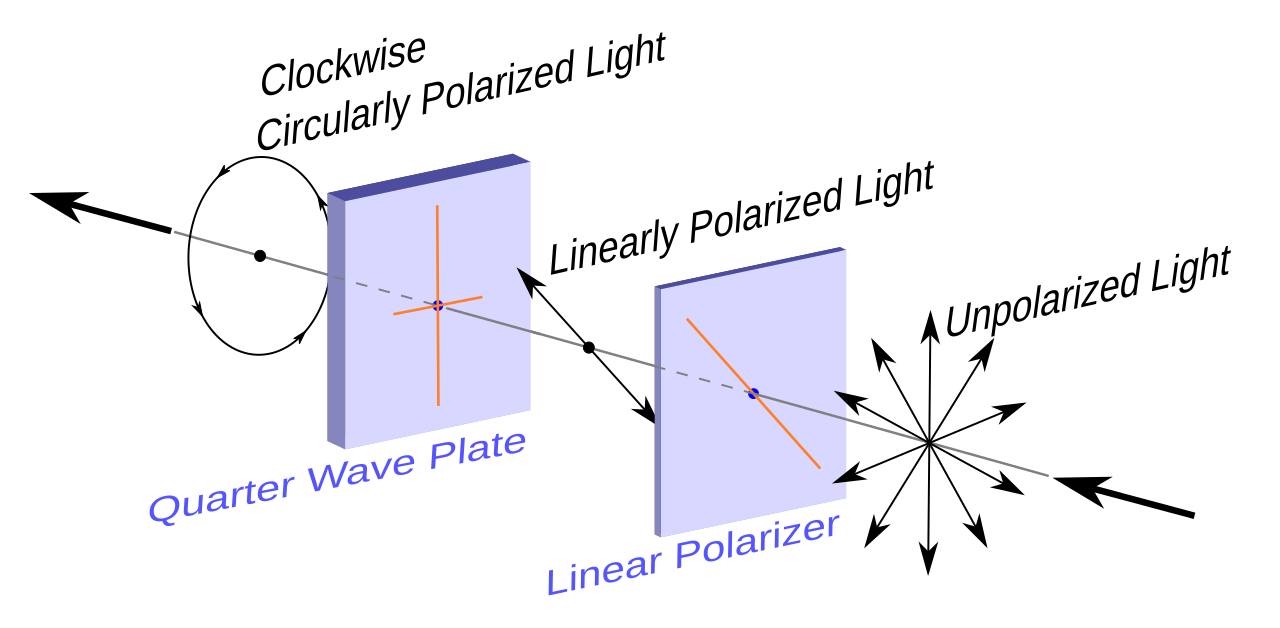
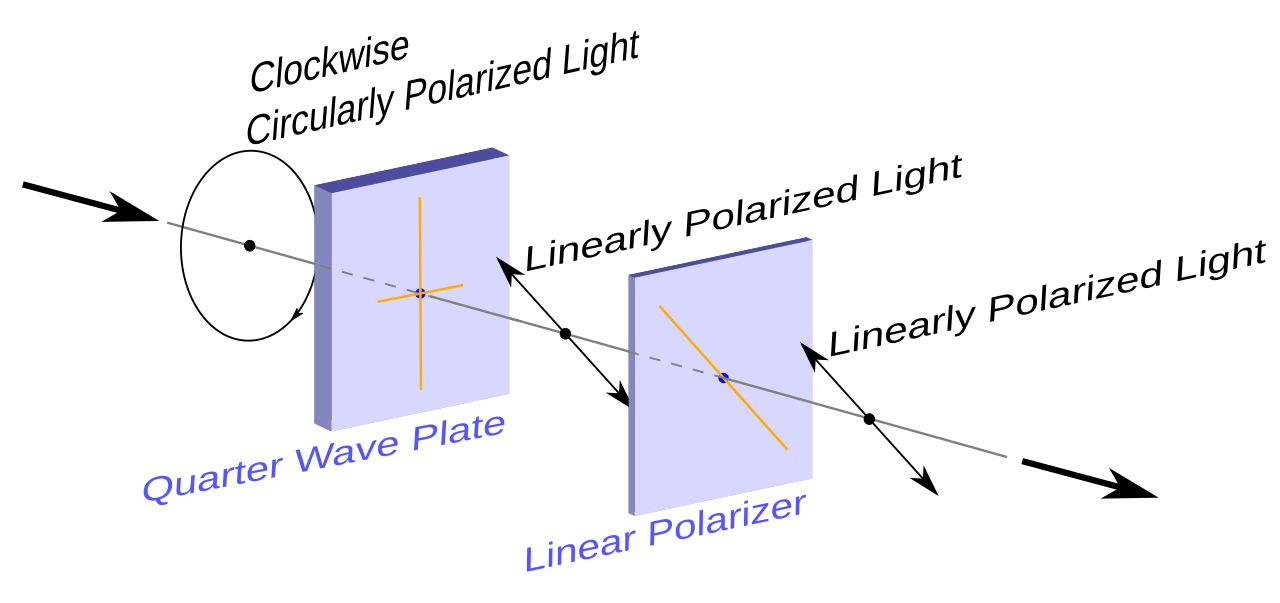
An electromagnetic wave such as light is built from two coupled oscillating fields—an electric field and a magnetic field—that are always at right angles to each other. The way these fields relate to the beam's direction of travel defines the polarization state. In linear polarization, both fields simply oscillate back and forth along a single fixed axis, each perpendicular to the other. In circular or elliptical polarization, the fields instead trace a rotating pattern around the direction of propagation at a steady rate. That rotation can proceed in a right-hand sense or a left-hand sense, giving two distinct circular states. These different states are not merely academic distinctions; they represent fundamentally different geometrical relationships between the fields and the propagation axis, and they underpin how polarizing filters, optical instruments, and communication systems sort and manipulate light.
Sorting the Unpolarized: How Light Gets Filtered
Most everyday light sources—the sun, a candle flame, an incandescent bulb—emit what physicists call unpolarized light: a jumble of short wave trains carrying an equal mix of every possible polarization state. A polarizer is a device that breaks this symmetry, permitting only waves aligned to one particular polarization to pass through while blocking the rest, thereby converting a disordered stream into a clean, single-state beam. Beyond dedicated polarizing filters, certain optical materials interact with light differently depending on its polarization through effects like birefringence, dichroism, or optical activity, and these properties are exploited in the construction of polarizing components. Light also acquires partial polarization naturally when it bounces off a surface at an angle, a phenomenon that explains why glare from water or glass can be reduced with a simple polarizing lens.
Photons, Spin, and the Technological Reach of Polarization
Quantum mechanics reframes polarization in particle language: an electromagnetic wave can be understood as a stream of photons, and each photon carries a quantum property called spin. A photon's spin comes in exactly two flavors—right-hand or left-hand about its direction of travel. A circularly polarized wave is then simply a collection of photons all sharing one spin orientation. A linearly polarized wave, by contrast, is a superposition of right- and left-spin photons whose amplitudes are equal and whose phases are locked so the combined oscillation stays confined to a single plane. This quantum picture is not just theoretical elegance; it feeds directly into technologies that rely on controlling transverse waves. Lasers, wireless communication, optical fiber telecommunications, and radar all treat polarization as a critical design parameter, and the same principles extend into seismology and microwave engineering.
Gallery
Frequently Asked Questions
What is a polarizer?
A polarizer is an optical filter that selectively transmits light waves aligned to one polarization direction while absorbing or reflecting those oriented differently. It converts unpolarized or randomly polarized light into a beam with a single, well-defined polarization state.
How does a polarizer work?
It operates by allowing electric-field oscillations that match its transmission axis to pass through while blocking the perpendicular component. The surviving light emerges with one specific polarization orientation, whether linear or circular, depending on the filter's design.
What types of polarizers exist?
The two principal categories are linear polarizers, which pass a single fixed orientation of the electric field, and circular polarizers, which produce light whose electric field rotates in a helical pattern. Each type serves distinct needs in photography, display engineering, and laboratory optics.
Where are polarizers commonly used?
They appear in camera lenses to suppress glare, in liquid-crystal displays to control pixel brightness, and in fiber-optic communication links to preserve signal integrity. They also feature in 3D cinema glasses, photoelastic stress-analysis tools, and a wide range of scientific instruments.
What materials are used to make polarizers?
Common materials include naturally birefringent crystals such as calcite and quartz, synthetic absorption films like Polaroid sheet, and nanostructured glass coatings containing embedded silver particles. Historically, tourmaline and herapathite crystals were among the first substances observed to exhibit polarization effects.
More in Science & Measurement 1-16
Spotted an error? Know more?
This is a living reference — every entry is fact-audited, and reader corrections feed straight into our audit queue. Suggest an edit · See this site's audit record