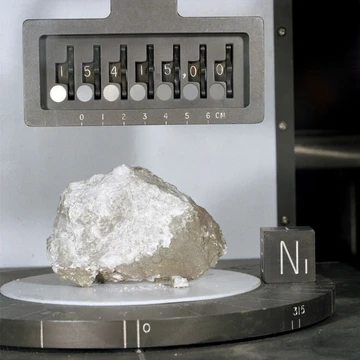
Luna 20
Second successful Soviet lunar sample return mission, returning 55 grams of highlands soil.
Luna 20, the second of three Soviet missions to successfully bring back Moon rock, was part of the robotic Luna program, which competed with the six crewed Apollo sample-return flights. After launching, the spacecraft first entered a parking orbit around Earth before being sent toward the Moon. It entered lunar orbit on 18 February 1972. Three days later, on 21 February, it made a soft landing in the Terra Apollonius highlands, a mountainous region near the Sea of Fertility, about 120 kilometers from the landing site of Luna 16.
On the surface, a panoramic television system operated, and an extendable drill collected lunar material. The ascent stage lifted off on 22 February, carrying 55 grams (1.9 ounces) of samples in a sealed capsule. It landed in the Soviet Union on 25 February, and the samples were recovered the next day.
This was the eighth Soviet spacecraft launched with the goal of returning lunar soil, apparently intended to complete the mission that Luna 18 had failed. After a 4.5-day flight with one midcourse correction on 15 February, Luna 20 entered a 100-by-100-kilometer orbit inclined at 65 degrees on 18 February. On 21 February at 19:13 UT, its main engine fired for 267 seconds to begin descent; a second burn slowed it further before touchdown at 19:19 UT at coordinates 3.7863° North, 56.6242° East, just 1.8 kilometers from Luna 18’s crash site.
After collecting a small soil sample, the ascent stage launched at 22:58 UT on 22 February, accelerating to 2.7 kilometers per second—enough to return to Earth. The spherical capsule parachuted down on an island in the Karkingir River, 40 kilometers north of Jezkazgan, Kazakhstan, at 19:19 UT on 25 February. The 30-gram sample differed from Luna 16’s: 50 to 60% of its rock particles were ancient highlands anorthosite (rich in feldspar), while Luna 16’s basalt contained only 1 to 2% anorthosite. Two months later, Apollo 16 returned similar highlands material.
As with Luna 16, samples were shared with American and French scientists; a 0.4983-gram portion from depths of 27 and 32 centimeters was sent to Britain. In March 2010, NASA’s Lunar Reconnaissance Orbiter spotted Luna 20 on the Moon.
Quick Facts
- Mission Type
- Lunar sample return
- Operator
- Soviet space program
- Cospar Id
- 1972-007A
- Satcat
- 5835
- Mission Duration
- 11 days (day of launch to day of landing)
- Spacecraft Bus
- Ye-8-5
- Manufacturer
- GSMZ Lavochkin
- Dry Mass
- 5600 kg
- Launch Mass
- 5725 kg
- Launch Rocket
- Proton-K/D
- Launch Site
- Baikonur 81/24
- Landing Site
- 47 · 24 · N · 68 · 36 · E, / 40 km north of Dzhezkazgan, Kazakhstan
Facts from the source article.
Lore & Background
Luna 20 was placed in an intermediate Earth parking orbit and from this orbit was sent towards the Moon. It entered lunar orbit on 18 February 1972. On 21 February 1972, Luna 20 soft landed on the Moon in a mountainous area known as the Terra Apollonius (or Apollonius highlands) near Mare Fecunditatis (Sea of Fertility), 120 km from where Luna 16 had landed. While on the lunar surface, the panoramic television system was operated. Lunar samples were obtained by means of an extendable drilling apparatus. The ascent stage of Luna 20 was launched from the lunar surface on 22 February 1972 carrying 55 grams of collected lunar samples in a sealed capsule. It landed in the Soviet Union on 25 February 1972. The lunar samples were recovered the following day. The 55-gram soil sample differed from that collected by Luna 16 in that the majority (50 to 60%) of the rock particles in the newer sample were ancient lunar highlands anorthosite (which consists largely of feldspar) rather than the basalt of the earlier one (which contained about 1 to 2% of anorthosite). The American Apollo 16 mission returned similar highlands material two months later. Like the Luna 16 soil, samples of the Luna 20 collection were shared with American and French scientists. A 0.4983g sample of material from a depth of 27 and 32 cm was sent to Britain.
Reader's Guide
This was the eighth Soviet spacecraft launched with the intent of returning lunar soil to Earth. It was evidently sent to complete the mission that Luna 18 had failed to accomplish. After a 4.5-day flight to the Moon, which included a single midcourse correction on 15 February, Luna 20 entered orbit around the Moon on 18 February. Initial orbital parameters were 100 x 100 kilometers at 65° inclination. Three days later, at 19:13 UT, the spacecraft fired its main engine for 267 seconds to begin descent to the lunar surface. A second firing further reduced velocity before Luna 20 set down safely on the Moon at 19:19 UT on 21 February 1972 at coordinates 3.7863 North and 56.6242 East, only 1.8 kilometers from the crash site of Luna 18. After collecting a small sample of lunar soil, the spacecraft's ascent stage lifted off at 22:58 UT on 22 February and quickly accelerated to 2.7 kilometers per second velocity—sufficient to return to Earth. The small spherical capsule eventually parachuted down safely on an island in the Karkingir River, 40 kilometers north of the town of Jezkazgan in Kazakhstan, at 19:19 UT on 25 February 1972.
Did You Know?
- Luna 20 returned 55 grams of lunar soil.
- The sample consisted mostly of ancient lunar highlands anorthosite.
More in Sample return missions 1-24
Spotted an error? Know more?
Reader corrections go straight into our review queue. Suggest an edit · How this site is sourced