Extraterrestrial sample curation
Preserving sample integrity and protecting Earth from extraterrestrial biohazards.
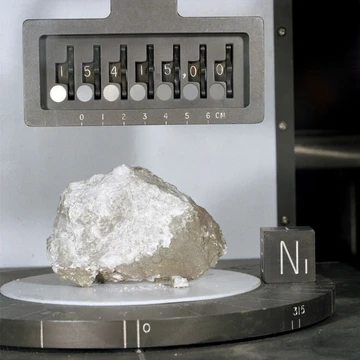
When spacecraft bring back rocks, dust, or other material from space, these samples need special handling. The facilities that receive them must do two things at once: keep the samples uncontaminated by Earth, and keep Earth safe from anything hazardous the samples might contain. Scientists divide these materials into two categories based on where they come from. Non-restricted samples come from the Moon, asteroids, comets, solar particles, and space dust. Restricted samples come from planets or moons where microscopic life might have existed in the past or could exist now—these are treated as extremely dangerous.
Bringing samples to Earth allows for much more detailed study than instruments on a spacecraft can do, since those instruments face limits on weight, power, and the harsh conditions of space. To protect both the sample and our planet, the receiving facility must be a cleanroom that also works as a biocontainment lab. Non-restricted samples are handled in labs rated Biosafety Level 3 (BSL-3). Restricted samples, from what the Outer Space Treaty calls Category V bodies, require Biosafety Level 4 (BSL-4) facilities. But existing BSL-4 labs around the world are designed for known organisms, not for unknown extraterrestrial material. A facility built for space samples would need to plan for unexpected problems and allow for creative problem-solving during handling and analysis. Keeping the samples contained is straightforward, but researchers also need to take portions for study without exposing them to Earth’s air or contaminants.
As of 2019, only two space agencies run BSL-3 labs dedicated to non-restricted samples: JAXA in Japan and NASA in the United States. JAXA’s Extraterrestrial Sample Curation Center lets scientists observe, remove portions, and store precious samples without exposing them to the atmosphere. Russia’s Vernadsky Institute at the Russian Academy of Sciences stores and studies samples from the Soviet Luna missions.
For restricted samples from Category V bodies like Mars, Europa, or Enceladus, no existing BSL-4 facility meets the complex needs of both sample preservation and Earth protection. Two proposals aim to fill this gap. The European Sample Curation Facility (ESCF), planned for Vienna, would handle both non-restricted and restricted materials. NASA’s proposed Mars Sample-Return Receiving Facility (MSRRF) has had at least three designs submitted since 2009. If built, it would take 7 to 10 years from design to completion, plus two more years for staff training. NASA is also looking at a 2017 idea for a mobile, modular BSL-4 lab that could secure a sample capsule at the landing site for initial biohazard tests. After those tests, scientists could decide to sterilize the sample or send all or part of it to a permanent quarantine facility anywhere in the world.
These facilities must contain unknown hazards, since the size of any alien microorganisms or infectious agents is unknown. Ideally, they should filter particles as small as 0.01 micrometers, and releasing a particle of 0.05 micrometers or larger is unacceptable. The 0.01-micrometer limit accounts for gene transfer agents (GTAs)—virus-like particles produced by some microorganisms that package random DNA segments and transfer them to other hosts without killing them. This allows many archaea and bacteria to swap DNA. If Martian life shares a common origin with Earth life, it might swap DNA with Earth microbes in the same way. The limit also considers ultramicrobacteria, which can be as small as 0.2 micrometers across. Some experts argue that robots should handle the samples, because humans are a major source of contamination.
- Biosafety levels
- BSL-2 or lower for non-restricted; BSL-4 for restricted
- Filtration requirement
- HEPA filtration at 0.3 μm for BSL-4 facilities
Lore & Background
Samples brought from non-restricted bodies such as the Moon, asteroids, comets, solar particles and space dust, are processed at specialized facilities rated Biosafety level-3 (BSL-3). Samples brought to Earth from a planet or moon suspected to have either past or present habitable environments to microscopic life would make it a Category V body, and must be curated at facilities rated Biosafety level-4 (BSL-4), as agreed in the Article IX of the Outer Space Treaty. However, the existing BSL-4 facilities in the world do not have the complex requirements to ensure the preservation and protection of Earth and the sample simultaneously.
Reader's Guide
Non-restricted materials: As of 2019, only JAXA and NASA operate BSL-3 laboratories exclusively dedicated to the curation of samples from non-restricted bodies. The Luna Soviet missions samples are studied and stored at the Vernadsky Institute of Geochemistry and Analytical Chemistry at the Russian Academy of Sciences. Restricted materials: Return-samples from a Category V body must be curated at BSL-4 facilities. There are at least two proposals to build a BSL-4 facility dedicated to curation of restricted extraterrestrial materials: the European Sample Curation Facility (ESCF) proposed for Vienna, and NASA's Mars Sample-Return Receiving Facility (MSRRF). The systems of such facilities must be able to contain unknown biohazards; ideally they should filter particles of 0.01 μm or larger, and release of a particle 0.05 μm or larger is unacceptable under any circumstance.
Did You Know?
- The filtration requirement for BSL-4 facilities handling restricted extraterrestrial samples is to filter particles of 0.01 μm or larger, with release of 0.05 μm or larger being unacceptable.
- The reason for the 0.01 μm limit includes consideration of gene transfer agents (GTAs) and the discovery of ultramicrobacteria as small as 0.2 μm across.
More in Sample return missions 1-24
Spotted an error? Know more?
Reader corrections go straight into our review queue. Suggest an edit · How this site is sourced