Chang'e 5
China's first lunar sample-return mission, launched in 2020.
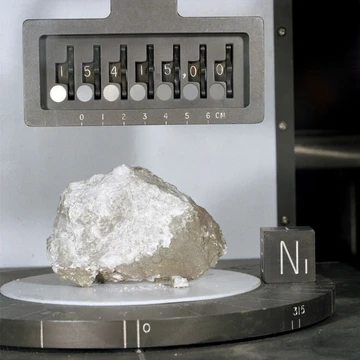
Chang'e 5 was the fifth mission in China's lunar exploration program and the country's first effort to bring back samples from the Moon. Launched on 23 November 2020 aboard a Long March 5 rocket from Hainan Island, it landed on the lunar surface on 1 December, collected about 1,731 grams of material—including a core sample from roughly one meter deep—and returned to Earth on 16 December. The spacecraft was named after the Chinese moon goddess, following the tradition of its predecessors.
This mission marked the first lunar sample return since the Soviet Union's Luna 24 in 1976, making China the third nation to accomplish this feat, after the United States (Apollo 11) and the USSR (Luna 16). The probe was built from four modules: a Lander and Ascender pair, plus an Orbiter and Returner pair. The Ascender performed the first robotic lunar orbit docking, linking up with the Orbiter/Returner—the eighth lunar orbit docking overall, following seven under the U.S. Apollo program. A precursor mission, Chang'e 5-T1, launched in 2014, had tested the return capsule and lunar orbit rendezvous technologies. A similar mission, Chang'e 6, followed in 2024, collecting samples from the Moon's far side.
The lunar samples led Chinese scientists to identify Changesite-(Y) and two structures of the titanium compound Ti₂O, the sixth, seventh, and eighth minerals discovered on the Moon. China also made the samples available to an international consortium of scientists from Australia, the United States, the United Kingdom, and Sweden, a move widely praised as a success in science diplomacy.
The Chinese Lunar Exploration Program unfolds in four phases. Phase one involved orbiting the Moon, achieved by Chang'e 1 in 2007 and Chang'e 2 in 2010. Phase two saw soft landings and rover deployments, completed by Chang'e 3 in 2013 and Chang'e 4, which landed on the far side in January 2019. Phase three, the sample-return stage, was fulfilled by Chang'e 5, with its backup, Chang'e 6, also a sample-return mission. Phase four focuses on in-situ resource use and building an International Lunar Research Station near the south pole, with crewed missions planned for the 2030s.
The mission's four modules launched together and traveled to the Moon as a single unit.
Quick Facts
- Mission Type
- Lunar sample return
- Operator
- CNSA
- Cospar Id
- 2020-087A
- Satcat
- 47097
- Manufacturer
- CAST
- Launch Mass
- 8,200 kg
- Launch Date
- 23 November 2020 / 20:30:12 UTC / 24 November 2020 / 04:30 CST
- Launch Rocket
- Long March 5
- Launch Site
- Wenchang
- Launch Contractor
- CALT
- Landing Date
- 16 December 2020 / 17:59 UTC / Return capsule
- Landing Site
- Inner Mongolia, China
Facts from the source article.
Lore & Background
Chang'e 5 consisted of four modules: a Lander/Ascender pair and an Orbiter/Returner pair. The Lander touched down on the Moon on 1 December 2020, collecting samples via drilling and scooping. The Ascender launched from the lunar surface on 3 December 2020 and performed the first ever robotic lunar orbit docking with the Orbiter/Returner, transferring the samples. The Ascender later deorbited and crashed into the Moon to avoid space debris.
Reader's Guide
Chang'e 5 marked a significant milestone in lunar exploration, being the first sample return since the Soviet Union's Luna 24 in 1976. The mission demonstrated advanced robotic capabilities, including automated docking in lunar orbit. The samples, collected from young mare basalts (~1.21 billion years old) in Oceanus Procellarum, led to the discovery of three new lunar minerals: Changesite-(Y) and two structures of Ti2O. China provided open access to the samples to an international consortium, hailed as a science diplomacy success. The mission's backup, Chang'e 6, later sampled the far side of the Moon in 2024.
Did You Know?
- Chang'e 5 was named after the Chinese moon goddess, Chang'e.
- The Ascender conducted the first ever robotic lunar orbit docking.
- The mission discovered Changesite-(Y) and two structures of Ti2O, the sixth, seventh, and eighth minerals found on the Moon.
- The landing site, Statio Tianchuan, is in the Procellarum KREEP Terrain with some of the youngest mare basalts on the Moon.
More in Sample return missions 1-24
Spotted an error? Know more?
Reader corrections go straight into our review queue. Suggest an edit · How this site is sourced