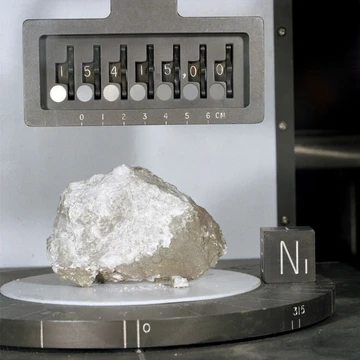
ISOCHRON (spacecraft)
Proposed lunar sample-return mission for young mare basalt.
ISOCHRON (Inner SOlar system CHRONogy) is a robotic lunar sample-return mission concept that was proposed to NASA's Discovery Program in July 2019, but it was not selected for further development. Its goal is to collect samples of the youngest basalt found on the Moon's mare. The mission would investigate the composition of the lunar crust and the timing of volcanic activity on the Moon, which could improve understanding of similar processes on other rocky planets. A major gap in lunar history—nearly two billion years—remains undated because the Apollo missions did not bring back young rocks. Lunar mare basalts originate from partial melting of the mantle, so they act as windows into the Moon's interior structure and composition. The mission's stated objective is to obtain precise radiometric ages for these young basalts, filling the gap in crater size-frequency distributions (CSFDs) and sharpening this key tool for dating exposed surfaces on rocky bodies. The proposed lander would touch down just south of the Aristarchus plateau, collect about 150 grams of basalt estimated to be between 1.5 and 2.0 billion years old, and launch the sample in a small container back to Earth. The returned material would be stored at NASA's Lunar Sample Laboratory Facility. The principal investigator is Dave Draper at NASA's Johnson Space Center in Texas. The Aristarchus plateau, where the sample would be taken, is a tilted crustal block roughly 200 kilometers across, located within the Oceanus Procellarum. Its southeastern section rises to a maximum height of about 2 kilometers above the surrounding mare.
Quick Facts
- Names List
- Inner SOlar system CHRONogy
- Mission Type
- Lunar sample-return
- Operator
- NASA
- Launch Date
- 2025 (proposed)
- Programme
- Discovery Program
Facts from the source article.
Lore & Background
ISOCHRON was conceived to fill a nearly 2-billion-year gap in lunar history that planetary scientists have not been able to date because the Apollo missions did not retrieve any young rocks. The mission would land a robotic lander just south of the Aristarchus plateau, a tilted crustal block about 200 km across that rises to a maximum elevation of 2 km above the mare. From there, it would retrieve about 150 g of basalt estimated to be 1.5 to 2.0 billion years old.
The sample would be placed in a small container, launched to Earth, and curated at NASA's Lunar Sample Laboratory Facility. The scientific objective was to make high-precision radiometric age measurements on these relatively young basalts to fill the existing gap in age-correlated crater size-frequency distributions (CSFDs), thereby improving this widely-used tool for estimating the ages of exposed surfaces on rocky bodies.
The Principal Investigator is Dave Draper at NASA's Johnson Space Center in Texas. The mission was proposed in July 2019 to NASA's Discovery Program but was not shortlisted.
Reader's Guide
ISOCHRON represents a targeted effort to address a critical gap in lunar and planetary science: the lack of dated young lunar rocks. The Apollo missions returned samples that are mostly older than 3 billion years, leaving nearly 2 billion years of lunar volcanic history undated. By retrieving and radiometrically dating basalts from the Aristarchus plateau, ISOCHRON would have provided absolute ages for surfaces that are currently dated only by relative crater counting. This would have greatly improved the calibration of crater size-frequency distributions, a tool used across the solar system to estimate the ages of exposed surfaces on rocky bodies. Although not selected, the mission concept highlights the ongoing scientific need for sample return from young lunar terrains and the importance of the Aristarchus region as a target for future exploration.
Did You Know?
- The mission would retrieve about 150 g (5.3 oz) of basalt estimated to be 1.5 to 2.0 billion years old.
- The sample would be obtained from the Aristarchus plateau, a tilted crustal block about 200 km across in Oceanus Procellarum.
More in Sample return missions 1-24
Spotted an error? Know more?
Reader corrections go straight into our review queue. Suggest an edit · How this site is sourced