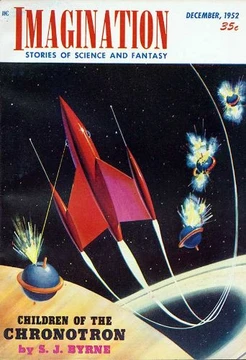
Professor Dowell's Head
A doctor revives his boss's severed head for scientific gain.

Professor Dowell's Head, a 1925 science fiction and horror story later expanded into a novel, was written by Russian author Alexander Belyaev. It centers on a doctor who secretly brings his former boss’s severed head back to life and then relies on it to direct his subsequent research.
The plot begins with Professor Dowell and his assistant, Dr. Kern, investigating how to sustain life in detached body parts. Kern murders Dowell, keeps the professor’s head alive, and forces it to reveal scientific knowledge. When a new assistant, the trained medic Marie Loren, uncovers the scheme, Kern has her locked away in a fake asylum for unwanted people. Kern then transplants a young woman’s head onto a new body—the body of a friend’s girlfriend. The woman flees, and Dowell’s son, along with his friend, recognizes the body and frees Marie. Kern tries to claim the inventions as his own, but Dowell’s son and Marie help the professor’s head appear before cameras to expose the truth. The head speaks and then dies. Disgraced, Kern is executed by a police detective.
The story first appeared in the Moscow daily *The Worker’s Gazette* from June 16 to July 6, 1925.
In 1980, *Library Journal* gave the book a positive review, calling it “an extraordinary tale” and comparing it to *Frankenstein* and Kafka’s works. David Kirby praised Antonina W. Bouis’s translation as “fluid” and the novel as “lively and readable,” interpreting it as an allegory for the Soviet revolution, with Dowell resembling leaders who could not foresee “the horrible ends to which his activities would lead.” Nick B. Williams of the *Los Angeles Times* noted that Belyaev continued the “Poe-esque” tradition into “the realm of modern pseudo-science,” advising, “if squeamish, skip it. If not, read and revel.” Less than three months after the story’s release, surgeon Sergei Brukhonenko performed similar experiments, which the Soviet press often compared to the tale.
The novel was adapted into several films. A very loose adaptation, *Professor Dowell’s Testament* (1984), directed by Leonid Menaker, used only the basic premise and made many changes. Another adaptation, *The Head in the House* (1989), was produced by China’s Xi’an Film Studio.
English translations include a 1980 edition by Antonia W. Bouis (Macmillan Publishing) and a 2021 edition by Carl Engel (King Tide Press).
Quick Facts
- Orig Lang Code
- ru
- Translator
- Antonina W. Bouis / Carl Engel
- Author
- Alexander Belyaev
- Cover Artist
- Richard M. Powers / Alex Dallman
- Country
- Soviet Union
- Language
- Russian
- Genre
- Science fiction
- Publisher
- Macmillan Publishing / King Tide Press
- English Release Date
- 1980, 2021
- Media Type
- Pages
- 157, 208
- Isbn
- 979-8-9851497-0-8
Facts from the source article.
Lore & Background
Professor Dowell and his assistant surgeon Dr. Kern work on medical problems including life support in separated body parts. Dr. Kern kills Dowell, then keeps Dowell's head alive to extract scientific secrets. His new assistant, the medically trained Marie Loren, discovers the ploy and is imprisoned in a false lunatic asylum to prevent exposure. Kern later transplants the head of a young woman onto a new body, which belongs to the girlfriend of a friend of Dowell's son. The son and friend recognize the body when the woman flees, and they free Marie Loren. Dowell's head reveals the truth before dying, and Dr. Kern is executed by a police detective.
Reader's Guide
Professor Dowell's Head is significant as an early Soviet science fiction work that blends horror with speculative medicine. The story was initially published in The Worker’s Gazette between 16 June and 6 July 1925. Less than three months after its release, similar experiments were performed by surgeon Sergei Brukhonenko, and Soviet press often compared his work to the story. The novel was positively reviewed in the Library Journal in 1980, described as 'an extraordinary tale' and compared to Frankenstein and Kafka. David Kirby praised the translation as 'fluid' and interpreted the novel as an allegory for the Soviet revolution. Nick B. Williams noted Belyaev continued the 'Poe-esque' tradition into 'the realm of modern pseudo-science.' The novel was adapted into several films, including a loose 1984 Soviet adaptation and a 1989 Chinese film.
Did You Know?
- The story was first published in The Worker’s Gazette, a Moscow daily, from 16 June to 6 July 1925.
- The novel was adapted into a 1984 Soviet film titled Professor Dowell's Testament and a 1989 Chinese film titled The Head in the House.
- The plot involves a false lunatic asylum used to imprison the assistant who discovers the secret.
More in Russian science fiction novels 1-24
Spotted an error? Know more?
Reader corrections go straight into our review queue. Suggest an edit · How this site is sourced