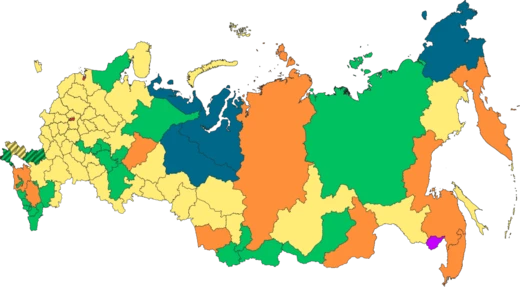
Udmurtia
A republic of Russia in Eastern Europe, part of the Volga Federal District, with capital Izhevsk.

Udmurtia, officially the Udmurt Republic, is a republic of Russia located in Eastern Europe. It is administratively part of the Volga Federal District. Its capital is the city of Izhevsk. It was established as the Udmurt (until 1931 — Votskaya) an autonomous region of the Udmurts, Udmurtia, within Russia on 4 November 1920.
- Established
- 4 November 1920
- Capital
- Izhevsk
- Population (2021 census)
- 1,452,914
- Area
- Located west of the Ural Mountains, between the Kama and Vyatka rivers
- Official status
- Republic of Russia, Volga Federal District
- Ethnic groups (2021)
- Russians 67.7%, Udmurts 24.1%, Tatars 5.5%
Lore & Background
The name Udmurt comes from ('meadow people'), where the first part represents the (Finno-Ugric) Permic root or ('meadow, glade, turf, greenery'). This is supported by a document dated 1557, in which the Udmurts are referred to as ('meadow people'), alongside the traditional Russian name. Udmurtia, and the Udmurts, are, still considered, since 1960s, as one of the Finno-Ugric National Regions and Republics within Russia. The second part means 'person' (cf. Komi, Mari). It is probably an early borrowing from a Scythian language or ('person, man'; Sanskrit: Manus or Manushya), which is thought to have been borrowed from the Indo-Aryan term ('man, mortal, one who is bound to die'). The Indo-Europeanists T. Gamkrelidze and V. Ivanov associate this word with horse-riding Altaic tribes in the Bronze Age. On the other hand, in the Russian tradition, the name 'meadow people' refers to the inhabitants of the left bank of river in particular. Recently, the most relevant is the version of V. V. Napolskikh and S. K. Belykh. They suppose that ethnonym was borrowed either from Indo-Iranian 'outside, close, last, edge, limit, boundary' or Turkic-Altaic / 'oath (in fidelity), comrade, friend'. On November 4, 1920, the Votyak Autonomous Oblast was formed. On January 1, 1932, it was renamed Udmurt Autonomous Oblast, which was then reorganized into the Udmurt ASSR on December 28, 1934. During World War II, many industrial factories were evacuated from the Ukrainian SSR and western borderlands to Udmurtia. On October 11, 1991, the Supreme Council of the Udmurt ASSR adopted a law according to which the Udmurt ASSR acquired a new name — the Udmurt Republic. The Votyaks are the only Finno-Ugric people who, to this day, are still essentially settled in the area that scholars, with good reason, consider to be the ancestral homeland of the Finno-Ugric peoples. After the ancestors of the present-day Komi migrated north around the 8th-9th centuries, the independent development of the Votyak people began. Their historical fate shares much with that of the Finno-Ugric peoples of the Volga region; for example, the Votyaks experience the same three historical periods as the Mordvins and the Cheremis: 1. The period of Volga-Bulgarian relations from the 8th-9th centuries to 1236.
Reader's Guide
The republic is located to the west of the Ural Mountains and borders Kirov, Perm, Bashkortostan, and Tatarstan. Udmurtia is a republic in the Russian Federation, located in Central Russia between the branches of the rivers Kama and its right tributary the Vyatka. The city of Izhevsk is the administrative, industrial, and cultural center of Udmurtia. Geographically, it is located not far from Moscow, the capital and largest city of the Russian Federation. The city has a well-developed transport system (including air, land, and water). Udmurtia borders Kirov Oblast to the west and north, Perm Oblast to the east, and the Bashkortostan and Tatarstan Republics to the south. The republic has a moderate continental climate, with warm summers and cold, snowy winters. Annual precipitation averages 400–600 mm. Population: Although as of 2007 the population was declining, the decline was stabilizing and was more pronounced in urban areas. Out of the 19,667 births reported in 2007, 12,631 were in urban areas (11.86 per 1,000) and 7,036 were in rural areas (14.88 per 1,000). Birth rates for rural areas are 25% higher than that of urban areas. Of the total of 21,727 deaths, 14,366 were reported in urban areas (13.49 per 1,000) and 7,361 were in rural areas (15.56 per 1,000). Natural decline of the population was measured at −0.16% for urban areas and an insignificant −0.07% for rural areas (the average for Russia was −0.33% in 2007). According to the 2021 Census, Russians make up 67.7% of the republic's population, while the ethnic Udmurts make up only 24.1%. Other groups include Tatars (5.5%), Mari (0.5%), Ukrainians (0.3%), and a host of smaller groups, each accounting for less than 0.5% of the republic's total population. As of 2013, over two-thirds of all Udmurts lived in the republic. According to a 2012 survey, 33.1% of the population of Udmurtia adheres to the Russian Orthodox Church, 5% are unaffiliated generic Christians, 2% are Eastern Orthodox Christian believers without belonging to any church or members of other Eastern Orthodox churches, 4% are Muslims, 2% of the population adheres to the Slavic native faith (Rodnovery) or to Udmurt Vos (Udmurt native faith), 1% adheres to forms of Protestantism, and 1% of the population are Old Believers. In addition, 29% of the population declares to be 'spiritual but not religious,' 19% is atheist, and 3.9% follows other
Did You Know?
- Udmurtia was established as an autonomous region on 4 November 1920.
- The name 'Udmurt' may derive from a root meaning 'meadow people'.
- According to the 2021 Census, ethnic Udmurts make up 24.1% of the republic's population.
- The republic has a moderate continental climate with warm summers and cold, snowy winters.
More in Russian Federal Subjects 1-20
Spotted an error? Know more?
This is a living reference — every entry is fact-audited, and reader corrections feed straight into our audit queue. Suggest an edit · See this site's audit record