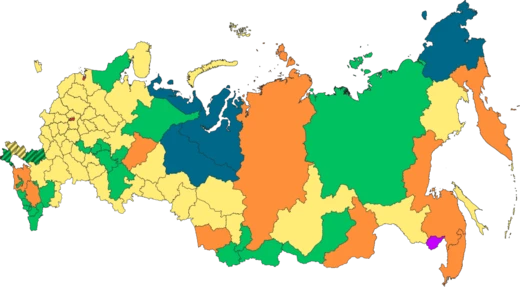
Mordovia
A republic of Russia in Eastern Europe, home to the Mordvin people and the city of Saransk.

Mordovia, officially the Republic of Mordovia, is a republic of Russia, situated in Eastern Europe. Its capital is the city of Saransk. As of the 2010 Census, the population of the republic was 834,755. Ethnic Russians (53.1%) and Mordvins (39.8%) account for the majority of the population.
- Capital
- Saransk
- Area
- 26,200 sq km
- Population (2010 Census)
- 834,755
- Ethnic Groups (2010)
- Russians 53.4%, Mordvins 39.8%, Tatars 5.2%
- Official Languages
- Russian, Erzya, Moksha
- Highest Point
- 324 m
- Climate
- Moderately continental
Lore & Background
The earliest archaeological signs of modern humans in the area of Mordovia are from the Neolithic era. Mordvins are mentioned in written sources from the 6th century. Later, Mordvins were under the influence of both Volga Bulgaria and the Kievan Rus. Mordovia was briefly united under the Principality of Purgaz, led by Erzya prince Purgaz. The Principality of Purgaz survived the war with Vladimir-Suzdal, which ended in 1232, and was later subjugated to the Golden Horde as the Mukhsha Ulus. The Golden Horde disintegrated in the 1430s, which resulted in some Mordvins becoming subjects of the Khanate of Kazan, whereas others were incorporated into Muscovy. After Ivan IV of Russia annexed the Khanate of Kazan in 1552, the Mordvin lands were subjugated by the Russian monarchy. The region of modern-day Mordovia was mainly organized as a part of Penza Governorate over the late 18th and the 19th centuries. During the Russian Revolution and Russian Civil War, Mordovia was held by Bolsheviks from the beginning of the war. The Mordovian Okrug was founded on 16 July 1928, and it was elevated to the status of an autonomous oblast becoming the on 10 January 1930. The autonomous oblast was transformed into the Mordovian Autonomous Soviet Socialist Republic on 20 December 1934. When the Soviet Union disintegrated, the Mordovian ASSR proclaimed itself the Mordovian Soviet Socialist Republic in 1990 and remained a part of the Russian Federation. Mordovia was one of only two republics that did not proclaim sovereignty. On 25 January 1994, it was renamed the Republic of Mordovia.
Reader's Guide
The republic is located in the eastern part of the East European Plain of Russia. Area: 26200 km2. Borders: internal: Nizhny Novgorod Oblast (N), Chuvashia (NE/E), Ulyanovsk Oblast (E/SE), Penza Oblast (S/SW), Ryazan Oblast (W/NW). Highest point: 324 m. There are 114 rivers in the republic. Major rivers include: Alatyr River, Issa River, Moksha River, Satis River, Sivin River, Sura River, Vad River. There are approximately five hundred lakes in the republic. Natural resources include peat, mineral waters, and others. The climate is moderately continental. Average January temperature: −11 C. Average July temperature: +19 C. Average annual precipitation: ~500 mm. Mordovia is divided into 22 districts called raions. The city of Saransk is administrated separately from the districts as an urban okrug. The head of the government in the Republic of Mordovia is the Head of the Republic. The office is currently held by Artyom Zdunov, who was made acting head on 18 November 2020. His predecessor was Vladimir Volkov who held the office from 2012. The State Assembly is the legislature of the republic. The most developed industries are machine construction, chemicals, woodworking, and food industries. The largest companies in the region include Unimilk (branch of Danone Russia), Ruzayevsky Chemical Machine-Building Plant, Mordovcement, Saranskkabel.
Did You Know?
- The Mordvin people are a Volga Finnic group speaking two related languages, Moksha and Erzya.
- According to the 2010 Census, Russians make up 53.4% of the republic's population, while ethnic Erzya and Moksha are 39.8%.
- The republic has its own supreme court, the Supreme Court of the Republic of Mordovia.
- During the Soviet era, two written languages were developed, one based on the Erzya dialect in 1922 and one on the Moksha dialect in 1923, both using Cyrillic script.
Constitutional Standing as a Republic
Mordovia holds the status of a Republic within the Russian Federation, placing it among the top-level political divisions of the country. Under the constitutional framework, all federal subjects—whether republics, krais, oblasts, cities of federal importance, an autonomous oblast, or autonomous okrugs—are declared equal in their rights as constituent entities. However, the degree of autonomy varies by type, and republics are specifically noted as being offered more autonomy than other categories. This means Mordovia, as a Republic, occupies a position with somewhat greater self-governance compared to, say, an oblast or a krai. Each subject, including Mordovia, maintains its own constitution or charter and its own legislative body, though the authority of these organs differs across the federation. The 1993 Constitution, adopted by federal referendum on 12 December 1993, reserved the rights of regions while eliminating the Soviet-era right to secede, a provision that had existed in the 1918 model but was never actually exercised in practice.
Governance Architecture
Like every federal subject in Russia, Mordovia possesses its own head of government, a regional parliament, and a constitutional court. These institutions operate under the subject's own constitution or charter and its own body of legislation. The specific authority granted to each of these organs is not uniform across all subjects; it varies depending on the type of entity and the particular constitutional or charter provisions in place. Despite these internal differences, all subjects enjoy equal standing in their relations with federal government bodies. In the Federation Council—the upper house of the Federal Assembly—Mordovia, like every other subject, sends exactly two delegates, ensuring uniform representation regardless of population size or territorial extent. This equal representation principle was enshrined in the constitutional framework that replaced the earlier Soviet model of governance, creating a structure where regional legislative bodies participate in federal lawmaking on a parity basis with all other constituent entities of the federation.
Linguistic Self-Determination
One of the distinguishing features of Mordovia as a constituent Republic is its role in the linguistic landscape of the Russian Federation. While the federal system recognizes Russian as the overarching language of the state, the Constitutions of the constituent Republics—including Mordovia, alongside Chechnya and Dagestan—are the instruments through which additional official languages are established. This stands in contrast to the merged territories that became 'administrative-territorial regions with special status' during the 2005–2008 consolidation, where second official languages such as Buryat, Komi-Permian, and Koryak were granted in a manner that does not appear in the Constitution of the Russian Federation. For Mordovia, the authority to designate its own non-Russian official languages flows directly from its republican constitution, reflecting the broader principle that republics enjoy a greater degree of autonomy within the federal structure. This linguistic self-determination is a concrete expression of the differentiated autonomy that the constitutional framework affords to the Republic category of subjects.
Federal Integration and Political Evolution
Mordovia's place within the Russian Federation has been shaped by several pivotal moments in the country's post-Soviet political history. The territory's current status as a constituent entity traces back to the structure inherited from the Russian Soviet Federative Socialist Republic, which persisted through the dissolution of the USSR in 1991. In 1992, amid the 'parade of sovereignties' and the War of Laws, Russian regions signed the Federation Treaty, establishing the division of authorities between federal and regional government bodies—a framework subsequently incorporated into the 1993 Constitution. That constitution, which came into force on 25 December 1993, abolished the Lenin-era model of unlimited regional sovereignty and the theoretical right to secession, while simultaneously introducing local self-government and reserving regional rights. In the 2000s, under policies associated with Vladimir Putin and the United Russia party, the federal parliament shifted tax revenue distribution, reduced the number of regional elections, and expanded the power of federal authorities, altering the practical balance of autonomy that Mordovia and other subjects had previously enjoyed.
More in Russian Federal Subjects 1-20
Spotted an error? Know more?
This is a living reference — every entry is fact-audited, and reader corrections feed straight into our audit queue. Suggest an edit · See this site's audit record