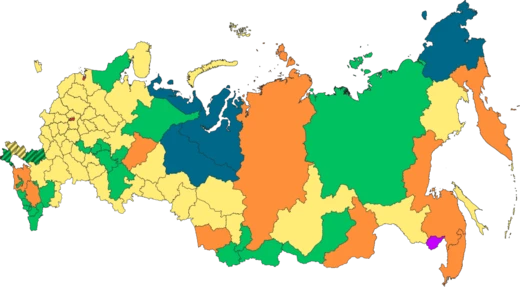
Kalmykia
The Buddhist heart of Europe on the Caspian steppe.

Kalmykia, officially the Republic of Kalmykia, is a republic of Russia, located in the Volga region of European Russia. The republic is part of the Southern Federal District, and borders Dagestan to the south and Stavropol Krai to the southwest; Volgograd Oblast to the northwest and north and Astrakhan Oblast to the north and east; Rostov Oblast to the west and the Caspian Sea to the east. Through the Caspian Depression, the Kuma river forms Kalmykia's natural border with Dagestan. Kalmykia is the only polity within the European continent where Buddhism is the majority religion; the majority of Kalmyk people are Vajrayana Tibetan Buddhists of the Gelug and Kagyu lineages. The Kalmykia republic covers an area of 76100 km², with a small population of about 275,000 residents. The capital is the city of Elista.
- area
- 76,100 square kilometres (29,400 square miles)
- population
- about 275,000 residents
- capital
- Elista
- majority_religion
- Buddhism (Vajrayana Tibetan Buddhism of Gelug and Kagyu lineages)
- highest_point
- 222 metres (728 ft) in the Yergeni hills
- hottest_place
- Utta (record 45.4 °C on 12 July 2010)
Lore & Background
The ancestors of the Kalmyks, the Oirat Mongols, migrated from the steppes of southern Siberia on the banks of the Irtysh River, reaching the Lower Volga region of Eastern Europe by the early 17th century. Historians have given various explanations for the move, but generally recognise that the Kalmyks sought abundant pastures for their herds. Another motivation may have involved escaping the growing dominance of the neighbouring Dzungar Mongol tribe. They reached the lower Volga region in or about 1630. That land was the homeland of the Nogai Horde, a confederation of Turkic-speaking nomadic tribes. The Kalmyks expelled the Nogais, who fled to the Caucasian plains and to the Crimean Khanate. Some Nogai groups sought the protection of the Russian garrison at Astrakhan. The remaining nomadic Mongol Oirat tribes became vassals of the Kalmyk Khan. The Kalmyks settled in the wide-open steppes – from Saratov in the north to Astrakhan on the Volga delta in the south and to the Terek River in the southwest. They also encamped on both sides of the Volga River, from the Don River in the west to the Ural River in the east. This area under Kalmyk control would eventually be called the Kalmyk Khanate. Within twenty-five years of settling in the Lower Volga region, the Kalmyks became subjects of the Tsar of Russia. In exchange for protecting Russia's southern border, the Kalmyks were promised an annual allowance and access to the markets of Russian border settlements. Kalmyk allegiance was often nominal, as the Kalmyk Khans practised self-government, based on a set of laws they called the Great Code of the Nomads (Iki Tsaadzhin Bichig). The Kalmyk Khanate reached its peak of military and political power under Ayuka Khan (ruled 1672–1724, khan 1690–1724).
Reader's Guide
The republic is located in Southern Russia, lying north of the North Caucasus. A small stretch of the Volga River flows through eastern Kalmykia. Other major rivers include the Yegorlyk, the Kuma, and the Manych. Lake Manych-Gudilo is the largest lake; other lakes of significance include Lakes Sarpa and Tsagan-Khak. The highest point in Kalmykia is shared, with an elevation of 222 m; it is located in the Yergeni hills. Kalmykia's natural resources include coal, oil, and natural gas. The average January temperature is -5°C and the average July temperature is 24°C. Average annual precipitation ranges from 170 mm in the east to 400 mm in the west. The small town of Utta is the hottest place in Russia. On 12 July 2010, an all-time record-high temperature was observed at 45.4°C. The republic's wildlife includes the saiga antelope, whose habitat is protected in Chyornye Zemli Nature Reserve. National Parks: Bamb Tsetsg Tulip Island.
Did You Know?
- Kalmykia is the only polity in Europe where Buddhism is the majority religion.
- The small town of Utta in Kalmykia is the hottest place in Russia, with a record temperature of 45.4°C.
- The highest point in Kalmykia is only 222 m, located in the Yergeni hills.
More in Russian Federal Subjects 1-20
Spotted an error? Know more?
This is a living reference — every entry is fact-audited, and reader corrections feed straight into our audit queue. Suggest an edit · See this site's audit record