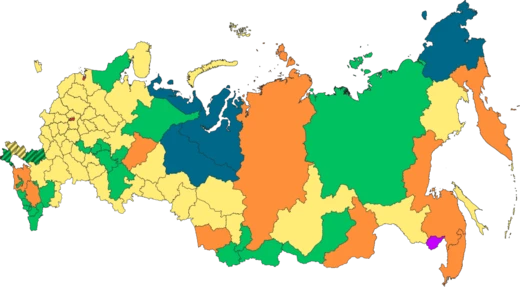
Chuvashia
A republic in Eastern Europe, homeland of the Chuvash people, known for its Volga rivers, hop-growing, and high rate of osteopetrosis.

Chuvashia, officially known as Chuvash Republic — Chuvashia, is a republic of Russia located in Eastern Europe. It is the homeland of the Chuvash people. The republic's capital city is the city of Cheboksary. As of the 2010 Census, its population was 1,251,619.
- Capital
- Cheboksary
- Population (2010 Census)
- 1,251,619
- Area
- Located in the center of European Russia, in the Volga-Vyatka economic region
- Major Rivers
- Volga, Sura, Tsivil
- Official Status
- Republic (state) within the Russian Federation
Lore & Background
The ancestors of the Chuvash were Bulgars and Suars, Oghur Turkic tribes residing in the Northern Caucasus in the 5th to 8th centuries. In the 7th and 8th centuries, a part of the Bulgars left for the Balkans, where, together with local South Slavs, they established the state of modern Bulgaria. Another part moved to the Middle Volga Region (see Volga Bulgaria), where the Bulgar population that did not adopt Islam formed the foundation of the Chuvash people. During the Mongol invasion of Volga Bulgaria, the steppe-dwelling Suar migrated north, where Volga Finnic tribes, such as the Mordvins and Mari lived. The Chuvash claim to be the descendants of these Suars who assimilated with the Mari. In 1242, they became vassals of the Golden Horde. Later Mongol and Tatar rulers did not intervene in local internal affairs as long as tribute was paid annually to Sarai. When the power of the Golden Horde began to diminish, local Mişär Tatar Murzas from Piana and Temnikov tried to govern the Chuvash area. During Ivan the Terrible's war of conquest against the Khanate of Kazan, in August 1552, the Chuvash Orsai and Mari Akpar Tokari princes swore their loyalty to the Grand Duchy of Muscovy at Alatyr on the Sura River. Between 1650 and 1850, the Russian Orthodox Church sent Chuvash-speaking missionaries to try to convert the Chuvash to the Orthodox faith. A group of these missionaries created a written Chuvash language. Most of the Chuvash who stayed in the area became Orthodox Christians, but some remained pagan. On 15 May 1917, the Chuvash joined the Idel-Ural Movement and in December 1917 joined the short-lived Idel-Ural State, when an agreement was reached with Tatar representatives to draw the eastern border of Chuvashia at the Sviyaga River. Between 1918 and 1919, the Russian Civil War encompassed the area. This ended with victory for the Bolsheviks. To gain support from the local population, Lenin ordered the creation of a Chuvash state within the Russian SFSR. On 24 June 1920, the Chuvash Autonomous Oblast was formed, which was transformed into the Chuvash ASSR in April 1925.
Reader's Guide
The Chuvash Republic is located in the center of European Russia, in the heart of the Volga-Vyatka economic region, mostly to the west of the Volga River, in the Volga Upland. It borders with the Nizhny Novgorod Oblast in the west, Mari El Republic in the north, the Republic of Tatarstan in the east and southeast, Republic of Mordovia in the southwest, and the Ulyanovsk Oblast in the south. There are over two thousand rivers in the republic – with the major ones being the Volga, the Sura, and the Tsivil – as well as four hundred lakes. Some of the Volga River valley reservoirs are in the north of the republic, and the Sura River flows towards the Volga along much of the republic's western boundary. The climate is moderately continental, with the average temperatures ranging from -13 C in January to +19 C in July. Annual precipitation varies between 450 and 700 mm, but is uneven from one year to another. Natural resources include gypsum, sand, clay, sapropel deposits, phosphorite, and peat. There are oil and natural gas deposits, although their extraction has not yet been commercially pursued. Forests, mostly in the south along the Sura River, cover approximately 30% of the land. The capital and largest city of Chuvashia is Cheboksary, with a population of around 464,000 as of 2010. Cheboksary is situated mostly on the southern bank of the Volga in the northern part of the republic (one northern bank district was added in the second part of the 20th century), approximately 650 km east of Moscow. Nearby to the east is the next largest city, Novocheboksarsk, with a population of 124,000 as of 2010. The transport network in the republic is one of the most developed in Russia. The republic's system of roads, railroads, waterways, and airports closely ties the region with others in and outside of Russia. Only four roads in the Chuvash Republic are classified as important federal highways. The most important is Highway M-7, which runs from Nizhny Novgorod through the northern parts of the republic from Yadrinsky Nikolskoye via Malye Tyumerli, Kalmykovo, Khyrkasy, Novye Lapsary, Kugesi, Shivlinsk, Staraya Tyurlema, to Kazan in the Republic of Tatarstan. It also forms a connection via Chuvashia through the southern suburbs of Cheboksary and Novocheboksary to the Mari El Republic and the Vyatka Highway. Part of this road is classified as a motorway, the onl
Did You Know?
- Osteopetrosis affects 1 newborn out of every 20,000 to 250,000 worldwide, but the odds are much higher in the Russian region of Chuvashia (1 of every 3,500–4,000 newborns) due to genetic traits of the Chuvash people.
- The Chuvash Republic is Russia's center for growing hops and is famous throughout the country for its long history of beer brewing.
- According to the 2021 Census, ethnic Chuvash make up 63.7% of the republic's population.
More in Russian Federal Subjects 1-20
Spotted an error? Know more?
This is a living reference — every entry is fact-audited, and reader corrections feed straight into our audit queue. Suggest an edit · See this site's audit record