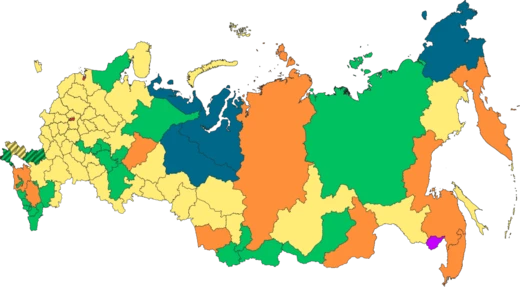
Altai Krai
A federal subject of Russia in Siberia, named after the Altai Mountains, with Barnaul as its administrative centre.

Altai Krai is a federal subject of Russia (a krai). It borders, clockwise from the west, Kazakhstan (East Kazakhstan Region, Abai Region and Pavlodar Region), Novosibirsk and Kemerovo, and the Altai Republic. Its administrative centre is the city of Barnaul. As of the 2021 Census, the population of the krai was 2,163,693.
- type
- Federal subject (krai) of Russia
- administrative_centre
- Barnaul
- population_2021
- 2,163,693
- area_forests
- about 60,000 km²
- highest_point
- Mayak Shangina (2,490 m)
- established
- 1937 (by resolution of the Central Executive Committee of the USSR)
Quick Facts
- En Name
- Altai Krai
- Political Status
- Krai
- Political Status Link
- Krais of Russia
- Federal District
- Siberian
- Economic Region
- West Siberian
- Adm Ctr Type
- Administrative center
- Adm Ctr Name
- Barnaul
- Pop 2021Census
- 2,163,693
- Pop 2021Census Rank
- 22nd
- Urban Pop 2021Census
- 58.1%
- Rural Pop 2021Census
- 41.9%
- Pop Latest
- 2390638
Facts from the source article.
Lore & Background
The region is named after the Altai Mountains. Bone fragments of the Denisova hominin originate from the Denisova Cave in Altai Krai. This area is part of a great crossroads in the ancient world. Nomadic tribes crossed through the territory during periods of migration. These nomadic tribes consisted of different peoples. Archeological sites reveal that ancient humans lived in the area. The Altay people are a Turkic people, some of whom settled here, who were originally nomadic and date back to the 2nd millennium BC. The territory of the krai has been controlled by the Xiongnu Empire (209 BC–93 AD), the Rouran Khaganate (330–555), the Mongol Empire (1206–1368), the Golden Horde, the Northern Yuan (1368–1691) and the Zunghar Khanate (1634–1758). After the Russian Revolution and the rise of the Russian Soviet Federative Socialist Republic, the policy of war communism was imposed on the rural population of Altai Krai, destroying the livelihood of many local farmers. In response, the peasant rebellion of Sorokino broke out in 1921; this uprising was quickly crushed by the Red Army. Many locals who had taken part in the rebellion were later put on trial and convicted to hard labor or execution, in accordance with NKVD Order No. 00447 in 1937. During the interwar period, the Soviet state collectivised the livestock and husbandry activities of the Altai population within Altai Krai, resulting in local resistance to the measures and their subsequent migration, with their herds, to China and Mongolia. In June 1942 Altai Krai was one of the territories to which the families of men deported from Eastern Europe, in particular 'foreigners' and 'other ethnicities' such as Kola Norwegians, Lithuanians and Latvians, by Soviet Russia to GULAG hard labor camps.
Reader's Guide
Altai Krai has rolling foothills, grasslands, lakes, rivers, and mountains. The highest point of the krai is the 2490 m tall Mayak Shangina. The climate is severe with long cold dry winters and hot, usually dry summers. The region's main waterway is the Ob River, which gives its name to the Ob Plateau. The Biya and Katun Rivers are also important. The biggest lakes are Lake Kulunda, Lake Kuchuk, Bolshoye Topolnoye, Bolshoye Yarovoye and Lake Mikhaylov. Altai Krai has rich natural resources, including lumber, as well as significant mineral reserves. These include the nonferrous metals lead, manganese, tungsten, molybdenum, bauxite, and gold, as well as iron ore. Forests cover about 60000 km2 of the krai's land. This region of Siberia is extremely important due to its biodiversity, an area of over 1.6 e6ha is recognised by UNESCO as a World Heritage Site. The area is home to animals considered rare, including the endangered snow leopard. The flag of Altai Krai is red, with the leftmost portion blue. The blue portion contains, in golden yellow, a stylized depiction of an upright ear of wheat. Centered in the red field is the coat of arms of the territory. It is derived from the flag of the Russian Soviet Federative Socialist Republic. The coat of arms of Altai Krai was established in 2000. It includes a shield of French heraldry form with a basement of 8/10th of its height and a sharp part in the middle of the bottom part. Bottom edges of the shield are rounded. The shield is divided with a horizontal stripe into two equal parts. In the upper part has a blue background, which is a symbol of glory, is a steamy oven of the 18th century, which reflects a historical past of the krai. In the bottom part on the red background, which is a symbol of dignity, braveness and courage, is an image of the Koluvan Queen of Vases mainly in green color, which is kept in the Hermitage Museum. The shield is framed with golden wheat ears which represent agriculture as a main industry of Altai Krai. During the Soviet period, the high authority in the krai was shared between three persons: The first secretary of the Altai CPSU Committee (who in reality had the most authority), the chairman of the Krai Soviet (legislative power), and the Chairman of the Krai Executive Committee (executive power). Since 1991, CPSU lost all the power, and the head of the krai administration, and eventu
Did You Know?
- The highest point of Altai Krai is the 2490 m tall Mayak Shangina.
- Bone fragments of the Denisova hominin originate from the Denisova Cave in Altai Krai.
- The flag of Altai Krai is derived from the flag of the Russian Soviet Federative Socialist Republic.
- Altai Krai has a sister district: Xinjiang, China.
More in Russian Federal Subjects 1-20
Spotted an error? Know more?
This is a living reference — every entry is fact-audited, and reader corrections feed straight into our audit queue. Suggest an edit · See this site's audit record