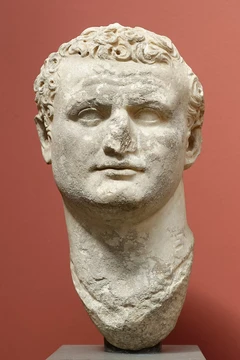
Julian (emperor)
Last non-Christian Roman emperor and Neoplatonic philosopher.
Last updated
Julian (Flavius Claudius Julianus) was Roman emperor from 361 to 363, known for his rejection of Christianity and promotion of Neoplatonic Hellenism. His reign ended with his death during a campaign against the Sasanian Empire, and he is remembered as Julian the Apostate in Christian tradition.
Early life
Julian, full name Flavius Claudius Julianus, was born in Constantinople around 331, the first known person born there after the city was refounded. His father was Julius Constantius, Constantine I’s younger half-brother; his mother, Basilina, was a Bithynian noble whose father had been praetorian prefect under Licinius. Basilina died soon after his birth, and Julian grew up in Constantinople, developing a deep bond with the city.
He likely learned Greek first and was raised Christian. In his satire Misopogon, Julian initially claims his ancestors were Moesians from the Danube, then later calls them Thracian. After Constantine’s death in 337, Julian and his half-brother Gallus were kept out of public life, closely watched, and given a Christian education.
Caesar in Gaul
In 355, Julian was summoned to Mediolanum and on 6 November was made Caesar of the West, marrying Constantius' sister Helena. Constantius intended his representative to be a figurehead, sending Julian to Gaul with a small retinue, but Julian eventually involved himself in the affairs of Gaul. During his first campaign in 356, he led an army to the Rhine, recovering several towns including Colonia Agrippina (Cologne). He withdrew for the winter to Senon, where a large contingent of Franks besieged the town for several months until his general Marcellus lifted the siege.
Constantius accepted Julian's report and replaced Marcellus with Severus as magister equitum. The following year, a combined operation with magister peditum Barbatio was planned to regain control of the Rhine. Barbatio was to amass forces at Augst with 25,000 soldiers, while Julian with 13,000 troops moved east from Durocortorum (Rheims). However, while Julian was in transit, a group of Laeti attacked Lugdunum (Lyon), delaying him and leaving Barbatio unsupported in Alamanni territory, forcing him to withdraw.
Reign
On 11 December 361, Julian entered Constantinople as sole emperor and his first political act was to preside over Constantius' Christian burial, escorting the body to the Church of the Apostles. He rejected the style of administration of his immediate predecessors, blaming Constantine for abandoning traditions. He idealized the reigns of Hadrian and Marcus Aurelius, and described the ideal ruler as primus inter pares. Julian frequently participated in Senate debates and speeches.
He dismissed thousands of servants, eunuchs and superfluous officials, viewing the court as inefficient and corrupt. He set up the Chalcedon tribunal to deal with corruption under Constantius, and several high-ranking officials, including chamberlain Eusebius, were found guilty and executed. Julian was conspicuously absent from the proceedings. He sought to reduce what he saw as a burdensome bureaucracy within the Imperial administration.
Religious issues
Julian's personal religion was both pagan and philosophical; he viewed traditional myths as allegories in which the ancient gods were aspects of a philosophical divinity. His chief surviving sources on religion are his works To King Helios and To the Mother of the Gods, written as panegyrics. He learned theurgy from Maximus of Ephesus, a student of Iamblichus, and his system bears resemblance to the Neoplatonism of Plotinus. Some scholars have brought attention to his relations with Mithraism, though whether he was initiated remains debatable.
Certain aspects of his thought, such as his reorganization of paganism under High Priests and his fundamental monotheism, may show Christian influence. According to one theory, Julian's paganism was highly eccentric and atypical due to its esoteric approach to Platonic philosophy; others argue his perspective was nothing unusual for a cultured pagan of his time. Because of his Neoplatonist background, Julian accepted the creation of humanity as described in Plato's Timaeus, writing that drops of sacred blood fell from Zeus and from them arose the race of men.
He argued against the Christian belief that humanity derives from a single pair, noting differences in bodies between Germans, Scythians, Libyans and Ethiopians. The Christian historian Socrates Scholasticus believed Julian thought himself Alexander the Great in another body via transmigration of souls.
Did You Know?
- Julian wrote the Misopogon, a light-hearted account of his clash with the inhabitants of Antioch after he was mocked for his beard.
- The Julian Romance is a late antique Syriac romance of Julian's reign from a hostile Christian perspective.
- Julian's life inspired the play Emperor and Galilean published in 1873 by Henrik Ibsen.
More in Roman Emperor-consuls
Sources
Compiled from Wikipedia and the sources listed below. Text from Wikipedia is available under CC BY-SA 4.0; this entry is adapted from it.
- Wikipedia: Julian (emperor) (CC BY-SA 4.0).
Spotted an error? Know more?
Reader corrections go straight into our review queue. Suggest an edit · How this site is sourced