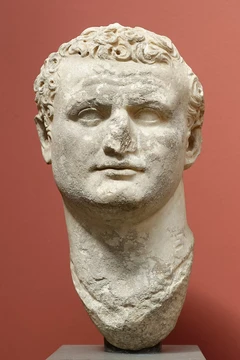
Macrinus
First Roman emperor from the equestrian class and of Berber origin.
Last updated
Marcus Opellius Macrinus was Roman emperor from April 217 to June 218, ruling jointly with his young son Diadumenianus. Born in Caesarea (modern Cherchell, Algeria) to an equestrian family of Berber origins, he was the first emperor not from the senatorial class and the first never to visit Rome during his reign. He came to power after conspiring to murder his predecessor Caracalla, whom he served as praetorian prefect.
Background and career
Macrinus came from Caesarea, which is now Cherchell, Algeria, located in the Roman province of Mauretania Caesariensis. He was born into an equestrian family with Berber roots. The scholar David Potter notes that his family claimed descent from local Berber tribes, and the fact that he wore a pierced ear marked him as Berber. A solid education allowed him to climb into Rome’s political ranks.
He built a reputation as a capable lawyer and, during the reign of Septimius Severus, became a key bureaucrat. Later, under Severus’s son Caracalla, he was made prefect of the Praetorian Guard. It seems Caracalla trusted him, but a prophecy supposedly warned that Macrinus would overthrow and replace the emperor. Worried that Caracalla might have him killed first, Macrinus decided to arrange the emperor’s murder.
In the spring of 217, Caracalla was in the eastern provinces getting ready for a campaign against the Parthian Empire. Macrinus was part of his staff, along with other Praetorian Guards. In April, Caracalla left the winter camp at Edessa to go to a temple of Luna near where the battle of Carrhae had taken place. He took only his personal guard, which included Macrinus.
The guard came back to camp carrying two bodies: the dead emperor and one of the soldiers who had gone with him. The official story said that on 8 April, while on the road to the temple, a soldier named Justin Martialis stabbed Caracalla to death. Later, it was claimed Macrinus had recruited Martialis for the job. Right after the killing, one of Caracalla’s men killed Martialis.
For two or three days, there was no emperor. On 11 April, Macrinus declared himself emperor, taking all the imperial titles and powers without waiting for the Senate’s approval. The army supported his claim, and the Senate, far away in Rome, could do nothing about it. Macrinus never went back to Rome as emperor; he stayed in Antioch throughout his rule.
He was the first emperor to come from the equestrian class instead of the senatorial class, and also the first emperor of Mauretanian descent. He took the name Severus to honor the Severan dynasty. He gave his wife Nonia Celsa the title Augusta, and made his son Diadumenianus Caesar with the name Antoninus, honoring the Antonine dynasty and putting the boy second in command. At that time, Diadumenianus was eight years old.
Reign
Macrinus came from an equestrian background, not the senatorial class, but the Senate accepted him as emperor for two reasons: he had removed Caracalla from power, and the army was loyal to him. The senators were more bothered by his low social rank than by his Mauretanian origins, and they watched his every move closely. Their opinion of him dropped further when he appointed men of similarly humble backgrounds to important positions. Because he was not a senator and had seized the throne through force instead of following tradition, he was held in contempt.
When Macrinus took over, he faced several problems left by his predecessor. Caracalla had preferred military aggression over negotiation, which created a number of conflicts that now fell to Macrinus to solve.
Caracalla had also been a reckless spender, pouring most of Rome’s money into the army. He had raised soldiers’ pay from 2,000 sesterces to 3,000 sesterces a year, and to cover the difference he had drained every available source of income. This left Rome in a severe financial crisis that Macrinus had to handle.
Macrinus first dealt with the threat from the Parthians, who had been at war with Rome since Caracalla’s reign. After an indecisive battle at Nisibis in 217, he negotiated a peace settlement. To secure it, he was forced to pay a large indemnity to the Parthian ruler Artabanus IV. Since Rome was also under pressure from Dacia and Armenia at the time, making peace with Parthia was probably a good move for the empire.
Next, Macrinus turned to Armenia. In 216, Caracalla had tricked Khosrov I of Armenia into meeting him for a conference, then imprisoned Khosrov and his family.
Caracalla put a Roman governor in charge of Armenia instead. This enraged the Armenian people, who soon rebelled. Macrinus ended the conflict by returning the crown and stolen goods to Khosrov’s son and successor, Tiridates II, releasing Tiridates’ mother from prison, and restoring Armenia to its former status as a client kingdom of Rome.
Macrinus also made peace with the Dacians by releasing hostages, though this was probably handled not by him but by his general Marcius Agrippa.
Downfall
Julia Maesa, having amassed a vast fortune over twenty years, retired to her hometown of Emesa, bringing along her daughters Julia Soaemias and Julia Mamaea, as well as her grandchildren, including the fourteen-year-old Elagabalus. In Emesa, Elagabalus served as the high priest of the local Phoenician sun god, also named Elagabalus.
Soldiers from the Legio III Gallica, stationed at the nearby camp of Raphanea, frequently visited Emesa and watched Elagabalus perform his religious duties. Seizing this opportunity, Julia Maesa began telling the soldiers that Elagabalus was actually the illegitimate son of the former emperor Caracalla. On May 16, the Third Legion proclaimed Elagabalus emperor at their camp in Raphanea.
Execution
When news of the rebellion reached him, Macrinus traveled to Apamea and elevated his own young son, Diadumenianus, to the rank of Augustus, making him co-emperor. Realizing his life was in danger, Macrinus hesitated and could not settle on a clear plan, remaining in Antioch. He dispatched a cavalry force under Ulpius Julianus to suppress the rebels, but the mission failed and Ulpius was killed. This setback only strengthened Elagabalus’s growing army.
Shortly afterward, a force led by Elagabalus’s tutor Gannys marched on Antioch, meeting Macrinus’s army on June 8 near the village of Immae, about twenty-four miles from the city. During the battle that followed, Macrinus abandoned his troops and fled back to Antioch. Fighting soon broke out inside the city itself, forcing Macrinus to escape again. Elagabalus then entered Antioch as the new ruler of the Roman Empire.
Macrinus attempted to reach Rome but was recognized and captured in Chalcedon. His son Diadumenianus, who had been sent to the Parthian king Artabanus IV for safekeeping, was intercepted at Zeugma and killed in June 218. Diadumenianus had been emperor for less than a month and was about ten years old at his death. Like his father, his head was severed and sent to Elagabalus as a trophy.
In popular culture
In the film Gladiator II (2024), Denzel Washington portrays the character "Macrinus", who is loosely inspired by the historical figure. Washington acknowledged that the real Macrinus was not black. The casting sparked controversy in Algeria, where many denounced a "blackwashing" of the historical Berber character, arguing that Macrinus was not of sub-Saharan African origin.
More in Roman Emperor-consuls
Sources
Compiled from Wikipedia and the sources listed below. Text from Wikipedia is available under CC BY-SA 4.0; this entry is adapted from it.
- Wikipedia: Macrinus (CC BY-SA 4.0).
Spotted an error? Know more?
Reader corrections go straight into our review queue. Suggest an edit · How this site is sourced