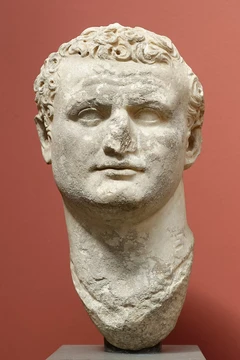
Justin I
Peasant-born emperor who ended the Acacian schism.
Last updated
Justin I, known as Justin the Thracian, ruled the Eastern Roman Empire from 518 to 527. A former peasant who climbed the military ranks to lead the imperial guard, he secured the throne after Emperor Anastasius I’s death, outmaneuvering rivals despite being about 68. His reign launched the Justinian dynasty, which included his nephew Justinian I and three later emperors.
His wife was Empress Euphemia. A staunch Chalcedonian Christian, Justin ended the Acacian schism with Rome, improving ties with the papacy. He emphasized the religious nature of his rule and issued laws against groups deemed non-Orthodox.
Early career
Justin was born a peasant and possibly a swineherd, according to legend, in the hamlet Bederiana near Naissus (modern Niš, Serbia) in the province of Dardania, part of the Prefecture of Illyricum. He was of Thraco-Roman or Illyro-Roman descent, spoke Latin and only rudimentary Greek. His sister Vigilantia (born c. 455) married Sabbatius and had two children: the future emperor Petrus Sabbatius Justinianus (born 483) and Vigilantia (born c. 490). The younger Vigilantia married Dulcissimus (or Dulcidio) and had at least three children: the future emperor Justin II (born c. 520), the future general Marcellus, and Praejecta (born c. 520), who married the senator Areobindus.
As a young man, Justin and two companions left Dardania to escape poverty, taking refuge in Constantinople with nothing more than ragged clothes and a sack of bread. Illiterate at the time, he joined the newly formed palace guard, the excubitors. He served in various positions, campaigning against the Isaurians and the Sassanian Persians, and was noticed for his bravery. Because of his ability, he was successively appointed a tribune, a comes, a senator, and under Emperor Anastasius I Dicorus, the influential position of comes excubitorum, commander of the palace guard.
During this period he married Lupicina; no surviving children are recorded from this marriage. According to contemporary historian Procopius, Lupicina was a barbarian slave who had been a concubine of her previous owner.
Succession
During the night of 8–9 July 518, Anastasius died, and his silentarii, a senior servant, summoned Justin and Celer to his deathbed. Celer was the magister officiorum (master of offices) and commander of the palace regiments of the Scholae Palatinae. By morning the event had been announced throughout Constantinople. The high officials, including John of Cappadocia, the recently appointed patriarch of Constantinople, were summoned to the Great Palace for the election of a new emperor.
Meanwhile, the people gathered in the Hippodrome of Constantinople and awaited the proclamation of the name of the new emperor. Anastasius had died childless but had a host of known relatives, including his brother Paulus, who had served as consul in 496. According to John Malalas, the praepositus sacri cubiculi (grand chamberlain), Amantius, had intended to have Theocritus, commander of an elite guard unit, elected to the throne. Amantius was said to have given a substantial sum of money to Justin in order to buy his support.
However, Justin controlled a smaller, but higher-quality group of soldiers, and used the money to buy support for himself. He was elected as the new emperor by the council and was proclaimed emperor in the Hippodrome. Justin's wife became empress under the name Euphemia. The name was probably chosen for reasons of respectability.
The original Euphemia was a Christian martyr during the Diocletianic Persecution, a local saint of Chalcedon, and the Council of Chalcedon (451) had taken place in a cathedral consecrated in her name. This selection was an early indication that Justin and Lupicina were fervent Chalcedonian Christians.
Emperor
Justin cemented his position by assassinating potential opponents, especially anti-Chalcedonian supporters of Anastasius. Both Amantius and Theocritus were executed nine days after the election. Early in his reign, he also dismissed a number of officials that served Emperor Anastasius, including Marinus, the praetorian prefect. In his time, Justin was viewed as an illiterate career soldier with little knowledge of statecraft.
He surrounded himself with trusted advisors, the most prominent being his nephew Flavius Petrus Sabbatius, whom he adopted as his son and invested with the name Iustinianus (Justinian). Another was the quaestor Proclus. Because Justin couldn't write or read, the palace created a stencil from a piece of wood carved with four letters that spelled the Latin word LEGI, which means 'I have read'. In foreign affairs, Justin endeavoured to cultivate client states on the borders of the Empire and avoided any significant warfare until late in his reign.
Foreign affairs
In 497 Anastasius had agreed with Theoderic, the Ostrogothic king of Italy, that he would rule Italy as Anastasius' deputy, preserving Italy as nominally part of the Empire. Theodoric's son-in-law Eutharic was appointed consul in Constantinople in 519 and confirmed as Theodoric's heir. Eutharic died in 522, by which time Justin's policies, possibly influenced by Justinian, had become more anti-Arian. In 526 Theodoric died, leaving Eutharic's ten-year-old son Athalaric as heir to the throne.
A number of initiatives in respect of neighbouring states were founded on religious motives, and were usually developed by Justinian as he assumed more power towards the end of Justin's reign. Kaleb I of Aksum was probably encouraged to aggressively enlarge his empire by Justin. Contemporary chronicler John Malalas reported that Byzantine merchants were robbed and killed by the Jewish king of the south Arabian kingdom of Himyar, causing Kaleb to claim, 'You have acted badly because you have killed merchants of the Christian Romans, which is a loss both to myself and my kingdom.'
After Kaleb invaded Himyar around 523, Justin saw what is now Yemen pass from Sassanian control to the rule of an allied Christian state. The Georgian Principality of Iberia was in the Sassanian sphere of influence, but was Christian. Vakhtang I of Iberia was encouraged into war with the Sassanians. After a lengthy struggle he was defeated and Iberia subjugated as a Sassanian province in 522.
Lazica was another border state; it was Christian, but in the Sassanid sphere. Its king, Tzath, wished to weaken Sassanid influence. In 521 or 522, he went to Constantinople to...
Justinian
The source states that Justin's nephew was Flavius Petrus Sabbatius, whom he adopted as his son and invested with the name Iustinianus (Justinian). The source also notes that Justinian was a prominent advisor and that initiatives were usually developed by Justinian as he assumed more power towards the end of Justin's reign.
Did You Know?
- Justin was around 68 years old when he was elected emperor.
- He was illiterate and used a wooden stencil with the word LEGI ('I have read') to sign documents.
More in Roman Emperor-consuls
Sources
Compiled from Wikipedia and the sources listed below. Text from Wikipedia is available under CC BY-SA 4.0; this entry is adapted from it.
- Wikipedia: Justin I (CC BY-SA 4.0).
Spotted an error? Know more?
Reader corrections go straight into our review queue. Suggest an edit · How this site is sourced