English Civil War
A series of civil wars over the balance of power in England.

The British Library · No restrictions
The English Civil War, also known as the Great Rebellion, was a conflict between Royalists and Parliamentarians in England that lasted from 1642 to 1651. It was part of the larger Wars of the Three Kingdoms (1639–1653) and is usually broken into the First and Second English Civil Wars, with the 1650–1652 Anglo-Scottish war sometimes called the Third. While the fighting in England, Scotland, and Ireland shared some features, each kingdom had its own distinct problems and goals. The First English Civil War mainly centered on how much power Parliament should have versus King Charles I. It ended in June 1646 with the Royalists beaten and the king imprisoned.
But winning the war exposed deep splits among Parliamentarians about what kind of government to set up. Most had fought in 1642 to secure Parliament’s role in running the country, not to get rid of the monarchy. Since Charles refused to compromise, things ground to a halt. Fears grew about the political influence of radicals in the New Model Army, like Oliver Cromwell. This led moderate Parliamentarians to team up with Royalists and the Covenanter Scots. The Royalists lost the Second English Civil War in 1648, which led to Charles I being executed in January 1649 and the creation of the Commonwealth of England.
In 1650, Charles II was crowned King of Scotland after promising to establish a Presbyterian church in both England and Scotland. The resulting Anglo-Scottish war ended with a Parliamentarian victory at Worcester on September 3, 1651. Both Ireland and Scotland were then absorbed into the Commonwealth, making the British Isles a single state. This setup proved unpopular and unstable in the long run, and it fell apart with the Stuart Restoration in 1660. The civil wars ultimately pushed England and Scotland toward a parliamentary monarchy.
The term "English Civil War" is usually used in the singular, but historians often split it into two or three separate wars. These conflicts weren't limited to England; Wales, already part of the Kingdom of England, faced the same political turmoil. The wars also involved Scotland and Ireland and civil wars within them. Some historians prefer the term "British Civil Wars." From the Restoration until the 19th century, the common name was "the rebellion" or "the great rebellion." The wars across all four countries are called the Wars of the Three Kingdoms. In the early 1800s, Walter Scott called it "The Great Civil War." The 1911 Encyclopædia Britannica used "Great Rebellion." Marxist historians like Christopher Hill favored "English Revolution."
The nicknames "Cavaliers" (for Royalists) and "Roundheads" (for Parliamentarians) both started as insults. "Cavalier" comes from the same Latin root as the Spanish "caballero" and was used in Elizabeth I’s court to imply pro-Spanish leanings. "Roundhead" referred to how some Puritans and London apprentices cut their hair short or flat, though generals on both sides wore their hair at similar lengths.
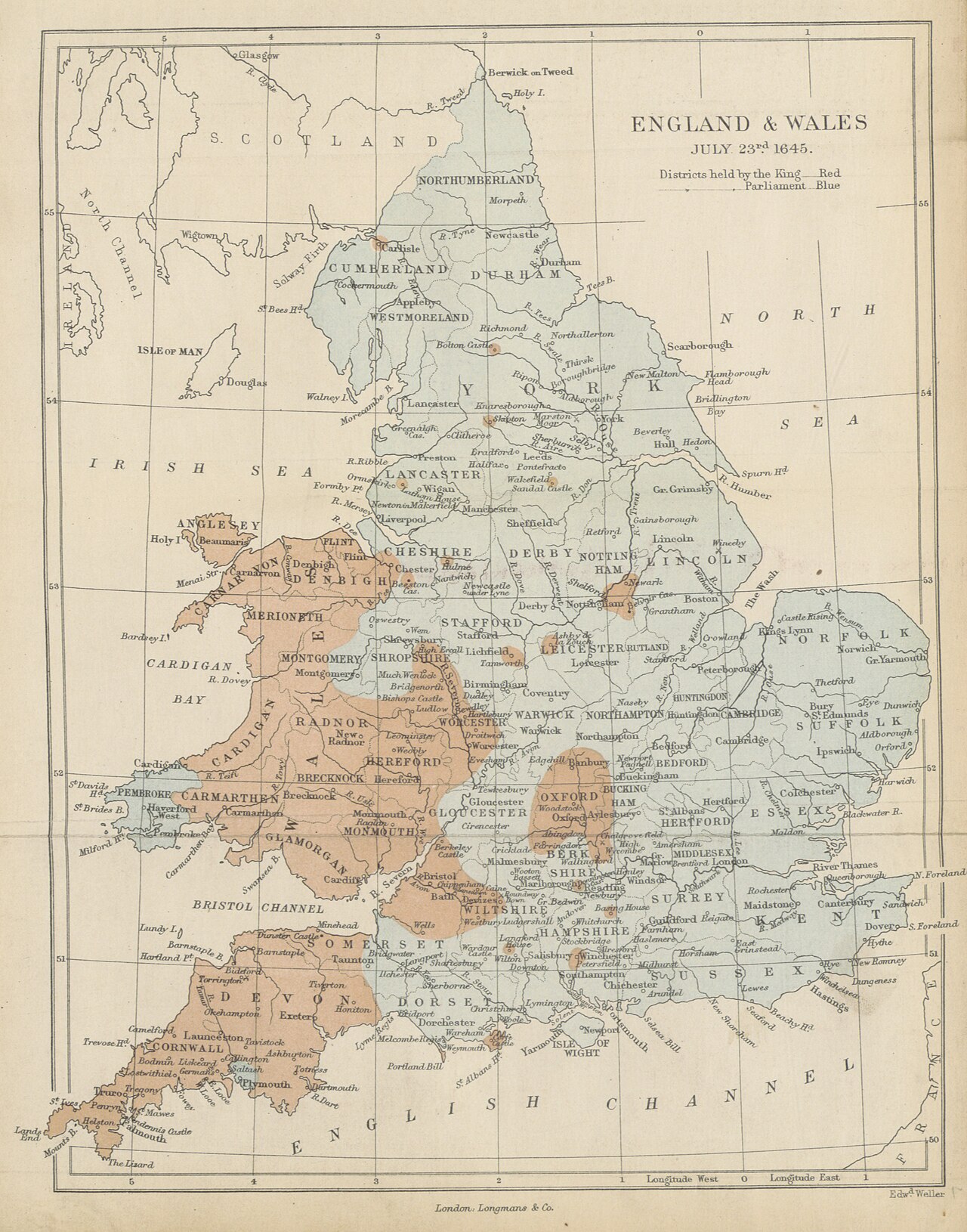
Geographically, each side had strongholds where minority views were silenced or people fled. Royalist areas included the countryside, the shires, the cathedral cities of York, Chester, Worcester, and Oxford, and the less developed parts of northern and western England and Wales. Parliament controlled the industrial centers, ports, and richer regions of southern and eastern England, plus the remaining cathedral cities. Historian Lacey Baldwin Smith noted that "the words populous, rich, and rebellious seemed to go hand in hand."
Many officers and veteran soldiers had fought in European wars, especially the Eighty Years' War between Spain and the Dutch (starting in 1568) and earlier phases of the Thirty Years' War (1618–1648). The war was on an unprecedented scale for England. During campaign seasons, 120,000 to 150,000 soldiers were in the field—a higher proportion of the population than in Germany during the Thirty Years' War. The main battle tactic was pike and shot infantry. The two sides lined up opposite each other, with infantry brigades of musketeers in the center. They carried matchlock muskets, inaccurate but deadly up to 300 yards. Musketeers formed three rows: first kneeling, second crouching, third standing. Sometimes troops split into two groups so one could reload while the other fired. Among the musketeers were pikemen carrying 12- to 18-foot pikes to protect the musketeers from cavalry charges. Cavalry were positioned on each side of the infantry, with the right wing led by the lieutenant-general and the left by the commissary general. Their main goal was to rout the enemy cavalry, then turn and overwhelm the infantry.
Royalist cavaliers' skill and speed on horseback led to many early victories. Prince Rupert, commanding the king's cavalry, used a tactic learned in the Dutch army: charging at full speed into enemy infantry, firing pistols just before impact. However, with Oliver Cromwell and the more disciplined New Model Army, a group of steady pikemen could stand their ground, which had a devastating effect. Royalist cavalry often chased individual targets after the initial charge, leaving their forces scattered.
- Conflict
- English Civil War
- Belligerents
- Royalists vs Parliamentarians
- Outcome
- Parliamentarian victory; execution of Charles I; establishment of the Commonweal
- Key Figures
- Oliver Cromwell, Prince Rupert, Charles I, Charles II
- Also Known As
- Great Rebellion, The Great Civil War, English Revolution
Lore & Background
The English Civil War broke out in 1642, less than 40 years after the death of Queen Elizabeth I. Elizabeth had been succeeded by her first cousin twice-removed, King James VI of Scotland, as James I of England, creating the first personal union of the Scottish and English kingdoms. As King of Scots, James had become accustomed to Scotland's weak parliamentary tradition, so that upon assuming power south of the border, the new King of England was affronted by the constraints the English Parliament attempted to place on him in exchange for money. James's personal extravagance meant he had to resort to extra-parliamentary sources of income. Charles I followed his father's dream of uniting the kingdoms of England, Scotland and Ireland into a single kingdom. Many English Parliamentarians were suspicious of such a move, fearing it might destroy old English traditions. Because James had described kings as 'little gods on Earth', chosen by God to rule in accordance with the Divine Right of Kings, and Charles shared his father's position, the suspicions of the Parliamentarians had some justification.
Reader's Guide
The outcome of the civil wars effectively set England and Scotland on course towards a parliamentary monarchy form of government. The conflict also introduced the disciplined New Model Army under Oliver Cromwell, which won many decisive victories against the Royalist cavalry. The terms 'Cavalier' and 'Roundhead' originated as pejoratives for Royalists and Parliamentarians respectively. Cavalier comes from the same Latin root as the Spanish word caballero ('knight, horseman') and had been used in the court of Elizabeth I as an insult implying pro-Spanish sympathies. Roundhead refers to how some Puritans and London apprentices wore their hair closely cropped around the head or flat, though generals of both sides wore their hair at similar lengths.
Did You Know?
- The Anglo-Scottish war of 1650 to 1652 is sometimes referred to as the Third English Civil War.
- During campaign seasons, 120,000 to 150,000 soldiers would be in the field, a higher proportion of the population than were fighting in Germany in the Thirty Years' War.
- The term 'Cavalier' comes from the same Latin root as the Spanish word caballero ('knight, horseman') and was used in the court of Elizabeth I as an insult implying pro-Spanish sympathies.
- Prince Rupert, commanding the king's cavalry, used a tactic learned while fighting in the Dutch army, charging at full speed into the opponent's infantry and firing pistols just before impact.
- The Second English Civil War ended with the execution of Charles I in January 1649 and the establishment of the Commonwealth of England.
The Political Heart of the Conflict
The First English Civil War ended in June 1646 with Royalist defeat and the king in custody. Yet victory exposed Parliamentarian divisions over the nature of the political settlement. The vast majority had gone to war in 1642 to assert Parliament's right to participate in government, not abolish the monarchy, which meant Charles' refusal to make concessions led to a stalemate. Concern over the political influence of radicals within the New Model Army like Oliver Cromwell led to an alliance between moderate Parliamentarians and Royalists, supported by the Covenanter Scots. Royalist defeat in the 1648 Second English Civil War resulted in the execution of Charles I in January 1649, and the establishment of the Commonwealth of England. In 1650, Charles II was crowned King of Scotland, in return for agreeing to create a Presbyterian church in both England and Scotland. The subsequent Anglo-Scottish war ended with Parliamentarian victory at Worcester on 3 September 1651.
The Battlefield Revolution
The war was of unprecedented scale for the English. During the campaign seasons, 120,000 to 150,000 soldiers would be in the field, a higher proportion of the population than were fighting in Germany in the Thirty Years' War. The main battle tactic came to be known as pike and shot infantry. The two sides would line up opposite one another, with infantry brigades of musketeers in the centre. These carried matchlock muskets, an inaccurate weapon which nevertheless could be lethal at a range of up to 300 yards. Musketeers would assemble three rows deep, the first kneeling, second crouching, and third standing. Among the musketeers were pike men, carrying pikes of 12 feet to 18 feet long, whose main purpose was to protect the musketeers from cavalry charges. Positioned on each side of the infantry were cavalry, with a right wing led by the lieutenant-general and the left by the commissary general. Prince Rupert, commanding the king's cavalry, used a tactic learned while fighting in the Dutch army, where cavalry would charge at full speed into the opponent's infantry, firing their pistols just before impact. However, with Oliver Cromwell and the introduction of the more disciplined New Model Army, a group of disciplined pike men would stand its ground, which could have a devastating effect. The Royalist cavalry had a tendency to chase down individual targets after the initial charge, leaving their forces scattered and tired, whereas Cromwell's cavalry was slower but better disciplined. Trained to operate as a single unit, it went on to win many decisive victories.
A Nation Divided by Geography
Each side had a geographical stronghold, such that minority elements were silenced or fled. The Royalist areas included the countryside, the Shires, the cathedral cities of York, Chester, Worcester and Oxford, and the less economically developed areas of northern and western England and Wales. Parliament's strengths spanned the industrial centres, ports, and economically advanced regions of southern and eastern England, including the remaining cathedral cities. Historian Lacey Baldwin Smith wrote: 'the words populous, rich, and rebellious seemed to go hand in hand.' The conflicts also involved wars with Scotland and Ireland and civil wars within them. Some historians have favoured the term The British Civil Wars. The wars spanning all four countries are known as the Wars of the Three Kingdoms.
The Long Shadow of the Wars
Both Ireland and Scotland were incorporated into the Commonwealth, and the British Isles became a unitary state. This arrangement ultimately proved both unpopular and unviable in the long term, and was dissolved upon the Stuart Restoration in 1660. The outcome of the civil wars effectively set England and Scotland on course towards a parliamentary monarchy form of government. From the Restoration to the 19th century, the common phrase for the civil wars was 'the rebellion' or 'the great rebellion'. In the early 19th century, Walter Scott referred to it as 'The Great Civil War'. The 1911 Encyclopædia Britannica called the series of conflicts the 'Great Rebellion'. Some historians, notably Marxists such as Christopher Hill, favoured the term 'English Revolution'.
Gallery
Frequently Asked Questions
What is the English Civil War in the Revolutions & Uprisings series?
It is a series of civil conflicts fought over who held ultimate political authority in England. The entry is also catalogued under the titles Great Rebellion, The Great Civil War, and English Revolution.
Who were the two opposing sides in the English Civil War?
The Royalists, who defended the king's prerogative, clashed with the Parliamentarians, who pushed for parliamentary supremacy. Notable leaders include Prince Rupert and Charles I on the crown's side, and Oliver Cromwell for Parliament.
How does the English Civil War story end?
Parliament emerged victorious, which led directly to the execution of King Charles I. The war's conclusion gave rise to the Commonwealth of England, a republican form of government.
Who are the key figures fans should know from the English Civil War entry?
Oliver Cromwell and Prince Rupert stand out as the principal military commanders, while Charles I and Charles II serve as the royal figureheads around whom the conflict revolves.
Why is the English Civil War considered important in the canon of uprisings?
It permanently altered the power balance between monarchy and parliament in England. By ending in a king's execution and the founding of a Commonwealth, it became a foundational precedent for later revolutionary movements.
More in Revolutions & Uprisings 1-15
Spotted an error? Know more?
This is a living reference — every entry is fact-audited, and reader corrections feed straight into our audit queue. Suggest an edit · See this site's audit record