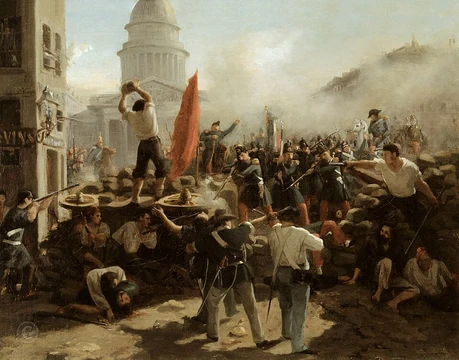
American Revolution
Political movement that created the sovereign United States.

via Wikipedia: American Revolution · see source
Between 1765 and 1789, the Thirteen Colonies of British North America underwent a political upheaval that started as a rebellion and evolved into a full revolution. This movement ultimately produced the independent United States, a direct result of the American Revolutionary War (1775–1783). In 1775, the Second Continental Congress, acting as a temporary government, formed the Continental Army and chose George Washington to lead it. The next year, on July 2, Congress approved the Lee Resolution, and two days later, on July 4, 1776, it unanimously endorsed the Declaration of Independence. The U.S. Constitution went into effect in 1789, and the Bill of Rights was added in 1791.
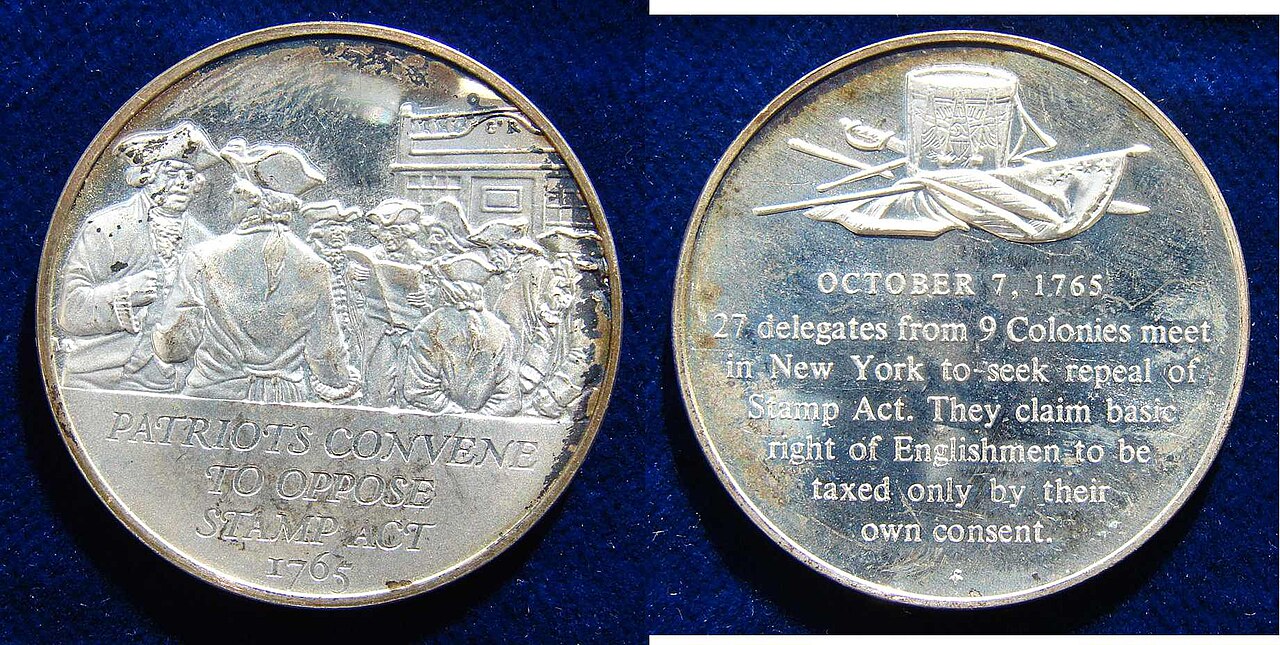
Discontent flared up soon after the French and Indian War ended in 1763. Even though the colonies had fought in and backed that war, the British Parliament imposed fresh taxes to cover war debts and handed control of western lands to officials in Montreal. In 1765, delegates from several colonies gathered in New York City for the Stamp Act Congress, arguing that taxation without representation and similar measures violated their rights as Englishmen. Although the Stamp Act was repealed in 1766, tensions reignited in 1767 when Parliament passed the Townshend Acts. To suppress the growing unrest, King George III sent British troops to Massachusetts, where the Boston Massacre occurred in 1770. In December 1773, a local branch of the Sons of Liberty carried out the Boston Tea Party, dumping chests of taxed tea from the British East India Company into Boston Harbor. Parliament responded with harsh punitive laws known as the Intolerable Acts, meant to end self-government in Massachusetts but instead fueling broader support for revolution.
In 1774, twelve of the Thirteen Colonies (Georgia joined the following year) sent representatives to the First Continental Congress. This body began coordinating Patriot resistance through underground committees, many built on the Sons of Liberty network. In August 1775, King George III declared Massachusetts to be in a state of rebellion. British efforts to disarm the colonists led to the Battles of Lexington and Concord, which started the Revolutionary War. The Second Continental Congress met in May 1775, created the Continental Army, and soon surrounded Boston, forcing the British to evacuate by sea in March 1776, leaving Patriots in charge of every colony. In May 1776, Congress voted to replace all Crown authority with locally created governments, and each colony drafted its own state constitution. On July 2, Congress passed the Lee Resolution, affirming support for joint independence, and on July 4, it unanimously adopted the Declaration of Independence, which proclaimed that "all men are created equal." Congress then began drafting the Articles of Confederation, a framework for a multi-state coordinating body able to negotiate treaties and wage war.
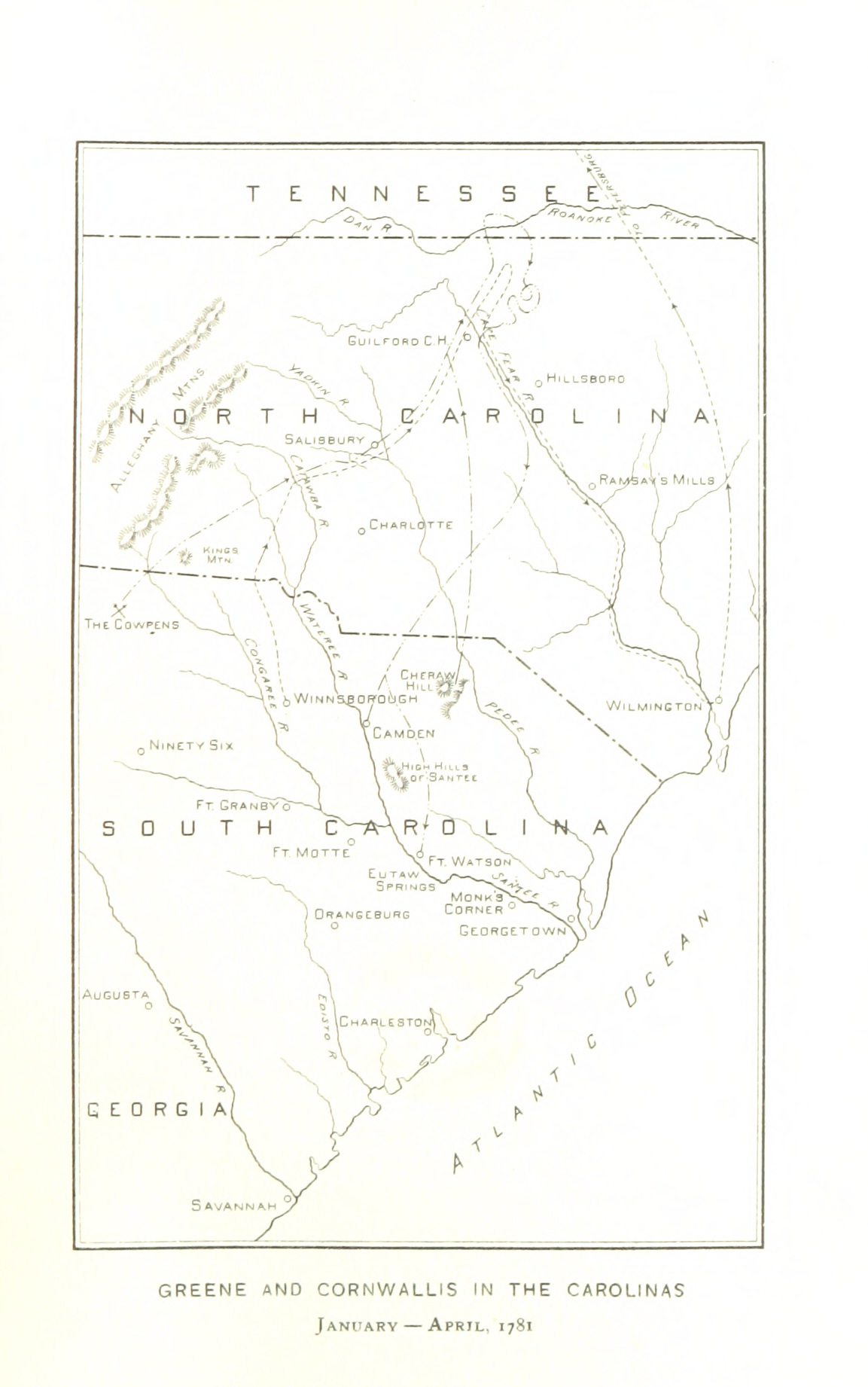
The war dragged on for five more years, with France eventually entering the conflict. On September 28, 1781, Washington led the Continental Army to capture a British force under General Cornwallis at the Siege of Yorktown. This victory caused King George III’s control over Parliament to collapse, and consensus shifted toward ending the war on American terms. On September 3, 1783, the British signed the Treaty of Paris, recognizing the United States as a sovereign nation and ceding nearly all territory east of the Mississippi River and south of the Great Lakes. The United States became the first country to establish a federal republic with a written constitution founded on principles of universal natural rights, consent of the governed, and equality under the law—though with significant democratic limits compared to later standards.
After England’s Glorious Revolution, Britain adopted a policy of "salutary neglect," largely leaving the Thirteen Colonies to govern themselves. This approach, combined with the liberty ideals from the Glorious Revolution, led to new government systems (such as William Penn’s Frame of Government for Pennsylvania and the Massachusetts Charter of 1691), religious institutions (like the democratic Congregational Protestantism in New England and the First Great Awakening across the colonies), and occasional attitudes against slavery (Massachusetts and initially Georgia banned it, though this was rare). This policy reversed sharply after the French and Indian War. The British establishment, especially after acquiring vast lands from New France, sought tighter control over colonial affairs, prompting the colonies to demand greater autonomy. Patriot Captain Levi Preston of Danvers, Massachusetts, explained the rebellion simply: "…we always had governed ourselves, and we always meant to. They didn't mean we should."
- start_year
- 1765
- end_year
- 1789
- field
- Political movement and war
- nationality
- Thirteen Colonies (later United States)
- known_for
- Establishing the sovereign United States and a federal republic with a written c
Lore & Background
Discontent with colonial rule began shortly after the French and Indian War, which ended in 1763. The British Parliament imposed new taxes to compensate for wartime costs and transferred control of the colonies' western lands to British officials in Montreal. Representatives from several colonies convened in New York City for the Stamp Act Congress in 1765. Its declaration argued that taxation without representation and other policies violated their rights as Englishmen. In 1767, though the Stamp Act was repealed, tensions increased again following Parliament's passing of the Townshend Acts. In an effort to quell the mounting rebellion, King George III deployed British troops to the colony of Massachusetts, where there was a conflict in the 1770 Boston Massacre. In December 1773, the local faction of the Sons of Liberty orchestrated the Boston Tea Party, during which they dumped chests of taxed tea owned by the British East India Company into the Boston Harbor. Parliament responded by enacting a series of punitive laws, called the Intolerable Acts. These were intended to end self-government in Massachusetts but instead increased American support for revolution. In 1774, 12 of the Thirteen Colonies sent delegates to the First Continental Congress (the Province of Georgia joined in 1775). The First Continental Congress began coordinating Patriot resistance through underground networks of committees largely built on the foundations of the Sons of Liberty network. In August 1775, King George III proclaimed Massachusetts to be in rebellion. The British attempted to disarm the colonists, resulting in the Battles of Lexington and Concord, starting the Revolutionary War. The Second Continental Congress convened in May of 1775 and created the Continental Army, which then surrounded Boston, forcing the British to withdraw by sea in March 1776 and leaving Patriots in control in every colony. In May 1776, Congress voted to suppress all forms of Crown authority to be replaced by locally created authority, and each colony created a state constitution. On July 2, the Congress passed the Lee Resolution, affirming their support for joint independence. On July 4, 1776, they unanimously adopted the Declaration of Independence, proclaiming that 'all men are created equal'. After that, Congress began drafting the Articles of Confederation, an effort to establish a multi-state self-governing coordinating body capable of negotiating international treaties and prosecuting the war.
Reader's Guide
The Revolutionary War continued for another five years, during which France eventually entered. On September 28, 1781, Washington commanded the Continental Army's capture of a British army under General Cornwallis at the Siege of Yorktown, leading to the collapse of King George's control of Parliament. Consensus in Parliament soon shifted to the war ending on American terms. On September 3, 1783, the British signed the Treaty of Paris, recognizing the sovereign independence of the United States, and ceding to the new nation nearly all the territory east of the Mississippi River and south of the Great Lakes. The United States became the first nation to establish a federal republic with a written constitution based on the principles of universal natural rights, consent of the governed, and equality under the law, although with significant democratic limitations compared to later evolution of the concept. The Constitution took effect in 1789, and the Bill of Rights was ratified in 1791. The revolution's legacy includes the establishment of a new form of government and the precedent of colonial rebellion against imperial rule.
Did You Know?
- The Stamp Act Congress convened in New York City in 1765, arguing that taxation without representation violated colonists' rights as Englishmen.
- The Boston Tea Party in December 1773 involved the Sons of Liberty dumping chests of taxed tea owned by the British East India Company into Boston Harbor.
- The Second Continental Congress appointed George Washington as commander-in-chief of the Continental Army in 1775.
- The Siege of Yorktown on September 28, 1781, led to the capture of a British army under General Cornwallis, shifting consensus in Parliament to end the war on American terms.
- The Treaty of Paris, signed on September 3, 1783, recognized the sovereign independence of the United States and ceded territory east of the Mississippi River and south of the Great Lakes.
Centuries of Ethnic Grievance and Revolutionary Seeds
The Qing dynasty's 267-year rule was never free from the friction between its Manchu rulers and the Han majority. From the early thinkers Gu Yanwu and Wang Fuzhi, who openly called for restoring the Ming, through the Tiandihui secret societies, the White Lotus Rebellion, and the Taiping Heavenly Kingdom, a thread of ethnic resistance ran continuously beneath the surface of imperial China. The court's policy of privileging Manchus in military and administrative appointments—allowing them to fill Han-designated posts while denying any reciprocal right to Han officials—fueled resentment that never fully dissipated. By the 1890s, that resentment rekindled with new force. Sun Yat-sen drew directly on this heritage, declaring in his Three Principles of the People that the Manchu conquest was a minority enslaving a majority, and that China had suffered two complete subjugations, first under the Yuan, then under the Qing. Underground groups like the Xingzhonghui circulated texts such as the Record of Ten Days at Yangzhou as propaganda, and families like the Huangs passed down injunctions against serving the Qing. When the Boxer Rebellion and the student movements in Japan pushed China into deeper crisis, this centuries-old current became an unstoppable tide.
The Wuchang Spark and Provincial Collapse
On 10 October 1911, members of the New Army in Wuchang launched an armed uprising that no one had fully anticipated. What began as a localized military rebellion ignited a chain reaction: spontaneous revolts then erupted across the country, and revolutionary forces in every province formally renounced allegiance to the Qing. The old dynasty, which had already spent a decade stumbling through failed reform attempts—conservatives blocking measures as too radical while reformers found the pace too glacial—simply crumbled. The Qing court, desperate, appointed Yuan Shikai, commander of the Beiyang Army, as prime minister on 1 November, hoping his military weight could salvage the throne. Meanwhile, in Nanjing, the revolutionary factions assembled a provisional coalition government. The Advisory Council declared the Republic of China into existence on 1 January 1912, installing Sun Yat-sen, the long-exiled leader of the Tongmenghui, as its first president. A short civil war between northern and southern forces followed, but it ended not in total victory for either side but in a negotiated compromise that would reshape the young republic's leadership.
Abdication and the Transfer of Power
The compromise that ended the brief civil war carried a dramatic condition: Sun Yat-sen would step down as president if Yuan Shikai could secure the abdication of the Qing emperor. Yuan accepted the deal and opened negotiations with the imperial court. On 12 February 1912, the abdication edict was promulgated, ending the reign of the six-year-old Xuantong Emperor and, with it, the 267-year Qing dynasty and more than two thousand years of continuous imperial rule in China. Yuan was sworn in as president of the new national government on 10 March 1912. The transition was remarkable in its speed—barely four months from the Wuchang Uprising to the formal end of monarchy—but it was also fragile. Yuan's authority rested on military prestige rather than on a consolidated, legitimate central government. He never fully unified the country under a single administrative framework, and the republican institutions that the revolutionaries had built in Nanjing remained underdeveloped. The abdication, while peaceful on paper, left the new republic without the deep institutional roots that a more protracted revolutionary process might have forged, setting the stage for the political instability that would follow.
Warlordism, Failed Restoration, and Enduring Legacy
Yuan Shikai's ambition to reassert monarchical power proved fatal to his legacy. In December 1915, he proclaimed himself the Hongxian Emperor, attempting to restore the throne he had helped dismantle. The move triggered strong opposition from both the general population and the military, forcing him to abdicate by March 1916. He died that June, and because he had never built a legitimate, unified central government before his death, China fractured into decades of warlordism and political division. Even an attempt to restore the Qing dynasty itself resurfaced in this chaotic period. Yet the revolution's ideals survived the chaos. Both the Republic of China and the People's Republic of China claim the 1911 Revolution as their legitimate predecessor, honoring its core principles of nationalism, republicanism, modernization, and national unity. In the sexagenary calendar, 1911 carries the label Xinhai, giving the revolution its traditional name. Every 10 October, the anniversary of the Wuchang Uprising, is still observed as a national holiday in Taiwan and as the Anniversary of the 1911 Revolution on the Chinese mainland—a reminder that the revolution's symbolic power outlasted any single government it produced.
Gallery
Frequently Asked Questions
Who is American Revolution?
The American Revolution was a political movement and armed conflict running from 1765 to 1789 that turned the Thirteen British Colonies into the independent sovereign United States. It started as colonial protest against British policy, escalated into open war, and ended with the founding of a new federal republic.
What are American Revolution's powers/role?
Its defining role was dismantling Crown authority over the colonies and building a self-governing nation with a written constitution. The Second Continental Congress acted as the provisional government, raising the Continental Army and naming George Washington its commander-in-chief in 1775.
How does American Revolution's story end?
The arc closes in 1789 when the U.S. Constitution is ratified and goes into effect, replacing the Articles of Confederation and locking in the federal structure of the new country. The military phase had already concluded in 1783 with Britain's formal recognition of American sovereignty.
Why is American Revolution important?
It produced one of the earliest modern federal republics grounded in a written constitution and popular sovereignty, a model that shaped later independence movements across the world. The unanimous Declaration of Independence adopted on July 4, 1776, articulated rights-based governance in a way that permanently altered political discourse.
When did American Revolution take place?
The broader political movement spans 1765, when organized colonial resistance to British taxation first emerged, through 1789, when the new Constitution took effect. The dedicated war period, the American Revolutionary War, ran from 1775 to 1783.
More in Revolutions & Uprisings 1-15
Spotted an error? Know more?
This is a living reference — every entry is fact-audited, and reader corrections feed straight into our audit queue. Suggest an edit · See this site's audit record