German revolution of 1918–1919
Revolution that ended the German Empire and founded the Weimar Republic.

The November Revolution of 1918–1919 ended the German Empire as World War I concluded and created the conditions for the Weimar Republic. German suffering during the war, the empire’s defeat (both economically and psychologically), and rising tensions between ordinary people and the aristocratic, military, and bourgeois elite all fueled the uprising. The first phase toppled the empire by 9 November 1918 with little bloodshed; the second, more violent phase saw advocates of a parliamentary republic defeat those pushing for a soviet-style council republic.
The revolt ignited on 29 October 1918 when sailors in Kiel refused orders to attack the British fleet. They formed a revolutionary workers’ and soldiers’ council, and by early November the insurrection had spread across Germany. Councils took over from military, royal, and civil authorities with minimal resistance. On 9 November the revolution reached Berlin, a republic was declared, and Emperor Wilhelm II fled to the Netherlands the next day.
On 10 November, the Council of the People’s Deputies—a provisional government—was created by Germany’s two main socialist parties. Led by Friedrich Ebert, it retained most imperial officers, administrators, and judges to use their expertise in handling the immediate crises.
The revolution’s left wing wanted to nationalize key industries, democratize the military, and establish a council republic, but moderates controlled most workers’ and soldiers’ councils and blocked significant moves in that direction. The split between moderate and radical socialists turned violent in late December 1918. The Spartacist uprising of January 1919 failed to create a dictatorship of the proletariat and led to the murders of Rosa Luxemburg and Karl Liebknecht by Freikorps members. Through spring, further attempts to push the revolution toward a council republic were violently suppressed, and short-lived local soviet republics appeared in Bavaria, Bremen, and Würzburg.
The revolution's violent phase is generally considered to have ended by May 1919, after the suppression of the Bavarian Soviet Republic, though the adoption of the Weimar Constitution on 11 August 1919 formally founded the republic.
Quick Facts
- Conflict
- German revolution
- Part Of
- the Revolutions of 1917–1923 and / Political violence in Germany (1918–1933)
- Location
- Germany
- Result
- Weimar Republic victory
Facts from the source article.
Lore & Background
The revolution began on 29 October 1918 when sailors at Kiel mutinied against orders to sail out against the British fleet. They established a revolutionary workers' and soldiers' council and in early November spread the revolt across Germany. Councils took power from the existing military, royal and civil authorities with little resistance or bloodshed. The revolution reached Berlin on 9 November, a republic was proclaimed, and Emperor Wilhelm II fled to Holland the next day. On 10 November, the Council of the People's Deputies was formed as a provisional government by members of Germany's two main socialist parties. Under the leadership of Friedrich Ebert, it kept most of the imperial officer corps, administration and judiciary in place so that it could use their expertise to address the crises of the moment.
Reader's Guide
The revolution's significance lies in its rapid overthrow of the German Empire and its role in creating the Weimar Republic, but it remained incomplete. It failed to resolve the fracture in the Left between moderate socialists and communists, while anti-democratic voices from the imperial government remained in positions of power. The split between moderate and radical socialists erupted into violence in the last days of 1918, including the Spartacist uprising in January 1919, which failed and led to the murders of Rosa Luxemburg and Karl Liebknecht by members of the Freikorps. Into the spring, there were additional violently suppressed efforts to push the revolution further toward a council republic, as well as short-lived local soviet republics. The Weimar Republic was from its birth under great pressure from both those on the Left and the Right who sought to undermine and replace it, and it ultimately ended with the ascent of Hitler and the National Socialist Party.
Did You Know?
- The revolution was sparked by a mutiny of sailors at Kiel on 29 October 1918.
- Emperor Wilhelm II fled to Holland on 10 November 1918, the day after a republic was proclaimed.
- The revolution's end date is generally given as 11 August 1919, the day the Weimar Constitution was adopted.
The War's Aftermath as Catalyst
World War I pulled millions of men into uniform and fundamentally restructured the balance of political power across Europe. The sheer scale of that mobilization, combined with the social dislocation it produced, created conditions of extraordinary turmoil in nearly every belligerent nation. In that chaos, outright revolutions erupted, massive general strikes paralyzed industries, and soldiers in large numbers refused orders and mutinied against their own governments. The success of the Russian Revolution in 1917 then added a powerful ideological spark to an already volatile mixture, inspiring further unrest across the continent. The uprisings that followed were predominantly socialist in character, though anti-colonial movements also seized the moment. In cities and port towns, workers, sailors, and soldiers organized their own councils, demanded political representation, and challenged the authority of long-standing monarchies. Germany, like its neighbors, was swept into this maelstrom of industrial action, military insubordination, and revolutionary ambition that would ultimately bring down one of Europe's great imperial structures.
The November Revolution and Imperial Collapse
The November Revolution of 1918 stands as one of the defining political ruptures of the early twentieth century, bringing the German Empire to a definitive end. The revolution emerged from the same confluence of war exhaustion, mass strikes, and military mutiny that had destabilized so many European states, and it succeeded where many other socialist uprisings of the period did not. The collapse of the German Empire was not an isolated event but part of a broader revolutionary wave that simultaneously dissolved Austria-Hungary and toppled the Romanov monarchy in Russia. Yet the German case carried particular weight: the empire's dissolution reshaped the political landscape of central Europe and created the conditions for the emergence of Weimar Germany. Unlike the Bolsheviks in Russia, who consolidated power through civil war and territorial concessions, the German revolution did not produce a lasting socialist state. The vast majority of socialist uprisings of the era never managed to establish a permanent socialist government, and Germany's post-revolutionary order would follow a different, more contested path.
A Continent in Upheaval
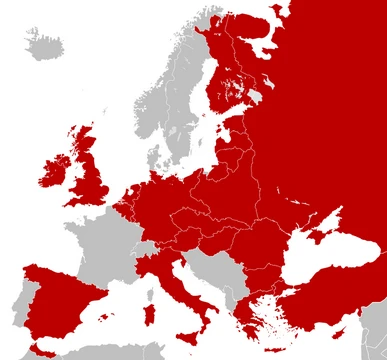
The German revolution did not occur in isolation; it was one thread in a vast web of revolutionary activity spanning the entire continent. In Russia, the February Revolution of 1917 toppled the Romanov monarchy, and the Bolsheviks—a radical faction that had split from the Mensheviks within the Social Democratic Labour Party—seized power that October, triggering a brutal civil war against White, Green, and nationalist forces. In Austria-Hungary, mass strikes and military mutinies brought the Habsburg monarchy to its knees. In Bulgaria, widespread troop mutinies forced the Tsar to step down. French soldiers in 1917 openly refused to engage the enemy, while Italian workers staged repeated mass strikes. Finland's Social Democrats, holding an absolute parliamentary majority, organized Red Guards and clashed with nationalist and agrarian factions, leading to a civil war. Even Turkey and Ireland experienced transformative upheavals, with Turkey winning a successful war of independence and Ireland being partitioned into the Irish Free State. Germany's November Revolution was thus one expression of a continent-wide crisis of authority, empire, and social order.
Legacy and the Reshaping of Europe
The revolutions of 1917 through 1923 left an indelible mark on the European political landscape, even as the vast majority of socialist uprisings never managed to establish a permanent socialist state. The end of the German imperial structure and the breakup of Austria-Hungary permanently redrew the continent's political boundaries and power arrangements. In Russia, the Bolsheviks' hard-won victory in civil war was tempered by the sobering failure of Comintern-inspired revolutions elsewhere; by 1921, the party had shifted from pursuing world revolution to building socialism within a single country. Lenin introduced the New Economic Policy, permitting private individuals to own small and medium-sized enterprises, and opened trade relations with Weimar Germany, the United Kingdom, and other major Western countries. The Kronstadt rebellion that same year, in which even dissident elements of the Red Army revolted against the communist state, underscored the fragility of the new order. The Menshevik party was banned in the aftermath, and in 1922 the Union of Soviet Socialist Republics was officially created. For Germany, the revolution's legacy was the end of imperial rule and the emergence of a new political order navigating a post-war world still shaped by the upheavals of 1918.
Frequently Asked Questions
What is the German revolution of 1918–1919?
It is the November Revolution that dismantled the German Empire in the closing days of World War I and paved the way for the Weimar Republic. The uprising unfolded in two distinct waves: a largely peaceful initial strike that brought down the monarchy, followed by a bloodier struggle over the shape of the new state.
When did the German revolution of 1918–1919 begin and end?
The revolt was triggered on 29 October 1918 and its final conflicts wrapped up by May 1919. The pivotal moment came on 9 November 1918, when the imperial system collapsed with remarkably little violence.
Why is the German revolution of 1918–1919 important?
It permanently ended the centuries-old German Empire and created the political conditions from which the Weimar Republic emerged. For fans of revolutionary history, it is a key case study of how wartime exhaustion, elite rigidity, and mass mobilization can topple a state in a matter of weeks.
What fueled the German revolution of 1918–1919?
Prolonged wartime hardship, the psychological shock of military and economic defeat, and deepening resentment toward the aristocratic, military, and bourgeois ruling class all converged to ignite the uprising. Ordinary workers and soldiers, who bore the heaviest costs of the war, found little room for compromise with the old power structure.
More in Revolutions of 1917–1923 1-24
Spotted an error? Know more?
Reader corrections go straight into our review queue. Suggest an edit · How this site is sourced