Communist Workers' Party of Germany
Anti-parliamentarian left communist party of the Weimar Republic.

The Communist Workers' Party of Germany (German: Kommunistische Arbeiterpartei Deutschlands, KAPD) was an anti-parliamentarian and left communist party active in Germany during the Weimar Republic. Founded in Berlin on 4–5 April 1920 as a split from the Communist Party of Germany (KPD), it rejected parliamentary participation, reformist trade unions, and Leninist democratic centralism, advocating instead for immediate abolition of bourgeois democracy and a dictatorship of the proletariat based on workers' councils. The party originally remained a sympathising member of the Communist International but broke with it after the 3rd World Congress in 1921 following criticism from Lenin.
Quick Facts
- Native Name
- Kommunistische Arbeiterpartei Deutschlands (KAPD)
- Dissolution
- 1933 · 03
- Split
- Communist Party of Germany
- Merged
- Communist Workers' Union of Germany
- Newspaper
- Kommunistische Arbeiter-Zeitung
- Ideology
- Left communism / Revolutionary socialism / Council communism
- Membership Year
- 1921
- Membership
- 43,000
- Position
- Far-left
- International
- Communist Workers' International
- Country
- Germany
Facts from the source article.
Lore & Background
The KAPD's roots lay in the left-wing split from the Social Democratic Party of Germany (SPD), the International Socialists of Germany (ISD), a separate council-communist group distinct from the more orthodox Marxist Spartacus League. The ISD and Spartacists entered the Independent Social Democratic Party of Germany (USPD) in 1915, and the left wing of the USPD formed the KPD in 1918. In 1920, ultra-left council communists from the ISD split from the KPD to form the KAPD, after being excluded at the Heidelberg Party Conference of the KPD in October 1919 by the central leadership under Paul Levi. The founding conference on 4–5 April 1920 in Berlin was attended by delegates from across Germany, representing about 38,000 members. The Kapp Putsch and the KPD's changing position on the general strike and disarmament of the Ruhr Red Army spurred the split.
Reader's Guide
The KAPD represents a significant current within left communism, distinguished by its principled anti-parliamentarism and rejection of both reformist trade unions and the Leninist vanguard party model. Its influence peaked around 1921 with over 43,000 members, but internal fragmentation and isolation from the Comintern led to decline. The party split in 1922 into the Essen Faction (linked to the Communist Workers' International) and the Berlin Faction, which survived until 1933. The KAPD's ideas, particularly through theorists Anton Pannekoek and Herman Gorter, contributed to the development of council communism. Its legacy includes a critique of parliamentary socialism and bureaucratic centralism, though its practical impact was limited by sectarianism and the rise of Nazism.
Did You Know?
- The KAPD was formed on 4 April 1920 by members excluded from the KPD at the Heidelberg Party Conference in October 1919.
- Lenin wrote 'Left-Wing Communism: An Infantile Disorder' partly as a critique of the KAPD's positions.
- The KAPD split in 1922 into the Essen Faction and the Berlin Faction, both retaining the name.
- The party's youth wing was the Kommunistische Arbeiter Jugend (KAJ), which published 'Rote Jugend'.
The Global Revolutionary Upheaval of 1917–1923
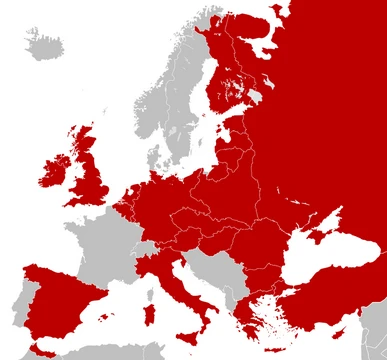
The period between 1917 and 1923 witnessed an extraordinary cascade of political upheaval that swept across multiple continents. Sparked by the success of the Russian Revolution and the deep disorder left in the wake of World War I, this wave of unrest manifested as armed revolts, mass strikes, and widespread social turmoil. The uprisings carried a predominantly socialist or anti-colonial character, reflecting the ideological ferment of the era. While the Russian experience ultimately produced a lasting communist state, the vast majority of socialist revolts elsewhere failed to establish durable socialist governments. Nevertheless, the collective impact of these events profoundly reshaped the European political map. The German Empire collapsed, Austria-Hungary dissolved, and new national boundaries emerged across the continent. For emerging communist movements in Germany and beyond, this era represented both an inspiration and a cautionary tale, demonstrating both the transformative potential and the fragility of revolutionary change in a world still reeling from the devastation of total war.
The Russian Revolution as Catalyst
In the war-torn landscape of Imperial Russia, the February Revolution of 1917 brought down the Romanov monarchy, ushering in a period of intense instability. A liberal Provisional Government briefly took power before being overthrown by the Bolsheviks, a radical faction that had split from the Mensheviks within the Russian Social Democratic Labour Party. The October Revolution triggered a devastating civil war, during which the Bolsheviks, under Vladimir Lenin, withdrew from the global conflict through the Treaty of Brest-Litovsk, conceding vast territories. They then faced a sprawling coalition of anti-communist forces, including the White movement, peasant Green armies, nationalist factions in Ukraine and Central Asia, and anarchist-inspired uprisings. By 1921, even elements of the Red Army itself revolted, as seen in the Kronstadt rebellion. Yet the anti-Bolshevik forces remained fragmented and peripheral, while the Red Army operated from the center, defeating opponents one by one. The Menshevik party was banned in the aftermath, and the USSR was formally established in 1922.
The German November Revolution and Imperial Collapse
World War I had mobilized millions of soldiers and fundamentally reshaped the balance of political power across Europe, generating enormous social turmoil in its wake. In Germany, this turmoil culminated in the November Revolution, which brought about the end of the German Empire. The broader context was one of widespread military and civilian unrest: French soldiers mutinied in 1917 and refused to engage the enemy, Bulgarian troops revolted and their Tsar was forced to abdicate, and across Austria-Hungary, mass strikes and military mutinies contributed to the collapse of the Habsburg monarchy. Italy experienced its own wave of mass strikes, while Turkey fought a successful war of independence and Ireland was partitioned to create the Irish Free State. For the emerging Communist Workers' Party of Germany, the November Revolution represented the most immediate and consequential of these upheavals. The dissolution of the imperial order created a political vacuum in which revolutionary socialist movements could organize, agitate, and compete for the allegiance of a working class radicalized by years of war, sacrifice, and economic hardship.
Aftermath and the Shaping of a New Political Order
The complete failure of Comintern-inspired revolutions across Europe proved a sobering lesson for the Bolshevik leadership in Moscow. This experience prompted a strategic pivot from the goal of worldwide revolution toward the more contained project of building socialism within a single country. Lenin responded by opening trade relations with the United Kingdom, Weimar Germany, and other major Western powers. Most dramatically, in 1921 he introduced the New Economic Policy, which permitted private individuals to own small and medium-sized enterprises, marking a significant retreat from pure state control of the economy. The exhaustion of war, the collapse of transportation networks and markets, and the specter of starvation had made even the Red Army question the communist state's direction. Yet the Bolsheviks ultimately consolidated power, and the Union of Soviet Socialist Republics was formally created in 1922. For communist parties in Germany and elsewhere, this period established a complex template: the revolutionary ideal remained, but the practical reality demanded adaptation, economic pragmatism, and a rethinking of how socialist transformation could be achieved amid entrenched opposition and material scarcity.
Frequently Asked Questions
What was the Communist Workers' Party of Germany (KAPD)?
KAPD was a German left-communist party that broke away from the KPD in April 1920 to champion a council-based workers' state. It rejected both parliamentary politics and the Leninist party structure its parent organization had adopted.
Why did KAPD split from the Communist Party of Germany?
The founders believed the KPD had drifted toward reformism by contesting elections and tolerating trade-union bureaucracy. They argued that only a direct dictatorship of the proletariat organized through workers' councils could overthrow bourgeois rule.
What kind of political structure did KAPD advocate?
The party called for the immediate abolition of parliamentary democracy and its replacement by a network of factory and local workers' assemblies. It explicitly opposed the 'democratic centralism' model that concentrated authority in a centralized party leadership.
How did KAPD relate to the Communist International?
KAPD maintained a sympathetic but deliberately independent stance toward the Comintern rather than submitting to its organizational discipline. That tension over party autonomy and the refusal to follow Comintern directives gradually isolated the group within the wider communist movement.
What happened to KAPD in the end?
The party never seized power in Germany and steadily lost influence through the late 1920s and early 1930s. Its Berlin-based faction merged into the Communist Workers' Union around 1933, effectively ending the original organization.
More in Revolutions of 1917–1923 1-24
Spotted an error? Know more?
Reader corrections go straight into our review queue. Suggest an edit · How this site is sourced