Bolshevik triennium
Period of social conflict in Spain influenced by the Russian Revolution.

The Bolshevik triennium is a term used in Spanish historiography to describe the period between 1918 and 1920 (or 1921), characterized by intense social conflict in the context of the crisis of the Restoration. The name reflects the influence of the Russian Revolution of 1917 and the Bolshevik revolutionaries, particularly on the impoverished masses in southern Spain.
- Field
- Historical period
- Nationality
- Spain
- Known for
- High level of social conflict, strikes, and peasant revolts in southern Spain
- Period
- 1918–1920 (or 1921)
Lore & Background
The term was first used in a 1929 study by Juan Díaz del Moral, who employed the expression 'Bolshevist triennium.' It is usually applied in a restricted way to revolts, demonstrations, assassinations, and strikes in the southern half of Spain, especially in the Andalusian countryside. The expectations aroused by news from the Russian Revolution were felt in urban or rural movements depending on local context.
During this period, there was a notable increase in union membership, with day laborers massively joining unions such as the CNT and UGT. Between autumn 1918 and summer 1919, mobilizations reached their peak, including general strikes in the province of Cordoba and across Andalusia. Movements radicalized into land occupations, crop burnings, and seizure of town halls, driven by slogans like 'land for those who work it.'
Reader's Guide
The Bolshevik triennium is significant as a period of intense class conflict in Spain, reflecting the global impact of the Russian Revolution. It highlighted the precarious situation of landless day laborers and industrial workers, who faced unemployment, wage cuts, and rising prices. The period saw both concessions, such as wage increases and recognition of unions, and harsh repression, including states of war and outlawing of workers' societies. The decline of the Andalusian workers' movement after May 1919, along with simultaneous strikes in mining areas like Riotinto and Peñarroya, contributed to broader political instability. This unrest, combined with the disaster of Annual in Morocco, led to the coup d'état of General Primo de Rivera in 1923, ending the Restoration system. The triennium thus marks a critical juncture in Spanish social and political history.
Did You Know?
- The period saw a nominal wage increase of 150% between 1917 and 1921, according to Díaz del Moral, though based on data that cannot be generalized.
- The CNT was present in the Comintern from 10 December 1919 until Ángel Pestaña's report in 1922.
- The Riotinto strike of 1920 paralyzed the mining basin and had a strong media impact across Spain.
The Global Uprising Inspired by Petrograd
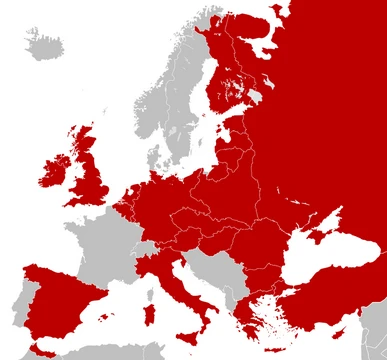
The revolutions spanning 1917 to 1923 constituted a sweeping wave of political upheaval that rippled far beyond Russia's borders. Fueled by the Bolsheviks' successful seizure of power and the chaos left in the wake of World War I, socialist and anti-colonial revolts erupted across the globe. In France, soldiers mutinied in 1917 and refused to continue engaging the enemy. Bulgaria saw its own troops mutiny, forcing the Tsar to step down. Austria-Hungary endured mass strikes and military mutinies that ultimately brought down the Habsburg monarchy. Germany's November Revolution ended the German Empire, while Italy was shaken by widespread mass strikes. Turkey fought a successful war of independence, and Ireland was partitioned to create the Irish Free State. Although most of these socialist uprisings failed to establish lasting socialist states, their collective impact reshaped the European political map, dissolving empires and redrawing national boundaries in ways that would echo for generations.
From Monarchy to Soviet Power
In war-weary Imperial Russia, the liberal February Revolution of 1917 forced Tsar Nicholas II to abdicate, briefly giving way to a Provisional Government. That liberal interlude ended when the Bolsheviks—the radical Marxist faction that had split from the Mensheviks within the RSDLP—seized power in the October Revolution. The new regime immediately withdrew from the war through the Treaty of Brest-Litovsk in 1918, conceding vast territories, and then plunged into a brutal civil war. The opposition was broad and ideologically diverse: the counter-revolutionary White movement, peasant Green armies, nationalist forces in Ukraine and the Transcaucasus, anarchist uprisings including the Tambov Rebellion, and even invading Allied forces. Yet by 1921, exhaustion, collapsed transport networks, and starvation had worn down even the Red Army's own ranks, as seen in the Kronstadt rebellion. Crucially, the anti-Bolshevik forces remained fragmented and peripheral, while the Red Army, concentrated at the center, defeated them sequentially and consolidated control.
The Strategic Retreat and the Birth of a New State
The complete failure of Comintern-inspired revolutions abroad struck a sobering blow in Moscow. Faced with this reality, the Bolshevik leadership abandoned the doctrine of immediate world revolution in favor of building socialism within a single country. Vladimir Lenin pivoted toward opening trade relations with the United Kingdom, Weimar Germany, and other major Western powers. Most dramatically, in 1921 he introduced the New Economic Policy, which permitted private individuals to own small and medium-sized enterprises—a significant concession to market mechanisms within a communist framework. The Menshevik party was banned in the wake of the Kronstadt rebellion, eliminating a key rival. Out of this turbulent process of revolution, counter-revolution, and strategic recalibration, the Union of Soviet Socialist Republics was officially established in 1922, marking the formal birth of a new political entity that would dominate the twentieth century.
Finland's Fractured Left and the Road to Civil War
Finland's revolutionary trajectory was shaped by a deeply fractured political landscape. The Social Democratic Party, which had won an absolute parliamentary majority in the July 1916 elections with 103 of 200 seats, organized Red Guards composed of labor union activists, anarchists, and left-wing militants. Meanwhile, the political right was itself splintered: tenant farmers backed the Agrarian Union, the liberal middle class supported the Young Finnish Party, conservative Russification opponents aligned with the Finnish Party, and Finnish Swedes with the Swedish Folks' Party. The right had also secretly funded the Jäger Movement, enlisting young Finnish students into the German Army to fight on the Eastern Front. The central constitutional question—the valtalaki, or powers act, which would transfer executive authority from the abolished Russian monarch to a Finnish body—remained unresolved. The Social Democrats themselves were split: some wanted the law passed to establish an independent socialist state, while others hesitated. The Kornilov Coup in August 1917 and the chaos following the Romanovs' fall further destabilized Helsinki-Petrograd relations, setting the stage for armed conflict.
Frequently Asked Questions
What is the Bolshevik triennium?
It is a label coined in Spanish historiography for the stretch of years from 1918 to 1920 (sometimes extended to 1921) when social unrest reached its peak against the backdrop of the Restoration's ongoing crisis. The name borrows its energy from the 1917 Russian Revolution and the way Bolshevik ideas resonated with Spain's poorest workers and peasants.
Where and when did the Bolshevik triennium take place?
It unfolded in Spain, with the harshest confrontation concentrated in the southern provinces. The core years are 1918 through 1920, though some scholars stretch the endpoint to 1921.
What events defined the Bolshevik triennium?
The period was marked by an extraordinary wave of general strikes, peasant uprisings, and broader social confrontation. These clashes were especially intense among the landless and underpaid laborers of Andalusia and other southern regions.
Why is it called 'Bolshevik' if it happened in Spain?
The name reflects the ideological influence the 1917 Russian Revolution and its Bolshevik revolutionaries exerted on Spanish working and peasant classes. It signals that the unrest carried a revolutionary, left-wing character inspired by events across the continent rather than being purely an economic grievance.
Why does the Bolshevik triennium matter in the broader 1917–1923 revolutionary wave?
It demonstrates how the Russian Revolution's shockwave reached into southern Europe and turned Spain's existing class tensions into open, sustained conflict. For students of the interwar revolutionary period, it stands as a key example of transnational ideological contagion well beyond Russia's borders.
More in Revolutions of 1917–1923 1-24
Spotted an error? Know more?
Reader corrections go straight into our review queue. Suggest an edit · How this site is sourced