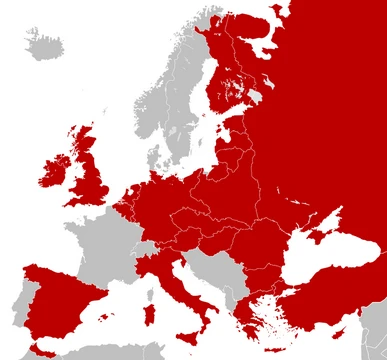
1918 Rio de Janeiro anarchist insurrection
The 1918 anarchist uprising in Rio de Janeiro, betrayed from within.

The 1918 Rio de Janeiro anarchist insurrection was an unsuccessful attempt at overthrowing the federal government and the establishment of a self-managed society, based on the anarcho-syndicalist models of decentralized organizations and trade unions. It was inspired by the events of the Russian Revolution.
Quick Facts
- Part Of
- the 1917–1919 Brazil strike movement and the Revolutions of 1917–1923
- Date
- November 18, 1918
- Location
- Rio de Janeiro
- Causes
- High cost of living / Poor working conditions / Police repression of strike actions
- Goals
- The overthrow of the state and its replacement with workers' councils
- Methods
- General strike / Insurrection
- Result
- Government victory / Insurrection suppressed / Anarchist movement repressed / Workers' organizations dissolved
- Fatalities
- 2 workers
- Arrests
- 14 strike leaders / 200 workers
Facts from the source article.
Lore & Background
In January 1918, the Anarchist Alliance of Rio de Janeiro was created. On March 1, the General Workers' Union (UGT) was founded, replacing the FORJ which in August 1917 had been closed by the state repressive apparatus. The insurrection was planned for November 18, with the objective to overthrow the State and substitute it with a worker council network. The plans involved over 400 workers directly, and indirectly thousands of others. The uprising was betrayed by Lieutenant Jorge Elias Ajuz, who acted as a spy and agent provocateur. After the betrayal, workers abandoned previously defined plans. The police arrested ten Brazilians, three Portuguese immigrants, and one Spanish immigrant, who were deported or expelled. About 200 workers were arrested, among them 78 directly linked to anarchist unions. The battle at the Confiança factory resulted in the death of textile industry trade unionist Manuel Martins and another worker who died days later.
Reader's Guide
The insurrection was widely used as a reason for Delfim Moreira, acting president, to persecute and put an end to countless anarchist organizations. On November 20, the federal government decreed the dissolution of the UGT, along with the closure of the metal workers, civil builders and textile industry unions that were still on strike – which lasted another two weeks. On November 20, 1918, a law was passed in the Federal Senate that defined that 'work is regulated by laws that give them necessary guarantees: guarantees to society, guarantees to employers, guarantees to the workers'.
Did You Know?
- The insurrection was inspired by the Russian Revolution, though anarchist groups did not know about the character of the Bolshevik Revolution.
- The uprising was betrayed by Lieutenant Jorge Elias Ajuz, who had attended all the meetings and knew all the plans.
- Over 200 workers were detained, and funeral processions for the killed workers were banned by the police but still took place accompanied by hundreds of workers.
The Crucible of Suffering
By 1918, the daily reality for Rio de Janeiro's working class had become almost unbearable. The Spanish flu swept through Brazilian cities, claiming thousands of lives, while the economic aftershocks of the First World War drove prices to levels that crushed the poorest families. Hunger drove thousands to loot warehouses and shops. Inside the factories of neighborhoods like Barreto and Santo Aleixo, conditions were deplorable: dimly lit, smoke-choked spaces with no proper sanitation—only holes in the ground where workers were expected to relieve themselves. Children on the production line could end up owing money to their employers for mistakes, and physical beatings were a routine tool of discipline. Even expectant mothers labored without respite. Foremen and hired thugs, living in the same cramped settlements as the workers they supervised, crushed any hint of protest. The May repression of the Corcovado textile factory strike and the July collapse of the Hotel New York, which killed tens of laborers, only deepened the animosity workers and anarchists felt toward both the state and the business class.
From Ideas to Organization
The seeds of libertarian thought reached Brazil at the close of the nineteenth century, carried by Italian and Spanish immigrants who had come to work as cheap labor in factories and farms. The writings of Bakunin, Kropotkin, and other European anarchists found fertile ground among a proletariat already building its organizational capacity. By 1917, the coordination of unions and anarchist groups in São Paulo produced a general strike that halted the city's industrial output. In Rio, the Worker Federation (FORJ) campaigned against the soaring cost of living and pushed to restructure trade unions, while police tried to shut down mass meetings where thousands gathered to hear speakers. After the state dissolved FORJ in August 1917, the movement regrouped: the Anarchist Alliance of Rio de Janeiro formed in January 1918, and in March the General Workers' Union (UGT) replaced FORJ as the central syndicalist body. Despite a state of siege declared on May 1, workers still marked International Workers' Day in union halls and a theatre, and the Germinal Anarchist Group staged a theatrical festival in June. By August, strikes at the Cantareira water company and Fluminense transit paralyzed ferryboats and trams, and soldiers of the 58th Hunters' Battalion took up arms alongside workers when police violence escalated.
The November 18 Confrontation
After months of street clashes in September and October, revolutionaries finalized their plans in secret meetings. Intellectuals and syndicalists—including professor José Oiticica, Manuel Campos, Astrogildo Pereira, Carlos Dias, Álvaro Palmeira, José Elias da Silva, João da Costa Pimenta, and Agripino Nazaré—laid out a strategy for November 18: overthrow the state and replace it with a network of worker councils. More than 400 workers would act directly, with thousands more joining a lightning general strike. The plan called for seizing the Government Palace, planting 1,600 bombs to sabotage energy lines and transport, and occupying police stations and military bases. Lieutenant Jorge Elias Ajuz, a low-ranking army officer, was to provide the military strategy. On the morning of November 18, textile workers in Niterói, Barreto, Petrópolis, Magé, Santo Aleixo, and Rio de Janeiro declared synchronous strikes, joined by metallurgy and civil construction workers. By afternoon, 400 workers gathered at São Cristóvão Palace, where police moved to disperse them. A battle erupted; two bombs exploded at a nearby police station and the crowd advanced. Army soldiers encircled the location, retaking the station and scattering the workers. The fighting spread to surrounding streets as the army attempted to seize the Army command building.
The Spy in the Ranks
The insurrection's failure was not simply a matter of military inferiority. The authorities had been aware of the workers' plans from the start. Lieutenant Jorge Elias Ajuz, who had attended every secret meeting and knew the full scope of the strategy, was in fact a spy and agent provocateur working for the state. His presence within the revolutionary leadership meant that police and army forces could anticipate every move. When the uprising was set in motion on November 18, the state's forces were already positioned to respond. The workers, upon learning that their leadership had been infiltrated and their plans leaked, began to shift away from extreme measures. The insurrection, conceived as a coordinated seizure of the Government Palace backed by a general strike and widespread sabotage, collapsed under the weight of its own betrayal. The dream of replacing the Brazilian state with a decentralized network of worker councils, inspired by the anarcho-syndicalist models of Bakunin and Kropotkin and the revolutionary fervor of 1917, was extinguished not by the sheer force of the army alone, but by the intimate knowledge the state possessed of every bomb, every route, and every name on the list.
Frequently Asked Questions
What was the 1918 Rio de Janeiro anarchist insurrection?
It was a brief, ultimately unsuccessful uprising in Rio de Janeiro carried out by anarchist and syndicalist workers who tried to overthrow Brazil's federal government. The event is remembered as a failed bid to build a decentralized, worker-managed society in 1918.
Who organized the 1918 Rio de Janeiro anarchist insurrection?
A tight circle of roughly thirty to fifty core organizers—drawn from anarchist intellectuals and trade-union leaders—planned the action in clandestine meetings. A wider base of workers offered indirect sympathy, but they were not directly involved in the planning.
Why did the 1918 Rio de Janeiro anarchist insurrection fail?
A police informant leaked the plans before the uprising could be executed, allowing authorities to move in almost immediately. The entire operation was crushed within a very short window, leaving the organizers no time to activate their broader network of supporters.
What political vision motivated the 1918 Rio de Janeiro anarchist insurrection?
The organizers wanted to replace the existing state with a self-managed society structured around voluntary, decentralized associations and trade unions. The Russian Revolution of 1917 served as the immediate inspiration, convincing them that a workers' takeover was suddenly within reach.
More in Revolutions of 1917–1923 1-24
Spotted an error? Know more?
Reader corrections go straight into our review queue. Suggest an edit · How this site is sourced