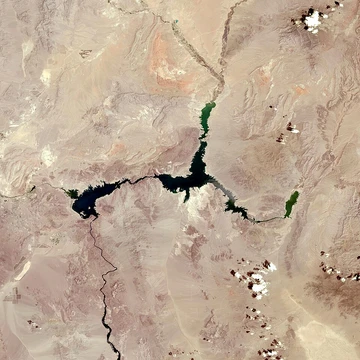
Lake Powell
Second-largest U.S. reservoir by volume when full, on the Colorado River.
Last updated

via Wikipedia: Lake Powell · see source
Lake Powell is a reservoir on the Colorado River in Utah and Arizona, United States. It is a major vacation destination visited by approximately two million people every year. It holds 24,322,000 acre-feet of water when full, second in the United States to only the downstream reservoir of Lake Mead – though Lake Mead has fallen below Lake Powell in size several times during the 21st century in terms of volume of water, depth and surface area. The reservoir is named for John Wesley Powell, a Civil War veteran who explored the river via three wooden boats in 1869.
History
In the 1940s and early 1950s, the Bureau of Reclamation planned a series of Colorado River dams on the Colorado Plateau. The dam was originally intended for Echo Park in Dinosaur National Monument, but objectors led by David Brower of the Sierra Club defeated that proposal, citing Echo Park's scenic value. Glen Canyon Dam was then built to meet the Upper Basin states' downstream delivery obligations under the Colorado River Compact. Construction began with a demolition blast triggered by President Dwight D. Eisenhower on October 1, 1956.
Water flowed through diversion tunnels on February 11, 1959, and concrete placement started on June 17, 1960. The last bucket of concrete was poured on September 13, 1963.
The dam is 710 feet high, cost $155 million, and 18 lives were lost during construction. Lady Bird Johnson dedicated the dam on September 22, 1966. Turbines and generators for hydroelectricity were installed from 1970 to 1980.
Geology
Lake Powell sits within Glen Canyon, which the Colorado River carved over roughly five million years through differential erosion. The surrounding Colorado Plateau rose about eleven million years ago, containing rock spanning from over 300 million years old to recent lava flows. In Cataract and San Juan Canyons, Pennsylvanian and Permian layers appear. At Lees Ferry and the Rincon, the Moenkopi and Chinle Formations, both from an ancient inland sea around 230 million years old, are found.
After that sea vanished, windblown sand created the Wingate Sandstone. Above sit the Entrada Sandstone and dark Carmel Formation, visible on mesas near Wahweap and atop Castle Rock and Tower Butte.
The Straight Cliffs Formation underlies the Kaiparowits Plateau and San Rafael Swell. Within the lake, the Escalante, Dirty Devil, and San Juan Rivers meet the Colorado. The San Juan’s slow flow forms goosenecks where five river miles fit within one straight mile.
Development
Access to Lake Powell is limited to developed marinas because most of the lake is surrounded by steep sandstone walls. These include Lee's Ferry, Page and Wahweap Marina, Antelope Point Marina, Halls Crossing Marina, Bullfrog Marina, and Hite Marina. Dangling Rope Marina, Rainbow Bridge National Monument, and the Escalante Subdistrict are accessible only by boat. Glen Canyon National Recreation Area draws over two million visitors annually for boating, fishing, waterskiing, jet-skiing, and hiking.
Prepared campgrounds exist at each marina, but many visitors rent houseboats or bring camping gear and camp in secluded canyon spots with no restrictions. The Castle Rock Cut, blasted in the 1970s, allows boaters to bypass winding canyons, saving about one hour of travel time. It has been deepened several times but dried up during the 21st-century drought, most recently being accessible in 2024. Continued deepening is criticized for cost, but the National Park Service and boaters cite safety, fuel savings, and improved emergency response.
Most marinas lack Automatic Identification System monitoring stations, and many vessels lack AIS transponders, requiring extra boating safety precautions. Burying human or pet waste is prohibited; campers more than a quarter mile from a marina must bring a portable toilet. The southwestern end is accessible via U.S. Route 89 and State Route 98; the northeastern end via State Route 95 and State Route 276.
Invasive species
Zebra and quagga mussels, first appearing in the United States in the 1980s via ballast water in the Great Lakes, spread to many eastern and western waters. By January 2008, zebra mussels were detected in Lakes Mead, Mojave, and Havasu along the Colorado River system. By the early 2000s, Arizona, California, Nebraska, Kansas, Colorado, Nevada, and Utah confirmed larval zebra mussels in lakes and reservoirs. These mussels compete with native species for resources, filter zooplankton that some fish feed on, and attach to hard surfaces, clogging pipes including those in hydroelectric systems.
Lake Powell began visual monitoring in 1999. Hot water boat decontamination sites were established at Wahweap, Bullfrog, and Halls Crossing marinas in 2001. After zebra mussels were detected in Lake Mead in January 2007, new action plans aimed to prevent spread to Lake Powell. Preliminary testing in August 2007 was positive for larvae but deemed false positives; adult quagga mussels were found in 2013.
A mandatory boat inspection program began June 2009, requiring a mussel certificate, with self-certification allowed. Despite these measures, quagga mussel DNA was detected in 2012, and live mussels were found at Wahweap Marina and other sites in spring and summer 2013. In June 2013, the National Park Service attempted a diver-based eradication program.
Did You Know?
- The all-time highest water level was reached on July 14, 1983, at 3708.34 ft above sea level, influenced by a strong El Niño event.
- It took sixteen years for Lake Powell to fill to the 3700 ft level after the dam's completion, finally reaching it on June 22, 1980.
- The reservoir loses an average of 33,270 acre-feet of storage capacity per year due to sediment from the Colorado and San Juan rivers.
More in Reservoirs and Dams in National Park Service Areas
Sources
Compiled from Wikipedia and the sources listed below. Text from Wikipedia is available under CC BY-SA 4.0; this entry is adapted from it.
- Wikipedia: Lake Powell (CC BY-SA 4.0).
- Word definitions: the , each quoted from its Wikipedia article.
Spotted an error? Know more?
Reader corrections go straight into our review queue. Suggest an edit · How this site is sourced