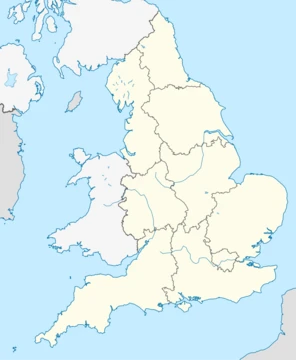
Huntingdonshire
Historic county now a district in Cambridgeshire, England.
Last updated
Where it is
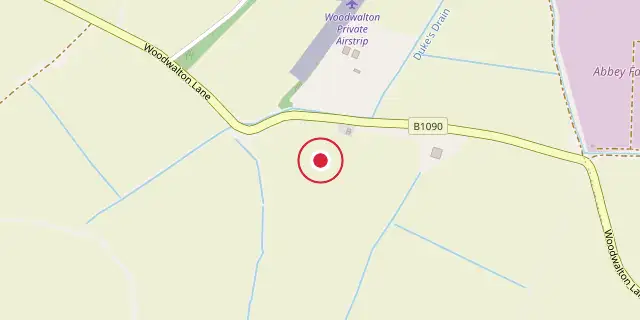
Coordinates: 52°25′01″N 0°15′00″W (52.4170, -0.2500) · Open in OpenStreetMap
Coordinates and connected clubs: the infobox of Wikipedia: Huntingdonshire (CC BY-SA 4.0). Map: drawn by Codexery from OpenStreetMap tiles.
Huntingdonshire is a local government district in Cambridgeshire, England, with a population of 180,800 at the 2021 census. Historically a county in its own right, its boundaries were established in the Anglo-Saxon era. The district council is based in Huntingdon, and the largest towns include St Neots, Huntingdon, and St Ives.
History
The area of modern Huntingdonshire was first delimited in Anglo-Saxon times, and its boundaries have remained largely unchanged since the 10th century. In 1154, Henry II declared all of Huntingdonshire a forest. Under the Local Government Act 1888, Huntingdonshire became an administrative county in 1889, with the newly-formed Huntingdonshire County Council taking over from the Quarter Sessions; the northern part around Peterborough became part of the Soke of Peterborough.
In 1965, Huntingdonshire merged with the Soke of Peterborough to form Huntingdon and Peterborough, and St Neots was expanded westwards into Eaton Ford and Eaton Socon in Bedfordshire. In 1974, Huntingdon and Peterborough merged with Cambridgeshire and Isle of Ely to form Cambridgeshire, and a Huntingdon district was created based on the former administrative county borders, excluding Old Fletton. The district was renamed Huntingdonshire on 1 October 1984.
Historical documents are held by Cambridgeshire Archives and Local Studies at the County Record Office in Huntingdon. The Local Government Boundary Commission for England considered making Huntingdonshire a unitary authority in the 1990s.
Sports
Bandy, now an Olympic-recognised sport, began in Huntingdonshire. Records from 1813 show the Bury Fen Bandy Club went undefeated for a century. In 1882, club member Charles Tebbutt drafted the sport’s first official rules and helped introduce it abroad.
Huntingdonshire County Cricket Club ranks among the 20 minor counties of English and Welsh cricket, yet it has never competed in the Minor Counties Championship. Between 1999 and 2003, it took part in England’s domestic one-day tournament, playing seven List A matches. Its final List A game was against Cheshire.
Notable people
Henry of Saltrey, a Huntingdonshire Cistercian monk, wrote Tractatus de Purgatorio Sancti Patricii around 1180–1184. Sir William Papworth of Grafham and Papworth St. Agnes was a member of five 14th-century parliaments. Catherine of Aragon, former Queen of England, died in confinement at Kimbolton Castle. Henry Brandon, 2nd Duke of Suffolk, and his brother Charles Brandon, 3rd Duke of Suffolk, died of sweating sickness at Buckden Towers within an hour of each other on 14 July 1551.
Nicholas Ferrar spent his last eleven years at the Little Gidding community, inspiration for T. S. Eliot's Four Quartets. Philip Nye, an Independent theologian, became incumbent of Kimbolton and an adviser to Cromwell. Oliver Cromwell, Lord Protector, was educated at Huntingdon Grammar School. Richard Astry was an English antiquary.
Samuel Pepys, MP and diarist, attended Huntingdon Grammar School. William Sparrow cut the turf maze at Hilton in 1660. Alice and Thomas Curwen were active as Quaker preachers in 1677–1678. Ann Jebb, political reformer and radical writer, was born at Kings Ripton.
William Henry Fellowes of Ramsey Abbey was a longstanding MP for Huntingdon and then Huntingdonshire. Olinthus Gregory, mathematician and editor, was born at Yaxley. Robert Fox, antiquary and local historian, was born and died at Godmanchester. Charles Bowen Cooke, locomotive engineer, was born at Orton Longueville.
Henry Royce, co-founder of Rolls-Royce, was born in Alwalton. Lucy M. Boston lived in Huntingdonshire from 1937 and set the Green Knowe series there. Josef Jakobs, a German spy, was captured in Ramsey Hollow in 1941. Michael Lawrence is known for the Jiggy McCue series.
John Major, Prime Minister from 1990 to 1997, was MP for Huntingdonshire from 1979 to 2001 and resides at Great Stukeley. John Butcher, Conservative MP, was raised in Huntingdonshire and attended Huntingdon Grammar School. Terry Reid, rock musician, grew up in Holywell.
Did You Know?
- Huntingdonshire District Council's headquarters are in Pathfinder House in Huntingdon.
- The district is served by BBC East and ITV Anglia from the Sandy Heath transmitting station.
- The Hunts Post is the local weekly newspaper.
Also in the Codexery
More in Regions Of England
Sources
Compiled from Wikipedia and the sources listed below. Text from Wikipedia is available under CC BY-SA 4.0; this entry is adapted from it.
- Wikipedia: Huntingdonshire (CC BY-SA 4.0).
Spotted an error? Know more?
Reader corrections go straight into our review queue. Suggest an edit · How this site is sourced