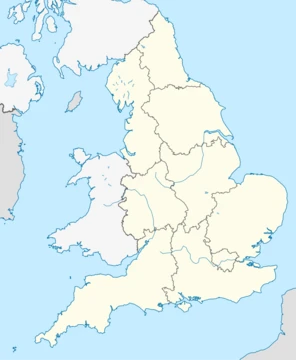
Suffolk
East Anglian county with Roman, Anglo-Saxon, and maritime heritage.
Last updated
The county has largely arable land and is known for extensive farming, as well as horse racing in Newmarket and a major container port at Felixstowe.[1] Suffolk is a county whose coastline includes deep estuaries and is backed by heath and wetland habitats.[2]
Geography and history
The Suffolk coastline is formed by London Clay and crag underlain by chalk, making it susceptible to erosion.[2] By the late 4th century, archaeological evidence suggests significant depopulation in parts of East Anglia, possibly linked to coastal raiding.[3] Heath and wetland habitats like Sandlings back large portions of the coast, and a section of the Broads national park lies in the county's northeast.[2] During the early Roman period, the Iceni tribe occupied most of Suffolk along with Norfolk, while the Trinobantes lived in parts of southern Suffolk and Essex.[4]
In AD 60–61, Boudica led the Iceni in an unsuccessful revolt.[3] Villas, small towns, and pottery kilns existed in Suffolk during the Roman period, though the area stayed mostly rural.[3]
What the cited sources add
The article adds that artefacts found included copper-alloy brooches, wrist clasps, amber and glass beads, small iron knives, and silver pennies.[5] The same report quotes Anglian Water's environment and heritage assessor saying the volume of discoveries would fill half a shipping container.[6] A 2023 news article notes that the East of England region, which includes Suffolk, is a sizeable cereals and vegetable producer, with 62% of England's sugar beet area and 28% of its wheat area.[7] A BBC News report on an excavation in Great Whelnetham states that of 52 skeletons found in a 4th-century Roman cemetery, up to 40% had been decapitated, which archaeologists called "quite a rare find".[8]
References
- Wikipedia, "Suffolk" (CC BY-SA 4.0), which cites: "Top 50 Container Ports in Europe", World Shipping Council (original not read by us) en.wikipedia.org
- Wikipedia, "Suffolk" (CC BY-SA 4.0), which cites: "Features and Habitats", coastandheaths.org (we also read that source) en.wikipedia.org
- Wikipedia, "Suffolk" (CC BY-SA 4.0), which cites: Dark, "Large-scale population movements into and from Britain south of Hadrian's Wall in the fourth to sixth centuries AD"; Dark, "Large-scale population movements into and from Britain south of Hadrian's Wall in the fourth to sixth centuries AD" (original not read by us) en.wikipedia.org
- Wikipedia, "Suffolk" (CC BY-SA 4.0), which cites: Mossop, "An Elusive Icenian Legend", Britannia, 1979, p. 258–259 (original not read by us) en.wikipedia.org
- Fox, "This Anglo-Saxon Cemetery Is Filled With Corpses' Ghostly Silhouettes", Smithsonian Magazine. facts only, no text reused. smithsonianmag.com
- "Roman skeletons discovered by Anglian Water in Barnham, Bardwell, Pakenham and Rougham", East Anglian Daily Times. facts only, no text reused. eadt.co.uk
- "Total income from farming in East of England has soared to above £1bn, figures show", 27 October 2023. facts only, no text reused. eadt.co.uk
- "Decapitated bodies found in Roman cemetery in Great Whelnetham", BBC News. facts only, no text reused. bbc.co.uk
Each numbered sentence above was checked against the source it cites before publication. Sentences citing Wikipedia adapt text from the English Wikipedia article Suffolk (contributors), used under CC BY-SA 4.0; this entry is available under the same licence. Other sources were used for facts only; no text or images are copied from them.
Also in the Codexery
More in Regions Of England
Sources
Compiled from Wikipedia and the sources listed below. Text from Wikipedia is available under CC BY-SA 4.0; this entry is adapted from it.
- Wikipedia: Suffolk (CC BY-SA 4.0).
Spotted an error? Know more?
Reader corrections go straight into our review queue. Suggest an edit · How this site is sourced