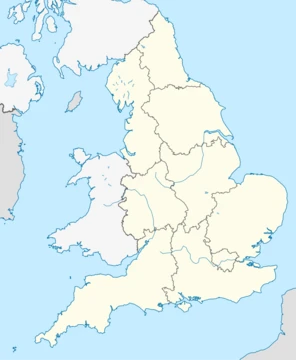
Buckinghamshire
Ceremonial county in South East England with Chiltern Hills and Milton Keynes.
Last updated
The county has a modern service-based economy and is part of the Berkshire, Buckinghamshire and Oxfordshire NUTS-2 region.[1] South East England's ceremonial county of Buckinghamshire is also referred to as Bucks.[2] The southern portion of Buckinghamshire forms a wealthy area within the London commuter belt.[1]
Geography and history
The history of the area predates the Anglo-Saxon period, with Brittonic and Roman periods, though the Anglo-Saxons had the greatest impact on the rural county.[3] The expansion of London and the railways promoted growth in towns like Aylesbury, Amersham and High Wycombe, leaving Buckingham itself a relative backwater.[4] The Chiltern Hills are the dominant landscape feature in the southern part of Buckinghamshire.[5] This migration changed the local economy and made land available at low prices while wealthy individuals had greater freedom to move.[6]
London commuters began to choose Buckinghamshire as a favored place to live.[6] Historically, the area was a center for extracting chalk and clay to manufacture bricks.[7]
What the cited sources add
The College Lake nature reserve is regarded as one of the best places in Buckinghamshire for water birds, with many hides overlooking the lake.[8] College Lake is a key breeding site in Buckinghamshire for lapwing and redshank, both rare species.[8] The Lord-Lieutenant is appointed by the King to be their personal representative in the Historic County of Buckinghamshire, which includes Milton Keynes.[9] The Lord-Lieutenant’s first and foremost duty is to uphold the dignity of the Crown.[9]
References
- Wikipedia, "Buckinghamshire" (CC BY-SA 4.0), which cites: "Regional GDP per capita in the EU25 GDP per capita in 2002 ranged from 32% of the EU25 average in Lubelskie to 315% in Inner London", Europa (web portal), 25 January 2005; Burridge, "Buckinghamshire is best county", The Independent, 29 March 2008 (original not read by us) en.wikipedia.org
- Wikipedia, "Buckinghamshire" (CC BY-SA 4.0) en.wikipedia.org
- Wikipedia, "Buckinghamshire" (CC BY-SA 4.0), which cites: "Biography of John Hampden", Johnhampden.org (original not read by us) en.wikipedia.org
- Wikipedia, "Buckinghamshire" (CC BY-SA 4.0), which cites: "About Buckingham", University of Buckingham (original not read by us) en.wikipedia.org
- Wikipedia, "Buckinghamshire" (CC BY-SA 4.0), which cites: Bathurst, "Walking the county high points of England", Summersdale, 2012, p. 105–110 (we also read that source) en.wikipedia.org
- Wikipedia, "Buckinghamshire" (CC BY-SA 4.0), which cites: "High Wycombe Local Community Area Profile", Buckinghamshire County Council, October 2008 (original not read by us) en.wikipedia.org
- Wikipedia, "Buckinghamshire" (CC BY-SA 4.0), which cites: "College Lake", BBOWT (we also read that source) en.wikipedia.org
- "College Lake", BBOWT. facts only, no text reused. bbowt.org.uk
- "The Lord-Lieutenant Buckinghamshire Lieutenancy", Buckinghamshire Lieutenancy. facts only, no text reused. buckslieutenancy.org
Each numbered sentence above was checked against the source it cites before publication. Sentences citing Wikipedia adapt text from the English Wikipedia article Buckinghamshire (contributors), used under CC BY-SA 4.0; this entry is available under the same licence. Other sources were used for facts only; no text or images are copied from them.
Also in the Codexery
More in Regions Of England
Sources
Compiled from Wikipedia and the sources listed below. Text from Wikipedia is available under CC BY-SA 4.0; this entry is adapted from it.
- Wikipedia: Buckinghamshire (CC BY-SA 4.0).
Spotted an error? Know more?
Reader corrections go straight into our review queue. Suggest an edit · How this site is sourced