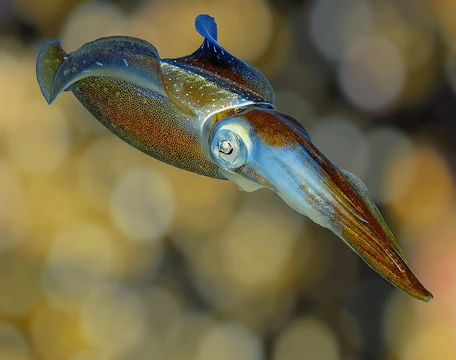
Graneledone boreopacifica
Deep-sea octopus with record 53-month egg brooding.
Last updated

NOAA/MBARI · via Wikipedia: Graneledone boreopacifica · Public domain
A female observed in the Monterey Canyon brooded eggs for a record 53 months.[1] In temperate climates, the benthic zones are where Graneledone boreopacifica, a deep-sea octopus, lives.[2] The mantle length of the holotype is 9 cm.[3]
Scientific classification
- OrderOctopoda
- FamilyMegaleledonidae
- GenusGraneledone
- SpeciesGraneledone boreopacifica
Named by Nesis, 1982
Close relatives
Other species of Graneledone with a Codexery entry.
- Graneledone yamana Graneledone yamana
Sources: Wikipedia taxobox: Graneledone boreopacifica (CC BY-SA 4.0) · order, family and genus agree with WoRMS AphiaID 342222 (CC BY 4.0)
Conservation status
Least Concern (LC)
- LC▲ this species
- NT
- VU
- EN
- CR
- EW
- EX
Source: IUCN Red List assessment · GBIF copy of the Red List category
How big is it?
Largest length in the source, 0.09 m, next to a 1.8 m person.
Diagram: drawn by Codexery, schematic shapes to scale (not a likeness). Length: Wikipedia: Graneledone boreopacifica
Where the graneledone boreopacifica has been recorded
Each dot is a place where the species has been observed and reported (89 records, half-degree grid) — not a modelled range. 1 inland record left out (institution coordinates).
Map: drawn by Codexery. Data: GBIF occurrence search (records CC0 / CC BY) · Natural Earth basemap (public domain) · place coordinates: Wikipedia (CC BY-SA 4.0)
Key facts and history
The type specimen was collected in the Pacific Ocean at 50°N, 151°E.[4] The eggs were never unattended during this period.[5] This 53-month brooding period is the longest known in the animal kingdom.[1] This brooding period alone makes it the longest-living octopus, as most live only 1 or 2 years.[5]
Saint Petersburg, Russia's Zoological Institute holds the deposited type specimen.[4] After egg-laying, females show no evidence of feeding.[1] Crushed gastropod shells from Provanna variabilis and Lepetodrilus fucensis were found in the gut during examination.[6]
What the cited sources add
The 2014 PLOS ONE study by Robison, Seibel, and Drazen documented the 53-month brooding record.[1][5] A 2000 Journal of Zoology paper by Voight described the octopus as a shell-crushing hydrothermal vent predator.[6] That paper reported the crushed gastropod shells found in the gut.[6] The same paper noted the mandible muscles' strength for crushing shells.[6]
References
- Wikipedia, "Graneledone boreopacifica" (CC BY-SA 4.0), which cites: Robison, Bruce; Seibel, Brad; Drazen, Jeffrey (2014). "Deep-Sea Octopus (Graneledone boreopacifica) Conducts the Longest-Known Egg-Brooding Period of Any Animal (original not read by us) en.wikipedia.org
- Wikipedia, "Graneledone boreopacifica" (CC BY-SA 4.0) en.wikipedia.org
- Wikipedia, "Graneledone boreopacifica" (CC BY-SA 4.0), which cites: Hochberg, F.G. 1998. Class Cephalopoda. In: P.V. Scott & J.A. Blake (Eds.) Taxonomic Atlas of the Benthic Fauna of the Santa Maria Basin and the Western Santa B (original not read by us) en.wikipedia.org
- Wikipedia, "Graneledone boreopacifica" (CC BY-SA 4.0), which cites: "Current Classification of Recent Cephalopoda" (original not read by us) en.wikipedia.org
- Wikipedia, "Graneledone boreopacifica" (CC BY-SA 4.0), which cites: Chung, Emily, "Octopus mom waits record 4.5 years for eggs to hatch", CBC News, 30 July 2014; Robison, "Deep-Sea Octopus (Graneledone boreopacifica) Conducts the Longest-Known Egg-Brooding Period of Any Animal", PLOS ONE, 2014-07-30; Robison, Bruce; Seibel, Brad; Drazen, Jeffrey (2014). "Deep-Sea Octopus (Graneledone boreopacifica) Conducts the Longest-Known Egg-Brooding Period of Any Animal (original not read by us) en.wikipedia.org
- Wikipedia, "Graneledone boreopacifica" (CC BY-SA 4.0), which cites: Voight, "A deep-sea octopus (Graneledone cf. boreopacifica) as a shell-crushing hydrothermal vent predator", Journal of Zoology, November 2000, p. 335–341 (original not read by us) en.wikipedia.org
Each numbered sentence above was checked against the source it cites before publication. Sentences citing Wikipedia adapt text from the English Wikipedia article Graneledone boreopacifica (contributors), used under CC BY-SA 4.0; this entry is available under the same licence. Other sources were used for facts only; no text or images are copied from them.
More in Reef Cephalopods
Sources
Compiled from Wikipedia and the sources listed below. Text from Wikipedia is available under CC BY-SA 4.0; this entry is adapted from it.
- Wikipedia: Graneledone boreopacifica (CC BY-SA 4.0).
- Classification: the source article's taxobox; order, family and genus checked against WoRMS, the World Register of Marine Species (CC BY 4.0).
- Conservation status: IUCN Red List assessment.
- Occurrence records: GBIF (CC0 / CC BY). Basemap: Natural Earth (public domain).
- Word definitions: the , each quoted from its Wikipedia article.
Spotted an error? Know more?
Reader corrections go straight into our review queue. Suggest an edit · How this site is sourced