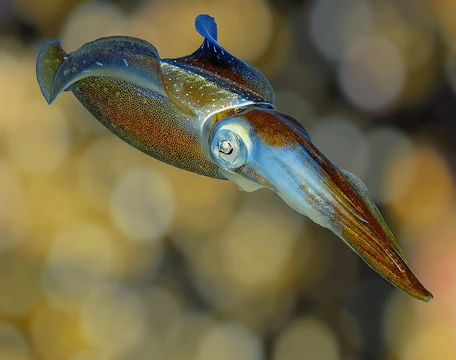
Mimic octopus
A cephalopod that impersonates multiple marine animals to evade predators.
Last updated

Steve Childs · via Wikipedia: Mimic octopus · CC BY 2.0
The Indo-Pacific region is home to the species Thaumoctopus mimicus, known as the mimic octopus.[1] With its arms included, this octopus reaches a maximum length of roughly 60 cm.[2][3] This species stands out because it can imitate many different kinds of marine life.[1] Above each eye, there is a small horn-like projection.[2]
Scientific classification
- OrderOctopoda
- FamilyOctopodidae
- GenusThaumoctopus
- SpeciesThaumoctopus mimicus
Named by Norman & Hochberg, 2005
Sources: Wikipedia taxobox: Mimic octopus (CC BY-SA 4.0) · order, family and genus agree with WoRMS AphiaID 342403 (CC BY 4.0)
Conservation status
Least Concern (LC)
- LC▲ this species
- NT
- VU
- EN
- CR
- EW
- EX
Source: IUCN Red List assessment · GBIF copy of the Red List category
How big is it?
Largest length in the source, 0.6 m, next to a 1.8 m person.
Diagram: drawn by Codexery, schematic shapes to scale (not a likeness). Length: Wikipedia: Mimic octopus
Where the mimic octopus has been recorded
Each dot is a place where the species has been observed and reported (227 records, half-degree grid) — not a modelled range. 11 inland records left out (institution coordinates).
Map: drawn by Codexery. Data: GBIF occurrence search (records CC0 / CC BY) · Natural Earth basemap (public domain) · place coordinates: Wikipedia (CC BY-SA 4.0)
Key facts and history
It has since been found to inhabit the Indo-Pacific, ranging from the Red Sea and Gulf of Oman to New Caledonia.[4] The mimic octopus has also been observed on the Great Barrier Reef, more than 2,000 kilometers from where it was first described.[5] Among the animals mimicked are lionfish, sea snake, jellyfish, and zebra sole.[6] In 1998, scientists first documented this octopus at a muddy river mouth near Sulawesi, Indonesia.[4][3]
Indonesia is the location of the majority of recorded sightings.[4] Sandy or silty seafloor areas shallower than 15 m are its main habitat.[4][3] Although its resting coloration is light brown or beige, it often displays a bold pattern of white and brown stripes to frighten predators.[2][3] The mimic octopus can assume the appearance of as many as 18 distinct marine species.[7]
There is evidence that this octopus chooses its mimicry tactic in a context-dependent, possibly intelligent, manner.[8][3]
What the cited sources add
The Maculay account notes that mimics are normally quite small, growing only up to 60 cm long, with a body covered with brown and white stripes or spots.[3] The same source states that the mimic octopus was only believed to have been officially discovered as recently as 1998, off the coast of Sulawesi in Indonesia.[3] According to Maculay, the mimic is said to live for only around 9 months.[3] Harmon also notes that the octopus "recovered quickly once moved to slightly deeper water" after being spotted in distress on a shallow sand flat.[5]
Harmon's report confirms a sighting on the Great Barrier Reef, where an adult octopus had a body length of about 10 cm.[5]
References
- Wikipedia, "Mimic octopus" (CC BY-SA 4.0), which cites: Maculay, G. (January 6, 2012). "Mimic Octopus Creature Feature - Diving with Mimics". Dive The World - Scuba Diving Vacations - Dive Travel - Diving Holidays - ; Harmon, "Mimic Octopus Makes Home on Great Barrier Reef", Scientific American Blog Network, February 21, 2013 (we also read that source) en.wikipedia.org
- Wikipedia, "Mimic octopus" (CC BY-SA 4.0), which cites: Baker, "Unusual Adaptations: Evolution of the Mimic Octopus", BioScience, 2010, p. 962 (original not read by us) en.wikipedia.org
- Maculay, G. (January 6, 2012). "Mimic Octopus Creature Feature - Diving with Mimics". Dive The World - Scuba Diving Vacations - Dive Travel - Diving Holidays - . facts only, no text reused. dive-the-world.com
- Wikipedia, "Mimic octopus" (CC BY-SA 4.0), which cites: "Mimic Octopuses, Thaumoctopus mimicus", MarineBio, January 14, 2013; Norman, "Dynamic mimicry in an Indo–Malayan octopus", Proceedings of the Royal Society of London. Series B: Biological Sciences, 2001-09-07, p. 1755–1758; Norman, M.D.; and Hochberg, F.G. (2005). "The 'mimic Octopus' (Thaumoctopus mimicus n. gen. et sp.), a new octopus from the tropical Indo-West Pacific (Cephalop; Coker, Darren J. (2013). "Documentation of the mimic octopus Thaumoctopus mimicus in the Great Barrier Reef, Australia." Marine Biodiversity Records 1-2.; Na en.wikipedia.org
- Harmon, "Mimic Octopus Makes Home on Great Barrier Reef", Scientific American Blog Network, February 21, 2013. facts only, no text reused. blogs.scientificamerican.com
- Wikipedia, "Mimic octopus" (CC BY-SA 4.0), which cites: "Mimic Octopuses", Marinebio.org (we also read that source) en.wikipedia.org
- Wikipedia, "Mimic octopus" (CC BY-SA 4.0), which cites: Balyi, "The Mimic Octopus", AIDASCO Reviews, 2024-02-02, p. 17–21 (original not read by us) en.wikipedia.org
- Wikipedia, "Mimic octopus" (CC BY-SA 4.0), which cites: John Roach, "Newfound Octopus Impersonates Fish,Snakes", 21 September 2001; Rocha, "Opportunistic mimicry by a Jawfish", Coral Reefs, 2012-03-01, p. 285 (original not read by us) en.wikipedia.org
Each numbered sentence above was checked against the source it cites before publication. Sentences citing Wikipedia adapt text from the English Wikipedia article Mimic octopus (contributors), used under CC BY-SA 4.0; this entry is available under the same licence. Other sources were used for facts only; no text or images are copied from them.
More in Reef Cephalopods
Sources
Compiled from Wikipedia and the sources listed below. Text from Wikipedia is available under CC BY-SA 4.0; this entry is adapted from it.
- Wikipedia: Mimic octopus (CC BY-SA 4.0).
- Classification: the source article's taxobox; order, family and genus checked against WoRMS, the World Register of Marine Species (CC BY 4.0).
- Conservation status: IUCN Red List assessment.
- Occurrence records: GBIF (CC0 / CC BY). Basemap: Natural Earth (public domain).
Spotted an error? Know more?
Reader corrections go straight into our review queue. Suggest an edit · How this site is sourced