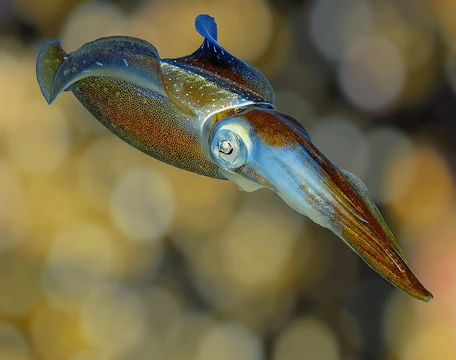
Macrotritopus defilippi
A small octopus that mimics a flounder when swimming.
Last updated

Comingio Merculiano in Jatta Giuseppe · via Wikipedia: Macrotritopus defilippi · Public domain
The marine cephalopod Macrotritopus defilippi is a diminutive octopus species referred to by the common names Lilliput longarm octopus and Atlantic longarm octopus.[1] When the octopus remains motionless on the seafloor, its yellowish-brown coloring allows it to blend in effectively with its environment.[2]
Scientific classification
- OrderOctopoda
- FamilyOctopodidae
- GenusMacrotritopus
- SpeciesMacrotritopus defilippi
Named by (Vérany, 1851)
Sources: Wikipedia taxobox: Macrotritopus defilippi (CC BY-SA 4.0) · order, family and genus agree with WoRMS AphiaID 534126 (CC BY 4.0)
Conservation status
Least Concern (LC)
- LC▲ this species
- NT
- VU
- EN
- CR
- EW
- EX
Source: IUCN Red List assessment · GBIF copy of the Red List category
How big is it?
Largest length in the source, 0.09 m, next to a 1.8 m person.
Diagram: drawn by Codexery, schematic shapes to scale (not a likeness). Length: Wikipedia: Macrotritopus defilippi
Where the macrotritopus defilippi has been recorded
Each dot is a place where the species has been observed and reported (286 records, half-degree grid) — not a modelled range. 23 inland records left out (institution coordinates).
Map: drawn by Codexery. Data: GBIF occurrence search (records CC0 / CC BY) · Natural Earth basemap (public domain)
Key facts and history
This species has a mantle length of up to 90 mm and relatively long arms.[2] Its skin is variable in colour, usually plain or speckled to match the sandy surroundings.[2] When stationary, the octopus closely matches the seabed in colour, patterning, and brightness.[2] On a seabed containing gravel, the animal's mottled pattern tends to be more pronounced, small fleshy papillae may appear, and the arms display alternating light and dark bands.[2]
Without leaving any visible sign of its location, this octopus is capable of burying itself in the substrate.[2] Larvae of Macrotritopus with notably long third arms were collected in the Caribbean, but their adult form remained a mystery until a female was successfully reared to adulthood in a lab setting.[3] When disturbed, these larvae, which float with their arms outstretched, quickly escape using jet propulsion.[3]
What the cited sources add
Based on field observations in the Caribbean, Hanlon, Watson, & Barbosa (2010) proposed that Macrotritopus defilippi imitates a flounder while swimming.[4] To avoid casting shadows, the octopus swims very close to the sand's surface, following the contours of ripples, and positions its eyes on the top side of its body to better imitate a lefteye flounder.[2][4] The plate fish (Bothus lunatus) typically swims for roughly 6 seconds, while the octopus swims for about 2 seconds; both animals then pause for 2 to 3 seconds before their next swimming burst.[4] Bacterial communities from the Flavobacteriaceae family are among the distinctive skin microbiome components found on Macrotritopus defilippi.[5][4]
References
- Wikipedia, "Macrotritopus defilippi" (CC BY-SA 4.0), which cites: Bouchet, Philippe, "Macrotritopus defilippi (Vérany, 1851)", 2013 (original not read by us) en.wikipedia.org
- Wikipedia, "Macrotritopus defilippi" (CC BY-SA 4.0), which cites: "A 'Mimic Octopus' in the Atlantic: Flatfish Mimicry and Camouflage by Macrotritopus defilippi", Biological Bulletin, 2010, p. 15–24 (original not read by us) en.wikipedia.org
- Wikipedia, "Macrotritopus defilippi" (CC BY-SA 4.0), which cites: "The "Macrotritopus problem" solved: Octopus defilippi raised from a wild-caught pelagic Macrotritopus" (original not read by us) en.wikipedia.org
- Wikipedia, "Macrotritopus defilippi" (CC BY-SA 4.0), which cites: "A 'Mimic Octopus' in the Atlantic: Flatfish Mimicry and Camouflage by Macrotritopus defilippi", Biological Bulletin, 2010, p. 15–24; Huffard, Christine L., "Locomotion by Abdopus aculeatus (Cephalopoda: Octopodidae): walking the line between primary and secondary defenses", Journal of Experimental Biology, 2006, p. 3697–3707; "A 'Mimic Octopus' in the Atlantic: Flatfish Mimicry and Camouflage by Macrotritopus defilippi", Biological Bulletin, 2010, p. 15–24 (original not read by us) en.wikipedia.org
- Wikipedia, "Macrotritopus defilippi" (CC BY-SA 4.0), which cites: Bennice, "Unique skin microbiome: insights to understanding bacterial symbionts in octopuses", Frontiers in Marine Science, 2024, p. 1448199 (original not read by us) en.wikipedia.org
Each numbered sentence above was checked against the source it cites before publication. Sentences citing Wikipedia adapt text from the English Wikipedia article Macrotritopus defilippi (contributors), used under CC BY-SA 4.0; this entry is available under the same licence. Other sources were used for facts only; no text or images are copied from them.
More in Reef Cephalopods
Sources
Compiled from Wikipedia and the sources listed below. Text from Wikipedia is available under CC BY-SA 4.0; this entry is adapted from it.
- Wikipedia: Macrotritopus defilippi (CC BY-SA 4.0).
- Classification: the source article's taxobox; order, family and genus checked against WoRMS, the World Register of Marine Species (CC BY 4.0).
- Conservation status: IUCN Red List assessment.
- Occurrence records: GBIF (CC0 / CC BY). Basemap: Natural Earth (public domain).
- Word definitions: the Codexery glossary, each quoted from its Wikipedia article.
Spotted an error? Know more?
Reader corrections go straight into our review queue. Suggest an edit · How this site is sourced