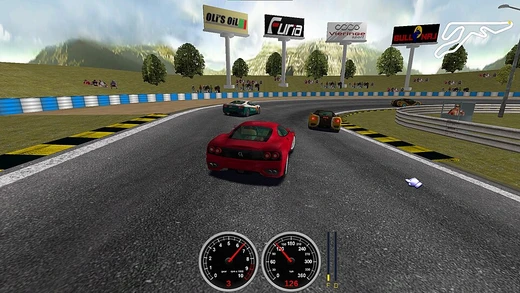
Top Gear Rally
A rally racer with realistic physics and customizable cars.
Top Gear Rally is a 1997 racing game developed by Boss Game Studios for the Nintendo 64. It follows Kemco's original Top Gear and features a championship mode across six seasons, along with split-screen multiplayer. The game combines road and off-road tracks with variable weather and car customization options.
Quick Facts
- Developer
- Boss Game Studios
- Publisher
- Midway (NA); Kemco (EU)
- Programmer
- Brian Fehdrau
- Artist
- Brian Sostrom
- Composer
- Barry Leitch
- Series
- Top Gear
- Platforms
- Nintendo 64
- Released
- September 30, 1997 (NA); November 1997 (EU)
Facts from the source article.
Gameplay
Top Gear Rally is a racing game where players drive cars on tracks that combine road and off-road surfaces. Tracks are relatively open and may include hidden shortcuts, and each can be played in sunny, nocturnal, foggy, rainy, or snowy conditions. Before a race, players can custom paint their car, select tire grips, adjust suspension stiffness and steering sensitivity, and choose manual or automatic transmission. Each car differs in acceleration, top speed, drivetrain, and engine placement, which affect handling significantly—for instance, engine placement influences how a car lands after a jump, while four-wheel drive cars have more grip on gravel. Cars can be damaged but performance is unaffected. The game has four modes: Championship, Arcade, Time Attack, and Practice. In Championship mode, a single player completes six seasons of two to four races in different weather, overtaking 19 AI opponents. Points are awarded by finishing rank; failing to meet the required points prevents progression. New cars and tracks unlock as the player advances. Nine cars and four tracks are included, plus two bonus cars and a hidden track unlocked by finishing first in every race of the last season. Mirror variants of each track can also be unlocked.
Development and release
Boss Game Studios created Top Gear Rally as the next chapter after Kemco's original Top Gear on the Super Nintendo. Work began in July 1996, sparked by a non-interactive demo built on Silicon Graphics workstations that showed two- and four-wheel drive cars tackling different surfaces. That demo, which featured vehicles made of 15,000 polygons, convinced Nintendo of America that Boss could handle a Nintendo 64 title. Even though the workstations were more powerful than the N64, Boss felt the final game would look nearly identical, claiming effects like lighting could be transferred without trouble. Sega Rally Championship served as a big influence, but the team insisted their game would have a distinct look and feel. Boss spent two to three months crafting programming tools, including a physics engine with working suspension that responds to rough terrain. Lead designer Colin Gordon noted that each car has unique shocks, brakes, and handling, making no two drive alike. Tracks were laid out to hide the game's distance fog and scenery rendering. Originally, a level editor for custom tracks and a Battle Mode inspired by Super Mario Kart's combat races were planned but cut. Multiplayer was capped at two players because four-player racing would have hurt either the draw distance or the target 30 frames per second. Without official car licenses, the vehicles were based on real models like the Ford Escort, Toyota Celica, Toyota Supra, and Porsche 959. Barry Leitch composed the soundtrack using 8-bit samples.
Reception
Top Gear Rally received generally positive reviews from critics, who considered it superior to MRC: Multi-Racing Championship. Next Generation called it a fabulous off-road racer with tons of bonus cars, courses, and replay value, stating it surpassed Sega Rally while adding its own twists. Game Informer remarked that the game feels more natural than MRC and its tracks are longer and more fun. GameSpot felt the game was too realistic and might frustrate players, but praised the graphics, physics, and track design. Edge said the game certainly has its moments but thought it inferior to high-quality rally titles. The graphics were widely praised for being clean and crisp; GameSpot noted that backgrounds and foregrounds blend in a nearly photorealistic effect and the high frame rate creates an impressive illusion of speed. N64 Magazine stated the graphics rival most arcade games of the time, while GamePro noted details like reflective mud and car damage. Some reviewers cited barren scenery and frequent texture repetition. Music and sound effects were considered weak; Nintendo Power said the soundtrack does not suit the game's fast pace. Occasional glitches were found, such as two cars overlapping when colliding and players getting stuck on slanted roadsides. Gameplay was highlighted for its fluidity and realistic feel, with N64 Magazine highly praising the suspension physics. Critics agreed that the Championship mode starts slow and controls require practice, but the game becomes more fun and challenging as players unlock powerful cars. Track length and varied weather were also highlighted. The split-screen multiplayer was criticized for a black area on the right side of the screen containing the HUD, leaving a small viewing area, and for not allowing both players to race against computer opponents.
PC port
In 1999, Boss brought the game to Windows under the name Boss Rally, since Kemco held the Top Gear trademark. This version includes three extra cars and one more track than the Nintendo 64 original. Players can choose from Championship, Time Attack, or Quick Race modes, the last being a single race against a computer rival. An eight-player multiplayer option is also available.
More in Racing Games of the 1990s
Spotted an error? Know more?
Reader corrections go straight into our review queue. Suggest an edit · How this site is sourced