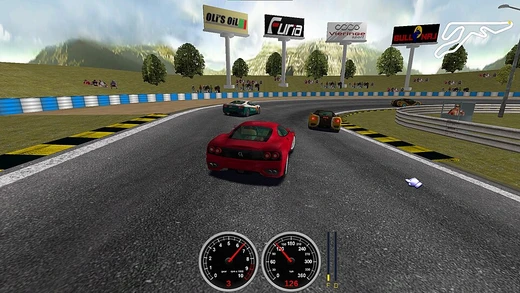
Test Drive 4
A 1997 racer with checkpoints, traffic, and police chases.
In 1997, Pitbull Syndicate and Accolade released Test Drive 4 for PlayStation and Windows. Players race 14 supercars and muscle cars through real-world tracks mixing rural roads and city streets. The game’s strong sales briefly made Test Drive the top-selling racing series, despite mixed critical reception.
Quick Facts
- Developer
- Pitbull Syndicate
- Publisher
- Accolade
- Producer
- Slade Anderson, Chris Downend
- Platforms
- PlayStation, Windows
- Series
- Test Drive
- Genre
- Racing
- Modes
- Single-player, multiplayer
Facts from the source article.
Gameplay
Test Drive 4 puts players behind the wheel of 14 supercars and muscle cars, racing against computer-controlled opponents across five real-world locations: Keswick, Cumbria; San Francisco; Bern; Kyoto; and Washington, D.C. The Windows version adds a sixth track in Munich. Each course is a long mix of rural roads and city streets, often filled with traffic and tight corners. To keep racing, players must hit checkpoint banners labeled "Stage 1" or "Stage 2" before a timer runs out, which adds more time; crossing the finish line ends the race. Police cars will chase and stop anyone speeding, but drivers can avoid this by pulling over in front of the cop or simply outrunning them. Only a handful of cars are available at the start; the rest must be won or bought. Single-player offers Single Race, Cup, and Drag Race modes. Multiplayer options vary by platform: the Windows version supports serial, modem, and LAN connections, while the PlayStation version uses the PlayStation Link Cable.
Development and release
In late 1996, eight veteran programmers and artists formed the English studio Pitbull Syndicate. The following year, they worked with publisher Accolade to create Test Drive 4. Accolade’s president, Jim Barnett, said the game used 3D graphics to deliver a satisfying driving feel. The fourteen cars in the game were officially licensed from manufacturers like Chrysler, which owned both Dodge and Plymouth. Instead of the usual multi-lap circuits, Test Drive 4 offered only linear point-to-point courses. Its tracks were built to resemble real locations, including Kyoto, Japan, and Washington, DC. The game’s techno soundtrack featured licensed tracks from Orbital and The Younger, Younger 28’s; Accolade executive producer Chris Downend felt these bands matched the game’s high-energy style.
Test Drive 4 appeared at the 1997 Electronic Entertainment Expo, where Accolade announced a November launch. Before the game was finished, the company spent $2 million on promotion. TV ads ran on ESPN, Speedvision, and MTV during the last two weeks of November, and radio spots aired on The Howard Stern Show in December. Accolade vice president Stan Roach said the company expected Test Drive 4 to be the top-selling racing game of the winter and its own most successful product in years. He noted these ads were the first broadcast media deals Accolade had made since the 16-bit era. The game came out on November 3 for PlayStation and November 24 for Windows. The Windows version had two editions: one that worked with 3dfx video cards and another that used a software renderer. Electronic Arts brought the PlayStation version to Japan on April 2, 1998.
Reception
As of March 1998, the game had sold over 850,000 copies, leading to its PlayStation version being republished under the Greatest Hits label. Accolade stated that the commercial success of Test Drive 4 and Test Drive: Off-Road made Test Drive the top-selling racing series at the time. Reviews were divergent, ranging from mediocre to moderately positive. Electronic Gaming Monthly and GameSpot reviewers felt the oncoming cars and police cars livened up the action and were distinctive to the series, but Next Generation found them irritating and unfairly difficult due to sensitive steering, concluding that without hazards the game might have been decent. Most critics cited sensitive controls as a problem, especially at high speed. IGN's Jaz Rignall noted that the car's weight-shift response is not fluid, making it difficult to avoid spinning out once control is lost, and said the controls kept the game from being great. Kelly Rickards and Kraig Kujawa of EGM and Glenn Rubenstein of GameSpot instead felt the gameplay was too basic and generic to stand out, though Rickards compared it positively to Need for Speed II. Rickards and others praised the clash of modern cars with 1960s muscle cars, diverse locales, and the drag strip. Rubenstein acknowledged the drag strip as a unique feature in an otherwise generic game.
More in Racing Games of the 1990s
Spotted an error? Know more?
Reader corrections go straight into our review queue. Suggest an edit · How this site is sourced