Terracotta Army
Terracotta sculptures buried to protect China's first emperor in the afterlife.
Last updated

via Wikipedia: Terracotta Army · see source
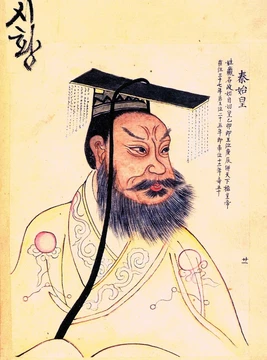
The Terracotta Army is a group of clay statues buried with China’s first emperor, Qin Shi Huang, in his tomb around 210–209 BCE to guard him in the afterlife. Made in the late 200s BCE, the figures were found in 1974 by farmers digging a well near Xi’an.
The statues range in height by rank, with generals being the tallest, and include soldiers, chariots, and horses. As of 2007, three pits held over 8,000 soldiers, 130 chariots with 520 horses, and 150 cavalry horses, most still in place. Other pits have since yielded non-military figures like officials, acrobats, strongmen, and musicians.
History
Work on the mausoleum began in 246 BCE, soon after Emperor Qin (then aged 13) succeeded his father as King of Qin, and the historian Sima Qian (145–90 BCE) wrote in the Records of the Grand Historian that the project eventually involved 700,000 conscripted workers. Geographer Li Daoyuan, writing six centuries after the first emperor's death, recorded in Shui Jing Zhu that Mount Li was a favoured location due to its auspicious geology: 'famed for its jade mines, its northern side was rich in gold, and its southern side rich in beautiful jade; the first emperor, covetous of its fine reputation, therefore chose to be buried there.'
Sima Qian wrote that the first emperor was buried with palaces, towers, officials, valuable artifacts and wondrous objects, including 100 flowing rivers simulated using mercury, with the ceiling decorated with heavenly bodies and below them the features of the lands of China which the emperor had unified. The original text makes no mention of the terracotta army. High levels of mercury detected in the soil of the tomb mound following the discovery of the mausoleum site have since given credence to Sima Qian's account.
The emperor is also documented for building monumental statues in human form during his reign, such as the Twelve Metal Colossi. Later historical accounts have suggested that the mausoleum complex and tomb itself had been looted by Xiang Yu, a contender for the throne after the death of the first emperor, though there are indications that the tomb itself may not have been plundered.
Excavation site
Four main pits approximately 7 m deep have been uncovered in the site excavations, located approximately 1500 m east of the burial mound. The soldiers within were laid out as if to protect the tomb from the east, where the Qin Emperor's conquered states lay. Pit 1, which is 230 m long and 62 m wide, contains the main army of more than 3,000 figures. It has eleven parallel corridors, most more than 3 m wide and paved with small bricks with a wooden ceiling supported by large beams and posts.
The wooden ceilings were covered with reed mats and layers of clay for waterproofing, and then mounded with more soil raising them about 2 to 3 m above the surrounding ground level when completed. Pit 2 has cavalry and infantry units as well as war chariots and is thought to represent a military guard. Pit 3 is the command post, with high-ranking officers and a war chariot. Pit 4 is empty, perhaps left unfinished by its builders.
Some of the figures in Pits 1 and 2 show fire damage, while the remains of burnt ceiling rafters have also been found. These, together with the missing weapons, have been taken as evidence of the reported looting by Xiang Yu and the subsequent burning of the site, which is thought to have caused the roof to collapse and crush the army figures below. Other pits that formed the necropolis have also been excavated, lying within and outside the walls surrounding the tomb mound.
They variously contain bronze carriages, terracotta figures of entertainers such as acrobats and strongmen, officials, stone armour suits, burial sites of horses, rare animals and labourers, as well as bronze cranes and ducks set in an underground park.
Warrior figures
The terracotta figures are life-sized, typically ranging from 1.75 metre to about 2 m (the officers are typically taller). They vary in height, uniform, and hairstyle in accordance with their portrayed rank. Their faces appear to be different for each individual figure. Scholars have identified 10 base facial forms which were then further developed to give each figure individuality in terms of facial morphology.
The figures are of these general types: armored infantry; unarmored infantry; cavalrymen who wear a pillbox hat; helmeted drivers of chariots with more armor protection; spear-carrying charioteers; kneeling crossbowmen or archers who are armored; standing archers who are not; as well as generals and other lower-ranking officers. There are many variations in the uniforms within the ranks: for example, some may wear shin pads while others not; they may wear either long or short trousers, some of which may be padded; and their body armors vary depending on rank, function, and position in formation.
There are also terracotta horses placed among the warrior figures. Originally, the figures were painted with ground precious stones, fired bones, and various pigments including iron oxide, cinnabar, malachite, azurite, charcoal, Chinese purple, and tree sap. The colored lacquer finish and individual facial features gave a realistic feel. However, in Xi'an's dry air, the lacquer covering the paint can curl in fifteen seconds once exposed and can flake off in just four minutes.
Exhibitions
Between 2003 and 2004, 120 real-size replicas were displayed in Frankfurt am Main, Munich, Oberhof, Berlin at the Palace of the Republic, and Nuremberg. Warriors and artifacts were exhibited at the Forum de Barcelona from 9 May to 26 September 2004, their most successful exhibition ever, and then at the Fundación Canal de Isabel II in Madrid from October 2004 to January 2005, also their most successful.
Did You Know?
- The Terracotta Army was discovered on 29 March 1974 by a group of farmers—Yang Zhifa, his five brothers, and neighbour Wang Puzhi—who were digging a well approximately 1.5 km east of the Qin Emperor's tomb mound at Mount Li.
- High levels of mercury detected in the soil of the tomb mound have given credence to Sima Qian's account of 100 flowing rivers simulated using mercury in the tomb.
More in Qin Shi Huang
Sources
Compiled from Wikipedia and the sources listed below. Text from Wikipedia is available under CC BY-SA 4.0; this entry is adapted from it.
- Wikipedia: Terracotta Army (CC BY-SA 4.0).
Spotted an error? Know more?
Reader corrections go straight into our review queue. Suggest an edit · How this site is sourced