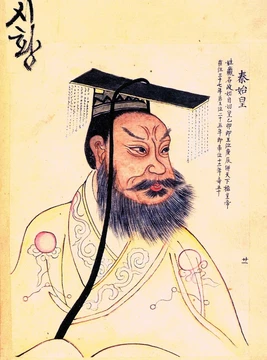
Mausoleum of Qin Shi Huang
Tomb complex of China's first emperor, with the Terracotta Army.
Last updated
Where it is
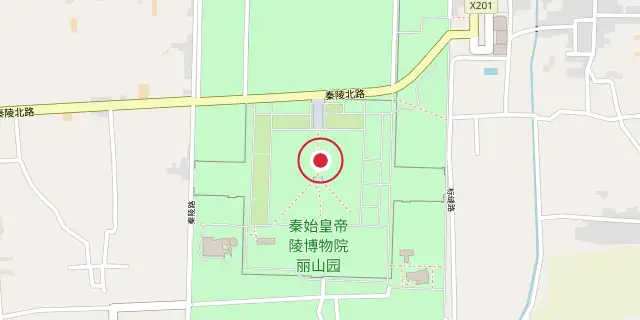
Coordinates: 34°22′55″N 109°15′14″E (34.3820, 109.2540) · Open in OpenStreetMap
Coordinates and connected clubs: the infobox of Wikipedia: Mausoleum of Qin Shi Huang (CC BY-SA 4.0). Map: drawn by Codexery from OpenStreetMap tiles.
The Mausoleum of Qin Shi Huang is a tomb complex built for the first emperor of the Qin dynasty, located in modern-day Lintong District in Xi'an, Shaanxi. Constructed over 38 years from 246 to 208 BC, it lies beneath a 76-meter tomb mound shaped like a truncated pyramid. The site is notable for its vast necropolis, including the Terracotta Army, which remains partially excavated.
History
Work on the mausoleum began soon after Emperor Qin ascended the throne in 246 BCE at age 13, but full-scale construction started after he unified China in 221 BCE. It was completed in 208 BCE, about 39 years after work started. Geographer Li Daoyuan, writing six centuries after the emperor's death, recorded in Shui Jing Zhu that Mount Li was chosen for its auspicious geology, being famed for jade mines with gold on its northern side and jade on its southern side.
Sima Qian's Records of the Grand Historian, written in the first century BCE, describes the tomb's construction, including claims of digging through three layers of groundwater, which some scholars consider figurative. The term for 'man-fish' in the text is uncertain, with interpretations ranging from whale to walrus. Before completion, a peasant rebellion broke out, and Zhang Han redeployed the 700,000 builders to suppress it, halting construction.
After Xiang Yu entered Xianyang, he was said to have looted the tomb, and a shepherd later allegedly burned it with a torch while searching for sheep. No solid evidence of destruction has been found, though fire damage appears in the Terracotta Army pits; some scholars believe the mausoleum avoided large-scale destruction.
Discovery of the Terracotta Army
In March 1974, Yang Zhifa, his five brothers, and Wang Puzhi discovered fragments of warriors and bronze arrowheads while digging a well in Xiyang, Lintong county. At about two meters deep, they found hardened dirt, red earthenware, terracotta fragments, bronze arrowheads, and terracotta bricks. Yang Zhifa discarded terracotta fragments and sold the arrowheads to a commercial agency; other villagers used terracotta bricks as pillows. Hydraulic works manager Fang Shumiao suggested selling the finds to the district cultural centre.
Yang Zhifa received 10 yuan for two carts of fragments. Zhao Kangmin, the cultural centre's director, bought all uncovered items and repurchased the arrowheads. Scientific exploration indicates many metal substances in the underground palace and a good drainage system. The palace's depth is debated, with estimates from 20 to 50 meters; some scholars consider the 'crossing three springs' claim false.
In May 1974, Shaanxi archaeologists began excavating what became Pit 1. Pit 2 was discovered by drilling in May 1976, and Pit 3 in July. Large structures were erected to protect the pits, the first finished in 1979. By 2008, a necropolis of six hundred pits was uncovered, some kilometers from the tomb mound.
Archaeological studies
The necropolis complex is a microcosm of the emperor's empire and palace, with the tomb mound at the center. Two walls, inner and outer, surround the mound, with pits containing figures and artifacts inside and outside them. West inside the inner wall, bronze chariots and horses were found, along with terracotta figures of courtiers and bureaucrats. Outside the inner wall but inside the outer wall, pits yielded terracotta entertainers, strongmen, and a stone suit of armour.
North of the outer wall, an imperial park contained bronze cranes, swans, ducks, and groups of musicians. Outside the outer walls, imperial stables held real horses with kneeling terracotta grooms. West of the complex, mass burial grounds for labourers were found. The Terracotta Army lies about 1.5 km east of the tomb mound.
The tomb mound remains largely unexcavated, but surveys and magnetic anomaly studies indicate a 4-meter-high brick perimeter wall, 460 meters north-south and 390 meters east-west, serving as the underground palace wall. Above is a rammed-earth enclosing wall 30–40 meters high.
Sloping passageways lead to the four walls; the west passage connects to the bronze chariot pit. The tomb chamber is 80 meters east-west, 50 meters north-south, and about 15 meters high. Academic estimates of the palace's depth range from 20 to 50 meters.
Opinions on possible excavation
Since 1976, some scholars have proposed exploring the underground palace to protect relics from seismic activity, develop tourism, and prevent grave robbery. Opponents argue that current technology cannot handle the palace's scale, noting that archaeologists initially failed to preserve the painted coating on Terracotta Army figures, which shed rapidly when exposed to air. The State Administration of Cultural Heritage indicated that research and evaluations should precede any protection plan, and rejected a proposal to excavate a nearby tomb thought to belong to the emperor's grandson due to fears of damaging the main mausoleum.
More in Qin Shi Huang
Sources
Compiled from Wikipedia and the sources listed below. Text from Wikipedia is available under CC BY-SA 4.0; this entry is adapted from it.
- Wikipedia: Mausoleum of Qin Shi Huang (CC BY-SA 4.0).
Spotted an error? Know more?
Reader corrections go straight into our review queue. Suggest an edit · How this site is sourced