Qin campaign against the Baiyue
Qin conquest of southern China's Baiyue tribes.
Last updated
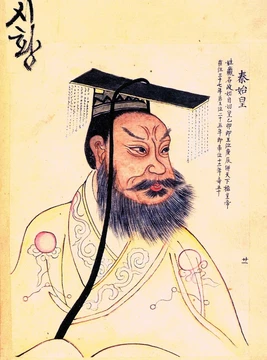
The Qin campaign against the Baiyue was a series of military expeditions launched by Emperor Qin Shi Huang to conquer the coastal southern China region known as Lingnan. The campaigns were driven by the region's temperate climate, fertile fields, maritime trade routes, and access to luxury tropical products from Southeast Asia. After five successive excursions, the Qin finally defeated the Yue in 214 BC.
Background
After Qin Shi Huang defeated the state of Chu in 223 BC, the Qin dynasty in 221 BC undertook a military campaign against the Baiyue in Lingnan. The emperor ordered armies of five hundred thousand men to advance southward in five columns to conquer and annex the Yue territories.
Another account states one hundred thousand people in armies was the maximum, including those transporting provisions and maintaining roads. The Lingnan population at the time numbered one hundred thousand at the maximum. The region's vast geography and rich natural endowment of exotic products motivated the emperor to secure his northern boundaries with a fraction of the army while devoting a large majority towards the south.
Campaigns
After taking the Yue state in northern Zhejiang, Qin Shi Huang pushed into southern Zhejiang, Jiangxi, and Fujian. The East Ou and Minyue peoples in Fujian submitted as vassals. Tougher opposition came from the Southern Yue in Guangdong and Guangxi. A Qin army of 500,000 was sent against the West Ou in Guangxi.
Three years in, Qin troops killed the West Ou chief Yiyusong, but the West Ou fought back with guerrilla tactics and killed the Qin commander Tu Sui. Unfamiliar with the jungle, the Qin force was nearly wiped out, losing over 10,000 men.
Despite these losses, the central government started pushing policies to assimilate the Yue tribes through sinicization. The Qin built the Lingqu Canal, linking the Xiang River to the Li River, to supply and reinforce troops for a renewed southern campaign. This canal also moved military supplies and prisoners into the Lingnan region, helping secure and extend Qin territory.
Post Qin
Following the collapse of the Qin dynasty, the Qin Chinese renegade general Zhao Tuo took control of Guangzhou and extended his territory south of the Red River. In 208 BC, Zhao Tuo reached Cổ Loa Citadel, capital of the state of Âu Lạc, defeated An Dương Vương, and established the Nanyue kingdom. Zhao partitioned Au Lac into two prefectures, Jiaozhi and Jiuzhen, and established his capital at Panyu, dividing his empire into seven provinces administered by a mix of Han Chinese and Yue feudal lords.
By the end of the Qin dynasty, Zhao Tuo claimed independence and declared himself emperor of Nanyue in 207 BC. At its height, Nanyue was the strongest of the Yue states, with Zhao receiving allegiance from neighboring kings. Zhao opened Guangxi and southern China to immigration of hundreds of thousands of Han Chinese. Prior to the Qin conquest, modern Southern China was inhabited by diverse non-Han tribal groups including the Baiyue, regarded by incoming Han Chinese immigrants as foreign and barbarian.
During Han Wudi's reign in 111 BC, a Han dynasty expedition conquered and annexed Nanyue, with two Nanyue legates offering acceptance of annexation and providing tokens of submission.
More in Qin Shi Huang
Sources
Compiled from Wikipedia and the sources listed below. Text from Wikipedia is available under CC BY-SA 4.0; this entry is adapted from it.
- Wikipedia: Qin campaign against the Baiyue (CC BY-SA 4.0).
Spotted an error? Know more?
Reader corrections go straight into our review queue. Suggest an edit · How this site is sourced