Poisson distribution
Last updated

Sergio01 · CC BY-SA 3.0
Its expected value and variance are both equal to the parameter λ.[1] It is a maximum-entropy distribution among generalized binomial distributions with mean λ as the number of trials approaches infinity.[2] The Poisson distribution is used to model the number of events that occur within a fixed interval when those events happen at a constant average rate, as illustrated by the example of counting radioactive decay events over a set observation period.[3][4]
Quick Facts
- Field
- Probability theory and statistics
Facts from the source article.
Key facts and history
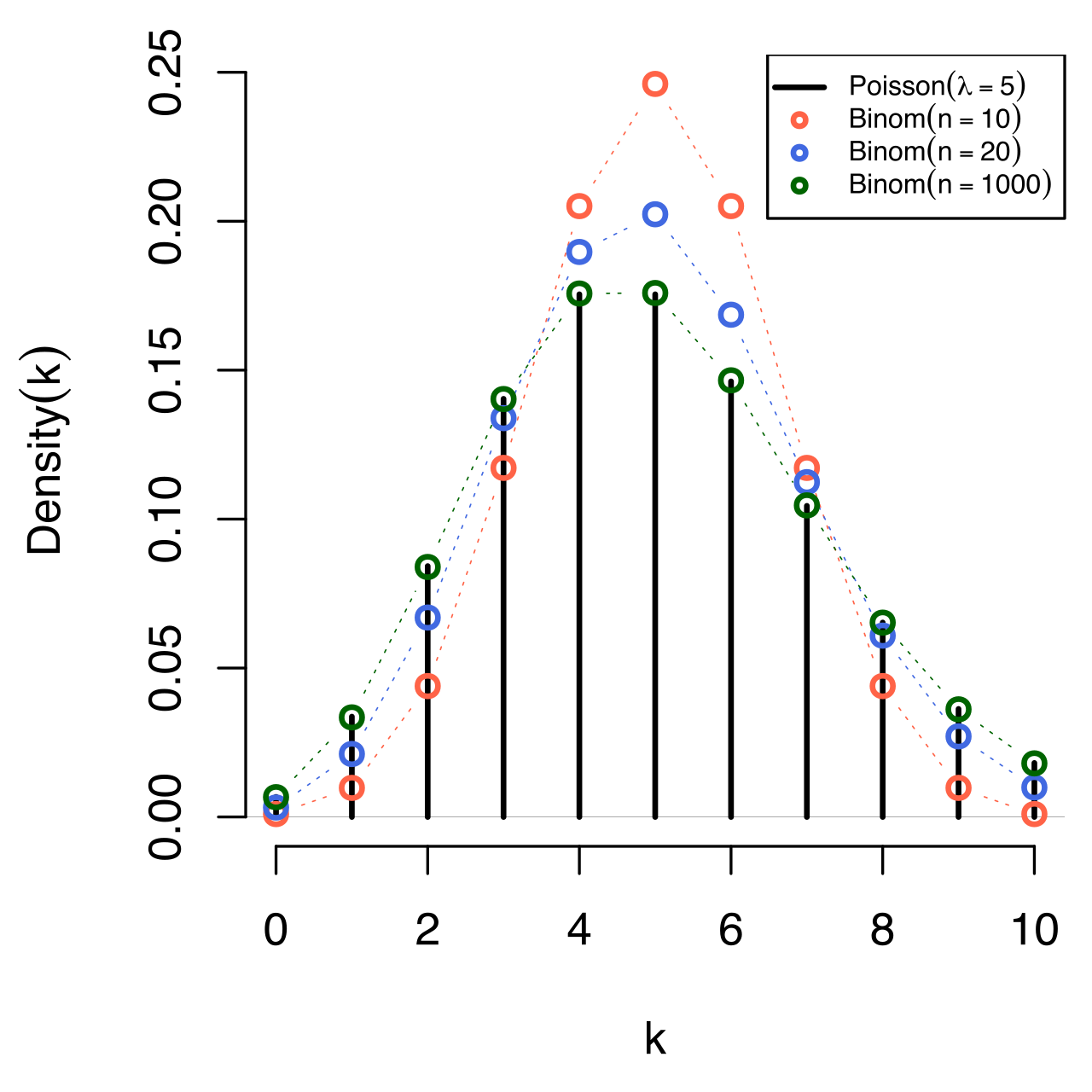
The distribution can be adapted using an average rate r, where λ = r t for interval length t.[4] The Poisson distribution is the limit of a binomial distribution as the number of trials n goes to infinity while the expectation λ remains constant.[5] It can also be derived from differential equations.[6] Examples of random points in space include locations of asteroid impacts and imperfections in a material.[7]
The maximum likelihood estimate of the parameter λ is the sample mean, which is unbiased and efficient.[8] In free probability theory, the free Poisson distribution emerges as the limit of the repeated free convolution of a specific two-point measure as the number of terms goes to infinity.[9]
What the research sources say
The same source gives values of important transforms of the free Poisson law.[10][11] The measure for the free Poisson law, which includes a point mass at zero when the parameter λ is between 0 and 1, is given by a specific formula.[12]
References
- Wikipedia, "Poisson distribution" (CC BY-SA 4.0), which cites: For the proof, see: Proof wiki: expectation and Proof wiki: variance (original not read by us) en.wikipedia.org
- Wikipedia, "Poisson distribution" (CC BY-SA 4.0), which cites: Harremoes, "Binomial and Poisson distributions as maximum entropy distributions", IEEE Transactions on Information Theory, July 2001, p. 2039–2041 (original not read by us) en.wikipedia.org
- Wikipedia, "Poisson distribution" (CC BY-SA 4.0), which cites: Ross, "Introduction to Probability Models", Academic Press, 2014 (original not read by us) en.wikipedia.org
- Wikipedia, "Poisson distribution" (CC BY-SA 4.0), which cites: Kardar, "Statistical Physics of Particles", Cambridge University Press, 2007, p. 42 (original not read by us) en.wikipedia.org
- Wikipedia, "Poisson distribution" (CC BY-SA 4.0), which cites: Pitman, "Probability", Springer, 1993, p. 118; Hsu, "Theory and Problems of Probability, Random Variables, and Random Processes", McGraw Hill, 1996, p. 68 (original not read by us) en.wikipedia.org
- Wikipedia, "Poisson distribution" (CC BY-SA 4.0), which cites: Arfken, "Mathematical Methods for Physicists Sixth Edition", Elsevier Academic Press, 2005, p. 1131; Cowan, "Derivation of the Poisson distribution", 2009; Joyce, "The Poisson process", 2014 (original not read by us) en.wikipedia.org
- Wikipedia, "Poisson distribution" (CC BY-SA 4.0), which cites: Dekking, "A Modern Introduction to Probability and Statistics", 2005, p. 167 (original not read by us) en.wikipedia.org
- Wikipedia, "Poisson distribution" (CC BY-SA 4.0), which cites: Van Trees, "Detection estimation and modulation theory.", 2013 (original not read by us) en.wikipedia.org
- Wikipedia, "Poisson distribution" (CC BY-SA 4.0), which cites: Free Random Variables by D. Voiculescu, K. Dykema, A. Nica, CRM Monograph Series, American Mathematical Society, Providence RI, 1992 (original not read by us) en.wikipedia.org
- Wikipedia, "Poisson distribution" (CC BY-SA 4.0), which cites: Lectures on the Combinatorics of Free Probability by A. Nica and R. Speicher, pp. 203–204, Cambridge Univ. Press 2006 (original not read by us) en.wikipedia.org
- Alexandru Nica, Roland Speicher: Lectures on the Combinatorics of Free Probability. London Mathematical Society Lecture Note Series, Vol. 335, Cambridge Un. facts only, no text reused. rolandspeicher.com
- Wikipedia, "Poisson distribution" (CC BY-SA 4.0), which cites: Alexandru Nica, Roland Speicher: Lectures on the Combinatorics of Free Probability. London Mathematical Society Lecture Note Series, Vol. 335, Cambridge Un (we also read that source) en.wikipedia.org
Each numbered sentence above was checked against the source it cites before publication. Sentences citing Wikipedia adapt text from the English Wikipedia article Poisson distribution (contributors), used under CC BY-SA 4.0; this entry is available under the same licence. Other sources were used for facts only; no text or images are copied from them.
More in Probability & Statistics
Sources
Compiled from Wikipedia and the sources listed below. Text from Wikipedia is available under CC BY-SA 4.0; this entry is adapted from it.
- Wikipedia: Poisson distribution (CC BY-SA 4.0).
- Word definitions: the Codexery glossary, each quoted from its Wikipedia article.
Spotted an error? Know more?
Reader corrections go straight into our review queue. Suggest an edit · How this site is sourced