Poisson point process
Last updated

Grap-wh · CC0
A Poisson point process is a mathematical object consisting of points randomly located on a space, where points occur independently of one another.[1] Siméon Denis Poisson, a French mathematician, is the namesake of both the process and the distribution.[2]
Quick Facts
- Type
- Mathematical object (point process)
Facts from the source article.
Key facts and history
In queueing theory, it models random events distributed in time, such as customer arrivals or phone calls.[3] In the plane, the spatial Poisson process can represent locations of scattered objects like wireless transmitters or trees in a forest.[4] The time differences between events of the counting process are exponential variables with mean 1/λ.[5] Multiple independent discoveries of the Poisson point process occurred across radioactive decay studies, telephone call arrival analysis, and actuarial work.[2]
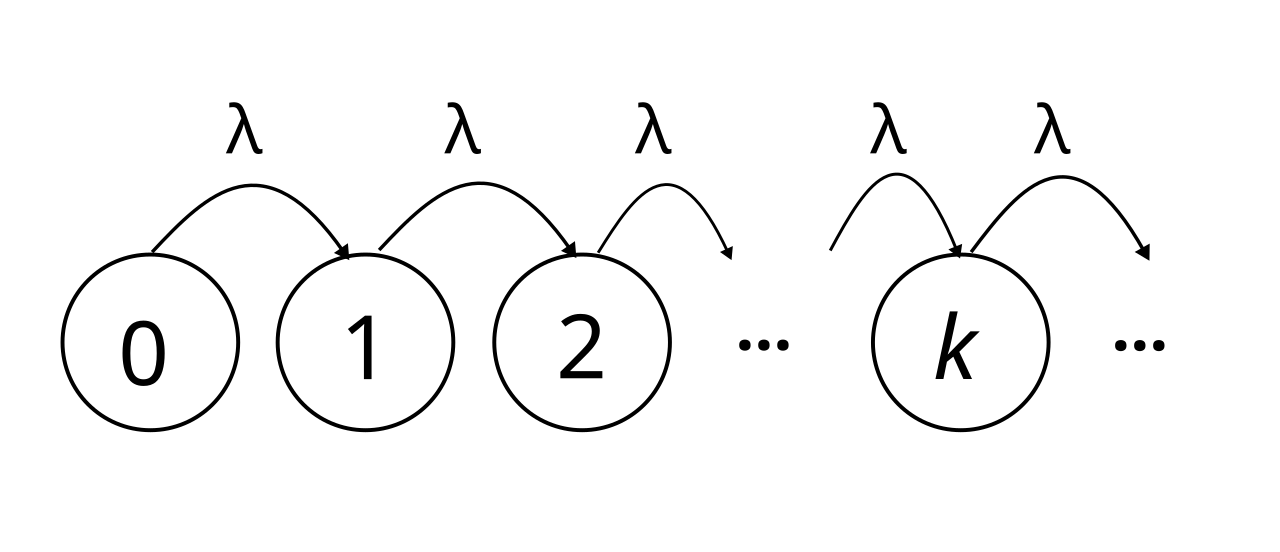
If the average density varies with location, the process is labeled inhomogeneous or nonhomogeneous.[6]
What the research sources say
The Open Library record for ISBN 9780471491101 lists "Queueing systems." as a 417-page work published by Wiley in 1974.[7]
References
- Wikipedia, "Poisson point process" (CC BY-SA 4.0), which cites: "Stochastic Geometry and Its Applications", John Wiley & Sons, 27 June 2013 (original not read by us) en.wikipedia.org
- Wikipedia, "Poisson point process" (CC BY-SA 4.0), which cites: Stirzaker, "Advice to Hedgehogs, or, Constants Can Vary", The Mathematical Gazette, 2000, p. 197–210; Guttorp, "What Happened to Discrete Chaos, the Quenouille Process, and the Sharp Markov Property? Some History of Stochastic Point Processes", International Statistical Review, 2012, p. 253–268 (original not read by us) en.wikipedia.org
- Wikipedia, "Poisson point process" (CC BY-SA 4.0), which cites: Leonard Kleinrock, "Queueing Systems: Theory", Wiley, 1976 (we also read that source) en.wikipedia.org
- Wikipedia, "Poisson point process" (CC BY-SA 4.0), which cites: "Stochastic Geometry: Lectures given at the C.I.M.E. Summer School held in Martina Franca, Italy, September 13–18, 2004", Springer, 26 October 2006, p. 10; F. Baccelli and B. Błaszczyszyn. Stochastic Geometry and Wireless Networks, Volume II- Applications, volume 4, No 1–2 of Foundations and Trends in Networking. N; J. G. Andrews, R. K. Ganti, M. Haenggi, N. Jindal, and S. Weber. A primer on spatial modeling and analysis in wireless networks. Communications Magazine, IEEE, ; F. Baccelli and B. Błaszczyszyn. Stochastic Geometry and en.wikipedia.org
- Wikipedia, "Poisson point process" (CC BY-SA 4.0), which cites: H. C. Tijms, "A First Course in Stochastic Models", John Wiley & Sons, 18 April 2003; Sheldon M. Ross, "Stochastic processes", Wiley, 1996, p. 64; H. C. Tijms, "A First Course in Stochastic Models", John Wiley & Sons, 18 April 2003 (original not read by us) en.wikipedia.org
- Wikipedia, "Poisson point process" (CC BY-SA 4.0), which cites: "Stochastic Geometry and Its Applications", John Wiley & Sons, 27 June 2013, p. 41–42; Daley Vere-Jones 2003; Kingman 1992; Kingman 1992 (original not read by us) en.wikipedia.org
- Open Library record, ISBN 9780471491101 ("Queueing systems."). CC0 (metadata); book content not read. openlibrary.org
Each numbered sentence above was checked against the source it cites before publication. Sentences citing Wikipedia adapt text from the English Wikipedia article Poisson point process (contributors), used under CC BY-SA 4.0; this entry is available under the same licence. Other sources were used for facts only; no text or images are copied from them.
More in Probability & Statistics
Sources
Compiled from Wikipedia and the sources listed below. Text from Wikipedia is available under CC BY-SA 4.0; this entry is adapted from it.
- Wikipedia: Poisson point process (CC BY-SA 4.0).
- Word definitions: the Codexery glossary, each quoted from its Wikipedia article.
Spotted an error? Know more?
Reader corrections go straight into our review queue. Suggest an edit · How this site is sourced