Probability mass function
Last updated

HB · CC BY-SA 4.0
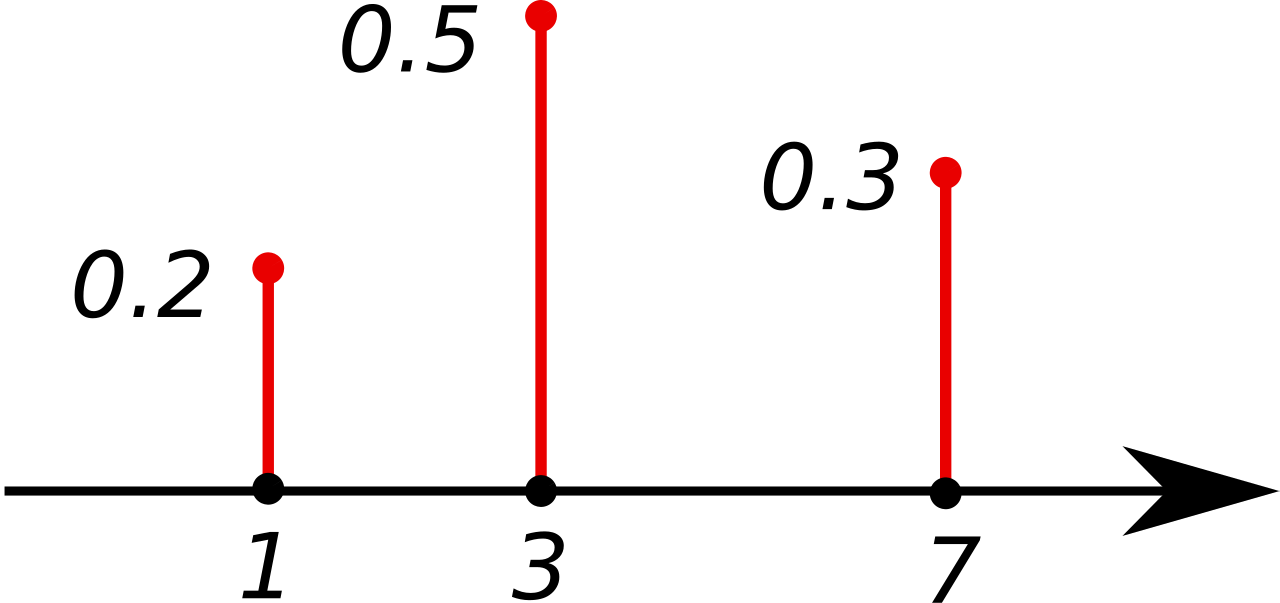
For a discrete random variable, the probability mass function returns the chance that the variable takes a particular value.[1] Alternate names for this function include probability function, frequency function, and discrete probability density function.[1] Unlike a probability mass function, a continuous probability density function requires integration across an interval to obtain a probability.[2]
Quick Facts
- Field
- Probability and statistics
- Related concept
- Mode (value of the random variable having the largest probability mass)
Facts from the source article.
Key facts and history
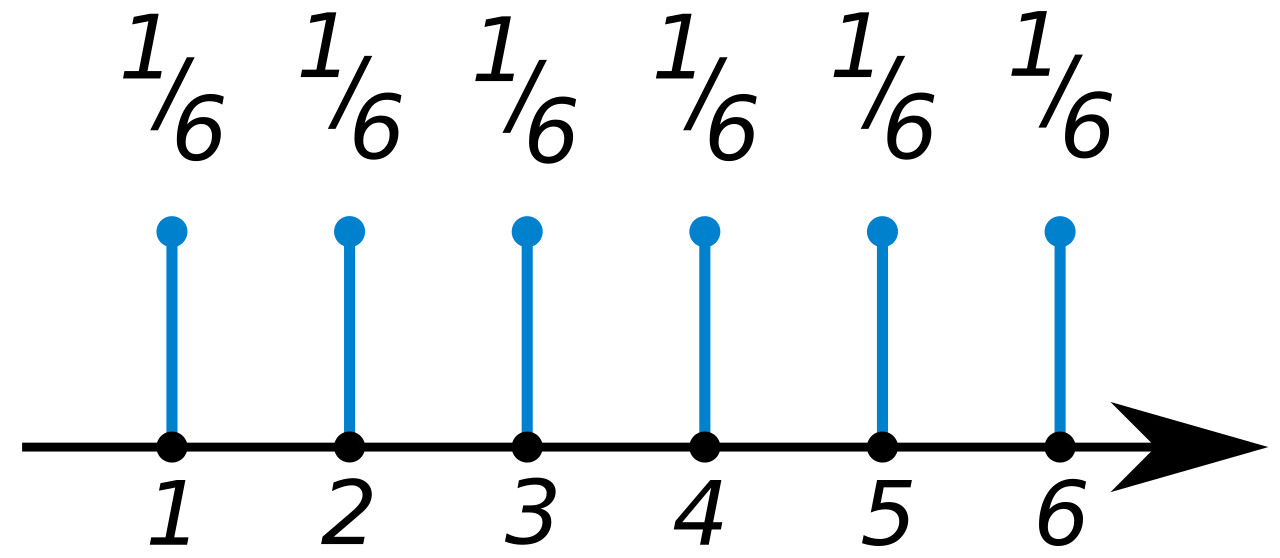
The probability mass function is defined for a discrete random variable X as p_X(x) = P(X = x).[3] The function assigns probabilities to each possible value of the discrete random variable.[1] The term "probability mass function" is used specifically for discrete distributions.[1] In the formal definition, P denotes a probability measure, and the notation p_X(x) is often shortened to p(x).[3]
Continuous random variables are associated with a continuous probability density function, not a discrete one.[2] To get a probability from a continuous PDF, you must integrate it over a range of values.[2] This function appears in both probability and statistics.[1]
References
- Wikipedia, "Probability mass function" (CC BY-SA 4.0), which cites: "7.2 - Probability Mass Functions STAT 414 - PennState - Eberly College of Science"; Stewart, William J., "Probability, Markov Chains, Queues, and Simulation: The Mathematical Basis of Performance Modeling", Princeton University Press, 2011, p. 105 (we also read that source) en.wikipedia.org
- Wikipedia, "Probability mass function" (CC BY-SA 4.0), which cites: "A modern introduction to probability and statistics : understanding why and how", Springer, 2005 (we also read that source) en.wikipedia.org
- Wikipedia, "Probability mass function" (CC BY-SA 4.0), which cites: "A modern introduction to probability and statistics : understanding why and how", Springer, 2005; Rao, "Engineering optimization : theory and practice", Wiley, 1996 (we also read that source) en.wikipedia.org
Each numbered sentence above was checked against the source it cites before publication. Sentences citing Wikipedia adapt text from the English Wikipedia article Probability mass function (contributors), used under CC BY-SA 4.0; this entry is available under the same licence. Other sources were used for facts only; no text or images are copied from them.
More in Probability & Statistics
Sources
Compiled from Wikipedia and the sources listed below. Text from Wikipedia is available under CC BY-SA 4.0; this entry is adapted from it.
- Wikipedia: Probability mass function (CC BY-SA 4.0).
- Word definitions: the Codexery glossary, each quoted from its Wikipedia article.
Spotted an error? Know more?
Reader corrections go straight into our review queue. Suggest an edit · How this site is sourced