
Poisson point process
Random point process with Poisson-distributed counts and independent points.

Grap-wh · CC0
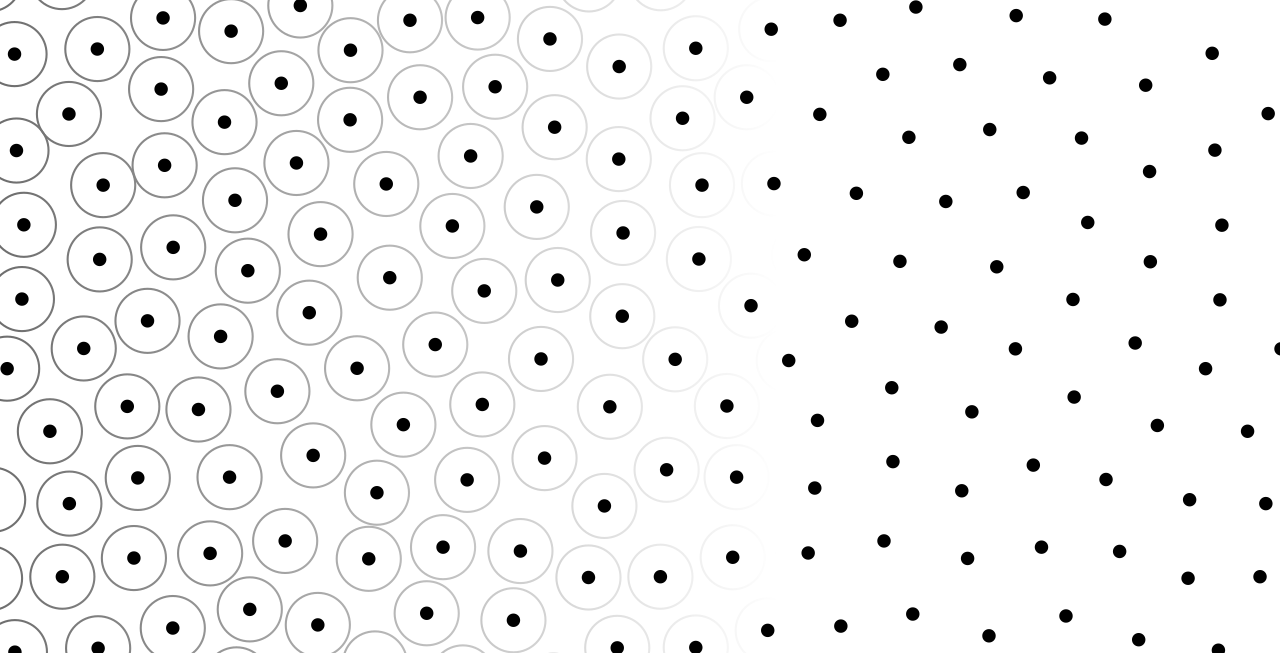
The Poisson point process is a fundamental mathematical object used to model seemingly random phenomena across numerous scientific fields. In probability theory and statistics, it consists of points randomly located on a mathematical space, with the core feature that the points occur independently of one another. The process is named after the French mathematician Siméon Denis Poisson, as the number of points found in any finite region follows a Poisson distribution. This process was discovered independently and repeatedly in various contexts, including experiments on radioactive decay, the arrival of telephone calls, and actuarial science. The Poisson point process is often defined on the real number line, where it can be viewed as a stochastic process, and is used in queueing theory to model random events distributed in time, such as customer arrivals or earthquake occurrences. In the plane, known as a spatial Poisson process, it can represent the locations of scattered objects like transmitters in a wireless network or trees in a forest. The process depends on a single mathematical object—a constant, a locally integrable function, or a Radon measure—which determines the average density of points. When this is a constant, the process is called homogeneous or stationary; when the density depends on location, it is called inhomogeneous or nonhomogeneous. The Poisson point process has two key properties: the Poisson property, meaning the number of points in a bounded region is a Poisson-distributed random variable, and complete independence, meaning the counts of points in disjoint bounded regions are independent of each other. This lack of interaction between regions motivates the process being called purely or completely random.
- field
- Probability theory, statistics, stochastic processes
- known_for
- Modeling random point patterns with Poisson-distributed counts and independent scattering
- type
- Mathematical object (point process)
Lore & Background
The Poisson point process is defined on various mathematical spaces, such as the real number line (where it can be viewed as a stochastic process) or the plane (where it is known as a spatial Poisson process). It depends on a single mathematical object—a constant, a locally integrable function, or a Radon measure—called the rate or intensity, which represents the average density of points. When the intensity is constant, the process is called homogeneous or stationary; when it varies with location, it is called inhomogeneous or nonhomogeneous. The process is characterized by two fundamental properties. First, the number of points in any bounded region of the underlying space follows a Poisson distribution, meaning the probability of finding exactly a given number of points in that region is determined by the distribution’s parameter, which equals the expected count. Second, the numbers of points in disjoint, bounded subregions are completely independent of one another, a property known as complete randomness or independent scattering. This lack of interaction between regions leads to the process being described as purely or completely random. The process was discovered independently in several contexts, including experiments on radioactive decay, telephone call arrivals, and actuarial science. It is used as a mathematical model across numerous disciplines, such as astronomy, biology, ecology, geology, seismology, physics, economics, image processing, and telecommunications. On the real line, it models random events distributed in time, like customer arrivals or earthquake occurrences. In the plane, it represents scattered objects, such as transmitters in a wireless network or trees in a forest.
Reader's Guide
The Poisson point process is widely used as a mathematical model for seemingly random processes in numerous disciplines, including astronomy, biology, ecology, geology, seismology, physics, economics, image processing, and telecommunications. In queueing theory, it models random events distributed in time, such as customer arrivals or phone calls. In spatial contexts, it represents locations of scattered objects like transmitters in a wireless network or trees in a forest. The process has two key properties: the Poisson property (the number of points in any bounded region follows a Poisson distribution) and the independence property (the numbers of points in disjoint bounded regions are completely independent). These properties make it a fundamental tool in spatial point processes, stochastic geometry, spatial statistics, and continuum percolation theory.
Did You Know?
- The Poisson point process is also known as a Poisson random measure, Poisson random point field, or Poisson point field.
- The number of points in any given finite region follows a Poisson distribution.
- The process was discovered independently in settings including radioactive decay, telephone call arrivals, and actuarial science.
- Both homogeneous and nonhomogeneous Poisson point processes are particular cases of the generalized renewal process.
Origins and Independent Discovery
The Poisson point process carries the name of French mathematician Siméon Denis Poisson, yet the process itself did not spring from a single breakthrough. Instead, it was discovered independently and repeatedly in several entirely different practical settings. Researchers examining radioactive decay, analysts tracking telephone call arrivals, and practitioners in actuarial science each encountered the same underlying pattern: points scattered across a space with no interaction whatsoever between them. The naming convention links the process directly to the Poisson distribution, which dictates how many points fall within any given finite region. This multi-origin discovery narrative underscores the process's deep roots in observable randomness across both the physical and social worlds. In the literature the object also appears under several alternative names—Poisson random measure, Poisson random point field, and Poisson point field—reflecting how it has been absorbed into distinct mathematical traditions over time.
The Two Pillars: Poisson Counts and Complete Independence
Every formulation of the Poisson point process, regardless of dimension or underlying space, rests on two defining properties: the Poisson distribution of point counts and the complete independence of counts across disjoint regions. The first property states that the number of points landing in any bounded region follows a Poisson law, parameterized by Λ, which equals the expected count in that region. The probability of observing exactly n points is given by Λ to the n divided by n factorial times e to the negative Λ. The second property, sometimes called complete randomness or independent scattering, guarantees that counts in one subregion carry no information whatsoever about counts in another. Crucially, these two properties are not logically independent of each other. The Poisson count distribution actually implies the independence property outright. The reverse direction, however, demands additional assumptions: the process must be simple, free of fixed atoms, and almost surely boundedly finite. This interplay makes the two properties a tightly coupled foundation rather than two separate axioms.
A Universal Language for Randomness Across Disciplines
The Poisson point process has become a default mathematical model for randomness in an astonishing breadth of fields. In queueing theory it captures the arrival of customers at a store, phone calls hitting a telephone exchange, or the timing of earthquakes along a fault line. In the plane, the same framework—often called a spatial Poisson process—describes the placement of transmitters in a wireless network, the impact points of particles in a detector, or the distribution of trees across a forest. Beyond these concrete examples, the process underpins entire subfields: spatial point processes, stochastic geometry, spatial statistics, and continuum percolation theory all draw on its structure. Its reach extends into astronomy, biology, ecology, geology, physics, economics, and image processing. This universality stems from the process's minimal assumptions: points appear independently, with no memory of where their neighbors landed, making it the natural first approximation for any scattering phenomenon.
Homogeneous, Inhomogeneous, and Beyond Points
The entire Poisson point process is governed by a single mathematical object that can take several forms depending on the level of generality required. When this object is a simple constant—the rate or intensity—the resulting process is called homogeneous or stationary, meaning the average density of points is uniform across the entire underlying space. When the object is instead a locally integrable function, the density varies from place to place, yielding an inhomogeneous or nonhomogeneous process. In the most abstract settings, a Radon measure plays this role. Both the homogeneous and nonhomogeneous variants are special cases of the broader generalized renewal process. The word point in the name is frequently dropped in casual usage, and the framework extends well beyond zero-dimensional objects: one can construct Poisson processes of lines or polygons, all built on the same foundational independence and count-distribution principles.
Gallery

Frequently Asked Questions
Who is Poisson point process?
A Poisson point process is a random scattering of points across a mathematical space in which no point influences the placement of any other. It takes its name from Siméon Denis Poisson because the number of points landing in any bounded region follows his eponymous distribution.
What are Poisson point process's powers and role?
Its signature ability is modeling events that pop up at random locations or times with no memory of past occurrences, such as radioactive decay or incoming telephone calls. The strict independence of each point from every other is what makes it a go-to baseline for random arrival patterns.
Where did Poisson point process first appear in canon?
Rather than a single origin story, the process surfaced independently across several real-world settings: radioactive decay experiments, telephone traffic analysis, and actuarial risk modeling. Each of those domains revealed the same underlying pattern of independent, randomly scattered events.
Why is Poisson point process important to the broader field?
It sits at the crossroads of probability theory, statistics, and stochastic processes, giving researchers a clean, tractable baseline for random spatial and temporal patterns. Because of its independence structure, it naturally serves as the starting point before more complex dependent models are introduced.
How does Poisson point process relate to the Poisson distribution?
The distribution is essentially the counting shadow of the process: if you project the process onto any finite region, the number of points you observe there is a Poisson random variable. In other words, the distribution is what you get when you ask the process a single counting question.
More in Probability & Statistics 1-24
Spotted an error? Know more?
This is a living reference — every entry is fact-audited, and reader corrections feed straight into our audit queue. Suggest an edit · See this site's audit record