Eddie Cochran
American rock and roll musician who died in a car accident.
Last updated

Pinterest · CC BY-SA 4.0
Edward Ray Cochran (October 3, 1938 – April 17, 1960) built a reputation as a rock and roll figure whose music spoke directly to the restlessness and desires of teenagers in the mid-1950s and early 1960s. Tracks like "Twenty Flight Rock," "Summertime Blues," "C'mon Everybody," and "Somethin' Else" became anthems of that era. Even on his earliest singles, he pushed boundaries by trying out multitrack recording, distortion, and overdubbing. He was a multi-instrumentalist, comfortable on guitar, piano, bass, and drums.
With his sharp clothes, good looks, and rebellious edge, he became the picture of a 1950s rocker, and his early death only cemented his iconic status. Music was part of his life from childhood. He played in the school band and taught himself blues guitar. In 1955, he teamed up with guitarist Hank Cochran (no relation) to form the Cochran Brothers.
Solo and film appearances (1956–1959)
After they parted ways the following year, Eddie began writing songs with Jerry Capehart. His big break came when he performed "Twenty Flight Rock" in the film The Girl Can't Help It, starring Jayne Mansfield. Soon after, he signed with Liberty Records, and his first single for the label, "Sittin' in the Balcony," reached number 18 on the Billboard charts.
Death
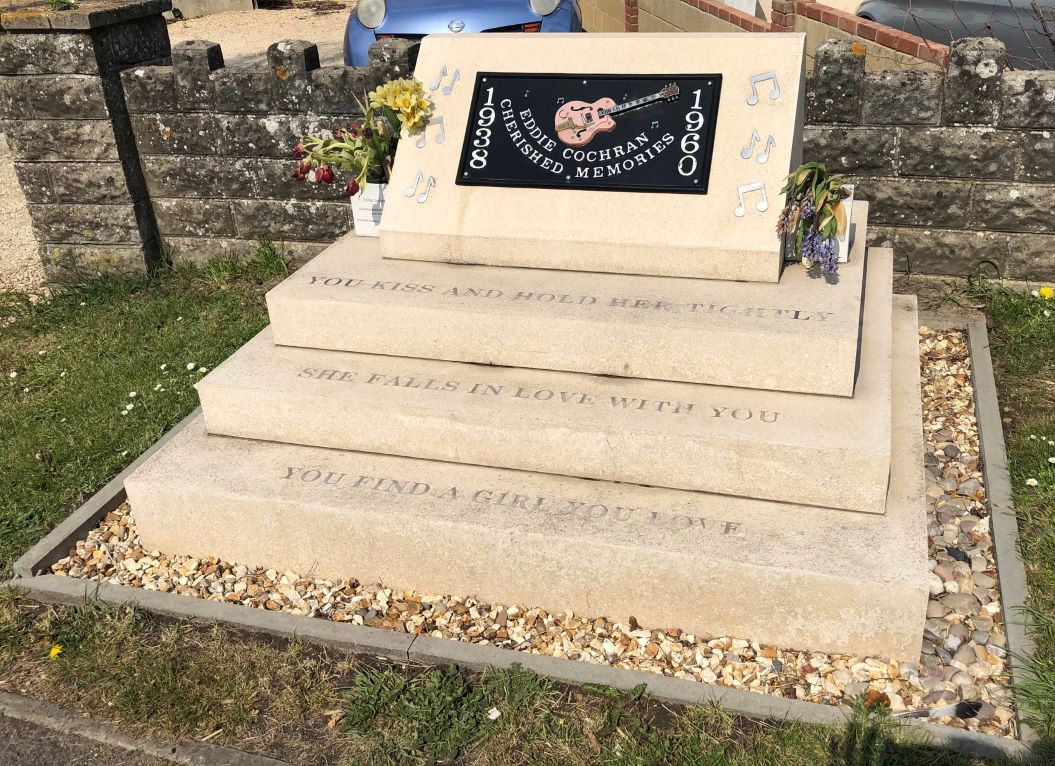
Cochran died on April 17, 1960, at St Martin's Hospital in Bath, Somerset, following a car crash in Chippenham, Wiltshire. The accident happened at the end of a British tour with Gene Vincent. On April 16, after a show at the Bristol Hippodrome, the group—including Vincent, Cochran, tour manager Patrick Tompkins, and songwriter Sharon Sheeley—was heading to Heathrow Airport in a private-hire taxi when a high-speed collision occurred. The other three survived, though with serious injuries, but Cochran was thrown from the vehicle and suffered fatal brain damage.
Influence
Although his best-known songs came out while he was alive, many more were released after his death. He was inducted into the Rock and Roll Hall of Fame in 1987. Numerous artists have covered his work. Paul McCartney used "Twenty Flight Rock" as his audition piece for John Lennon’s skiffle group, the Quarrymen; his performance impressed Lennon, and he was brought on board, a group that later evolved into the Beatles.
Early life
Cochran was born on October 3, 1938, in Albert Lea, Minnesota, to Alice and Frank R. Cochran. His family was of Scottish descent, and his parents originally came from Oklahoma. He took music lessons at school but quit the band to play drums. Instead of piano lessons, he taught himself guitar, picking up country music and other styles from the radio.
In 1952, his family moved to Bell Gardens, California. As his guitar skills grew, he formed a band with two junior high friends. In January 1955, he left Bell Gardens High School during his first year to pursue music full-time. At a show in an American Legion hall, he met songwriter Hank Cochran.
Though not related, they recorded as the Cochran Brothers and built a performing act, releasing a few singles on Ekko Records that found moderate success. Eddie also worked as a session musician and started writing songs, cutting a demo with Jerry Capehart, who would become his manager. In July 1956, Crest Records released his first solo single, "Skinny Jim," now considered a rock-and-roll and rockabilly classic.
That spring, director Boris Petroff asked him to appear in the musical comedy The Girl Can't Help It (1956), where he sang "Twenty Flight Rock." In 1957, he starred in Untamed Youth, co-writing the song "Oo Ba La Baby" with Capehart for co-star Mamie Van Doren. He also scored another hit with "Sittin' in the Balcony," one of the few songs he recorded that he didn't write himself (it was by John D. Loudermilk). "Twenty Flight Rock" was initially written by AMI staff writer Ned Fairchild (a pen name for Nelda Fairchild), but Cochran’s major changes and contributions earned him a co-writing credit. In the summer of 1957, Liberty Records released his only studio album during his lifetime, Singin' to My Baby. It included "Sittin' in the Balcony" and songs he wrote with Capehart, like "Completely Sweet," "Undying Love," "When I'm Mad," and his original "One Kiss." In 1958, he hit his stride with the teenage anthem "Summertime Blues," co-written with Capehart.
The single, Liberty 55144, reached number 8 on the charts and cemented his influence on 1950s rock and roll, both lyrically and musically. He initially toured with the Kelly Four—guitarist Mike Deasy, saxophonist Mike Henderson, bassist Dave Shriver, and drummer Gene Riggio—calling themselves the Hollywood Swingers, a nod to Dick D'Agostin's band. Over time, the lineup shifted, adding saxophonist Jim Seals, bassist Connie "Guybo" Smith, and pianist Jim Stivers, with various members from Dick D'Agostin and the Swingers joining in. By 1959, the Swingers included multi-instrumentalist Dick D'Agostin, pianist Jim Stivers (briefly on bass), guitarist Larry D'Agostin, and saxophonist...
Did You Know?
- Cochran's song "Three Steps to Heaven" posthumously topped the charts in the Republic of Ireland and the United Kingdom in 1960.
- Cochran played lead guitar on Skeets McDonald's 1959 session for "You Oughta See Grandma Rock" and "Heart Breaking Mama".
Frequently Asked Questions
Who is Eddie Cochran?
Eddie Cochran was an American rock and roll musician born in Albert Lea, Minnesota in 1938, best known for channeling raw teenage frustration and desire into his music during the mid-1950s and early 1960s. His sharply dressed, rebellious persona became the definitive image of the 1950s rock star.
How did Eddie Cochran die?
Cochran was killed in a car accident on April 17, 1960, in Bath, Somerset, England, at the age of just 21. His sudden death turned him into a tragic rock icon whose influence outlasted his brief career.
What instruments did Eddie Cochran play?
Cochran was a multi-instrumentalist who performed on guitar, piano, bass, and drums. His guitar work in particular became a signature element of his live and studio performances.
Also in the Codexery
More in Pop & Rock Solo Artists
Test yourself
Three questions drawn from this entry’s sources. Pick an answer to check it.
Answers checked against the source article
Sources
Compiled from Wikipedia and the sources listed below. Text from Wikipedia is available under CC BY-SA 4.0; this entry is adapted from it.
- Wikipedia: Eddie Cochran (CC BY-SA 4.0).
Spotted an error? Know more?
Reader corrections go straight into our review queue. Suggest an edit · How this site is sourced