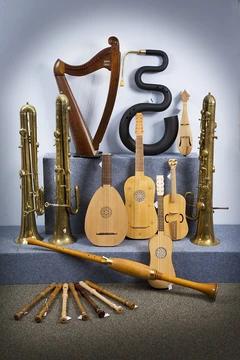
The Guitar
A chordophone from the reference compendium.
Last updated
The guitar is a stringed musical instrument classified as a chordophone, meaning its sound is produced by vibrating strings stretched between two fixed points. It is usually fretted and typically has six or twelve strings. The instrument is held flat against the player’s body, with one hand strumming or plucking the strings—often with a guitar pick—while the other hand presses selected strings against the frets. Sound is projected either acoustically, through a resonant hollow chamber, or electronically, via a pickup and amplifier.
History
Historically, guitars were made of wood with catgut strings; steel strings emerged near the end of the nineteenth century in the United States, though nylon and steel strings became common only after World War II. The guitar’s ancestors include the gittern, the vihuela, the four-course Renaissance guitar, and the five-course baroque guitar. The modern word “guitar” traces back through Spanish, Andalusian Arabic, Latin, and Ancient Greek, though its ultimate origin is uncertain. The instrument’s development is lost to medieval Spain, but two instruments—the four-string oud and the European lute—are often cited as predecessors, though many scholars consider the lute a separate line of development.
By 1200, two types called “guitars” were used in Spain: the guitarra Latina, with a single sound hole and narrow neck, and the guitarra morisca, with a rounded back and wide fingerboard. The Spanish vihuela of the fifteenth and sixteenth centuries is considered a major influence on the baroque guitar. Three main modern types exist: the classical (Spanish) guitar, the steel-string acoustic or electric guitar, and the lap steel (Hawaiian) guitar.
Acoustic
Acoustic guitars include flat-top and archtop (jazz) designs. Electric guitars, patented in 1937, use pickups and amplifiers, enabling solid-body construction and effects like reverb and distortion. Solid-body guitars became dominant in the 1960s and 1970s. The electric guitar’s amplified sound has been crucial to blues and rock music, both for accompaniment and solos, and it influences many genres worldwide, including country, flamenco, jazz, metal, punk, reggae, and pop.
Lore & Background
The guitar is a stringed musical instrument, typically fretted, most often with six or twelve strings. It is held flat against the body, played by strumming or plucking the strings with one hand while the other hand presses strings against frets. A pick may also be used. As a chordophone, its sound originates from a vibrating string stretched between two fixed points.
Historically, guitars were made of wood with catgut strings; steel strings appeared in the late nineteenth century in the United States, while nylon and steel strings became common after World War II. The guitar’s ancestors include the gittern, vihuela, four-course Renaissance guitar, and five-course baroque guitar. Three main modern types exist: the classical (Spanish) guitar, the steel-string acoustic or electric guitar, and the lap steel (Hawaiian) guitar, played across the lap.
Acoustic types include flat-top guitars with a large sound hole and archtop guitars, sometimes called jazz guitars. The classical Spanish guitar is often played solo using fingerstyle technique, plucking each string individually. Electric guitars, patented in 1937, use a pickup and amplifier, enabling solid-body construction without a resonant chamber. Effects like reverb and distortion became possible.
Solid-body guitars, less prone to feedback, dominated the market by the 1960s and 1970s. Electric guitars are central to blues and rock music, used for riffs, chords, and solos, and have profoundly influenced popular culture. The guitar appears in genres including blues, bluegrass, country, flamenco, folk, jazz, rock, metal, punk, funk, reggae, soul, and pop, and is occasionally sampled in hip-hop, dubstep, or trap.
Common Misconceptions (Editorial)
Some believe the word "guitar" originated directly from Latin, but it actually derives from Spanish guitarra, which traces back through Andalusian Arabic and Latin cithara to Ancient Greek kithára. Another common misconception is that the modern guitar was invented in the 20th century; in fact, its lineage includes the 15th- and 16th-century Spanish vihuela, which directly influenced the baroque guitar centuries earlier.
Why It Matters (Editorial)
The guitar endures because it bridges ancient craftsmanship and modern innovation, from the Hittite chordophone depicted 3,300 years ago to the electric guitar that shaped blues and rock. Its versatility across genres and cultures makes it more than an instrument—it is a global vehicle for personal expression and collective memory, reflecting humanity’s enduring need to make music tangible.
Reader's Guide
The guitar is played by holding it flat against the body, strumming or plucking the strings with one hand while the other hand presses strings against frets, sometimes using a pick. Acoustically, sound projects from a hollow resonating chamber, while electric models use a pickup and amplifier. The instrument is a chordophone, producing sound from vibrating strings stretched between fixed points. Historically made of wood with catgut strings, steel strings emerged in the late nineteenth century in the United States, with nylon and steel becoming common after World War II.
Three main modern types exist: classical (Spanish), steel-string acoustic or electric, and lap steel (Hawaiian). Acoustic guitars include flat-top and archtop (jazz) varieties. The classical Spanish guitar is often played solo with fingerstyle technique, plucking each string individually, while "finger-picking" also denotes a U.S. folk, blues, bluegrass, and country tradition. Electric guitars, patented in 1937, enabled solid-body construction without a resonant chamber, reducing feedback, and allowed electronic effects like reverb and distortion.
Solid-body models dominated the market from the 1960s. The electric guitar’s amplified sound was key to blues and rock, serving as accompaniment and for solos, influencing heavy metal, punk, and popular culture. The guitar is primary in blues, bluegrass, country, flamenco, folk, jazz, metal, punk, funk, reggae, rock, grunge, soul, disco, new wave, new age, adult contemporary, and pop, and is occasionally sampled in hip-hop, dubstep, or trap. Its ancestors include the gittern, vihuela, Renaissance guitar, and baroque guitar.
The modern word derives from Spanish, via Andalusian Arabic and Latin, ultimately from Ancient Greek kithara, appearing in the Bible. The instrument’s origins are unknown; a 3,300-year-old Hittite carving shows a chordophone, and Babylonian plaques depict a lute-like instrument. By 1200 Spain had two types: the Moorish guitar (rounded back, wide fingerboard, multiple sound holes) and the Latin guitar (single sound hole, narrow neck). The vihuela of the 15th–16th centuries is considered the most important influence on the baroque guitar.
Frequently Asked Questions
What is The Guitar?
The Guitar is a fretted stringed instrument, most commonly built with six strings (though twelve-string variants exist), classified as a chordophone. It produces tone when plucked or strummed strings vibrate between two fixed anchor points.
How does The Guitar actually make sound?
Sound comes from vibrating strings stretched between a bridge and a nut, with their vibrations transferred through the hollow body on acoustics or captured by magnetic pickups on electrics. The fretted neck lets the player change pitch by pressing strings down against the fretboard.
What musical genres feature The Guitar?
The Guitar spans virtually every major genre, from classical and folk to blues, jazz, country, and rock. Its electric variant became especially iconic in blues and rock, shaping the sonic identity of 20th-century popular music.
More in Musical Instruments
Sources
Compiled from Wikipedia and the sources listed below. Text from Wikipedia is available under CC BY-SA 4.0; this entry is adapted from it.
- Wikipedia: Guitar (CC BY-SA 4.0).
Spotted an error? Know more?
Reader corrections go straight into our review queue. Suggest an edit · How this site is sourced