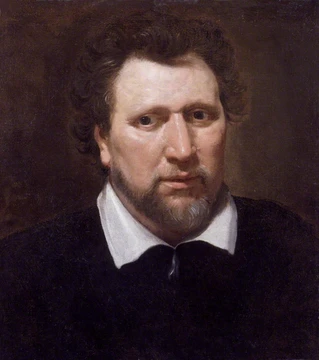
Chikamatsu Monzaemon
Japanese dramatist of bunraku and kabuki, famed for love-suicide plays.

via Wikipedia: Chikamatsu Monzaemon · see source
Chikamatsu Monzaemon, born Sugimori Nobumori in 1653 and died on January 6, 1725, is considered by the Encyclopædia Britannica to be Japan’s greatest dramatist. He wrote for both jōruri (puppet theater, later called bunraku) and kabuki, the live-actor stage. His most celebrated works are domestic tragedies about honor-bound lovers who commit double suicide, such as *The Courier for Hell* (1711) and *The Love Suicides at Amijima* (1721). Of his roughly 70 historical romances (jidaimono) and 24 domestic plays (sewamono), the domestic pieces are now seen as his core achievement, though *The Battles of Coxinga* (1715) remains a praised exception among his histories.
Chikamatsu came from a samurai family; his father, Sugimori Nobuyoshi, was a doctor to a daimyō in Echizen Province, and his mother was the daughter of another domain physician. After his father lost his position and became a masterless rōnin, the family moved to Kyoto when Chikamatsu was in his teens. He served briefly as a page for a noble family, and his first known work was a haiku published in 1671. He later appears in records of a temple in Ōmi Province, which likely inspired his pen name. His first confirmed puppet play, *The Soga Successors*, was staged in Kyoto in 1683, though 15 earlier anonymous works are sometimes attributed to him. Between 1684 and 1695, he wrote kabuki plays for the actor Sakata Tōjūrō, then focused almost exclusively on kabuki from 1695 to 1705. He abruptly abandoned the genre around 1705, possibly because puppets were easier to control, because Tōjūrō was retiring, or because puppet theater was more profitable. Scholar C. Andrew Gerstle notes that working with kabuki actors pushed Chikamatsu toward more realistic characters, while later collaboration with Takeda Izumo increased theatricality.
By 1705, Chikamatsu was a staff playwright, and soon after he moved to Osaka, where puppet theater was booming. His popularity peaked with domestic love-suicide plays and the massive success of *The Battles of Coxinga* in 1715. Audience tastes later shifted toward gore and crude spectacle, and many of his plays fell out of use, their music lost. He died on January 6, 1725, in either Amagasaki or Osaka. In 1706, he wrote *Goban Taiheiki*, a three-act puppet play about the Forty-seven rōnin, which later inspired the famous *Chūshingura*. Today, 130 plays are confirmed as his work, with 15 more suspected.
Chikamatsu’s dramatic theory survives in a 1738 posthumous preface, where he argued that art exists in the narrow gap between the real and the unreal, rejecting strict imitation of reality. This has been interpreted as a theory of realism that prioritizes emotional truth over surface appearance. His domestic plays were elevated to high literature during the Meiji and Taishō eras, praised for masterfully depicting human passions and irrationality. *The Love Suicides at Sonezaki* (1703), an early domestic hit, revived the Takemoto Theater in Osaka, and Donald Keene called its death scene one of the loveliest in Japanese literature. *The Drum of the Waves of Horikawa* (1707) is noted for its exploration of female sexuality and critique of lower-class life.
- born
- 1653
- died
- 6 January 1725
- field
- Dramatist
- nationality
- Japanese
- known_for
- Domestic tragedies (sewamono) about love suicides; The Love Suicides at Amijima;
Verified Timeline
Lore & Background
Chikamatsu was born Sugimori Nobumori to a samurai family. There is disagreement about his birthplace. The most popular theory suggests he was born in Echizen Province, but there are other plausible locations, including Hagi, Nagato Province. His father, Sugimori Nobuyoshi, served as a medical doctor to the daimyō Matsudaira in Echizen. His mother was the daughter of Okamoto Ichiku, a physician to the Echizen domain, and Chikamatsu’s younger brother later became the physician and medical author Okamoto Ippō. Chikamatsu’s father lost his office and became a rōnin, a masterless samurai. At some point in his teens, between 1664 and 1670, Chikamatsu moved with his father to the imperial capital of Kyoto, where he served for a few years as an obscure page for a civil noble family. He published his first known literary work during this period, a haiku that appeared in 1671. After he served as a page, he next appears in records of the Gonshō-ji temple in Ōmi Province, in present-day Shiga Prefecture. The temple has long been suggested as the origin of his pen name Chikamatsu, a kun reading of 近松. With the 1683 Kyoto production of his puppet play about the Soga brothers (The Soga Successors or The Soga Heir; Yotsugi Soga), Chikamatsu became known as a playwright. Chikamatsu also wrote plays for kabuki theatre between 1684 and 1695, most of them intended for performance by the famous actor Sakata Tōjūrō (1647–1709). From 1695 until 1705, Chikamatsu wrote almost exclusively kabuki plays, after which he abruptly and almost completely abandoned the genre. In 1705 or 1706, Chikamatsu left Kyoto for Osaka, where puppet theater was even more popular. Chikamatsu's popularity peaked with his domestic plays about love suicides and with the blockbuster success of The Battles of Coxinga in 1715, but patrons' tastes later turned to more sensational, gore-filled spectacles and cruder antics. Chikamatsu's plays fell out of use, and the music itself was lost for many of them. He died on January 6, 1725, in either Amagasaki, Hyōgo, or Osaka. Currently, 130 plays have been verified as Chikamatsu’s work, and another 15, mostly early kabuki works, are suspected to also have been penned by him.
Reader's Guide
Chikamatsu Monzaemon is central to Japanese theater history as the preeminent dramatist of bunraku and kabuki. His domestic tragedies (sewamono), especially The Love Suicides at Amijima (1721) and The Courier for Hell (1711), are considered the core of his artistic achievement, praised for their deep portrayal of commoners and the passions of the human heart. His historical romances (jidaimono) are viewed less positively, though The Battles of Coxinga (1715) remains praised and ran for seventeen months, becoming the classical model for later history plays. His dramatic theory, preserved in a posthumous preface to Hozumi Ikan’s Naniwa Miyage (1738), rejects strict imitation of reality, arguing that "Art abides in the narrow gap between the flesh and the skin, the real and the unreal." His works have been adapted into films by Kenji Mizoguchi (Chikamatsu Monogatari, 1954) and Masahiro Shinoda (Shinjū: Ten no Amijima, 1969), and into opera by Mayako Kubo (Osan, 2005). Chikamatsu's legacy endures as the defining figure of Japanese puppet theater and a master of tragic love stories.
Did You Know?
- Chikamatsu's real name was Sugimori Nobumori.
- His father lost his office as a medical doctor to a daimyō and became a rōnin (masterless samurai).
- Chikamatsu's pen name is thought to derive from the Gonshō-ji temple in Ōmi Province.
- His play The Battles of Coxinga (1715) ran for seventeen months and became the classical model for later history plays.
- Chikamatsu died on January 6, 1725, in either Amagasaki, Hyōgo, or Osaka.
Frequently Asked Questions
Who is Chikamatsu Monzaemon?
He was a Japanese playwright born in 1653 under the name Sugimori Nobumori and is widely considered the greatest dramatist in Japanese literary history. He passed away on January 6, 1725.
What theater forms did Chikamatsu Monzaemon write for?
He crafted scripts for two major Japanese stage traditions: jōruri puppet theater (later known as bunraku) and kabuki. His work elevated both forms by bringing deeply human, emotionally driven stories to their stages.
What is Chikamatsu Monzaemon's most famous play?
'The Love Suicides at Amijima' is his signature work, a domestic tragedy in which a couple bound by social duty chooses a double suicide together. It remains the defining example of his sewamono genre and is still performed today.
What kind of stories did Chikamatsu Monzaemon specialize in?
He is best known for sewamono, or domestic tragedies, depicting ordinary people trapped by honor, class obligations, and love. His most iconic plots center on lovers who see a shared death as their only escape from societal constraints.
Why is Chikamatsu Monzaemon considered so important in theater history?
He reshaped both puppet theater and kabuki by replacing ornate spectacle with raw, character-driven drama rooted in everyday life. His influence on Japanese storytelling and the global perception of the art form extends well beyond his own era.
More in Playwrights And Dramatists 1-24
Spotted an error? Know more?
This is a living reference — every entry is fact-audited, and reader corrections feed straight into our audit queue. Suggest an edit · See this site's audit record