Hedda Gabler
Daughter of a general, trapped in an unwanted marriage.
Last updated

via Wikipedia: Hedda Gabler · see source
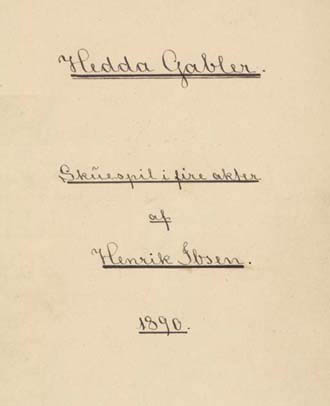
Hedda Gabler is a play by Norwegian playwright Henrik Ibsen that dramatizes the experiences of its title character, a general's daughter trapped in an unwanted marriage.[1][2] The role of Hedda is frequently ranked among theatre's most significant parts and is often compared to Hamlet as a female counterpart.[2][3]
Key facts and history
The play's title uses Hedda's maiden name Gabler, and Ibsen wrote that his intention was "to indicate that Hedda as a personality is to be regarded rather as her father's daughter than her husband's wife"[4] The play has been adapted for screen several times, including the 1975 British film Hedda directed by Trevor Nunn, for which Glenda Jackson was nominated for an Academy Award.[5] The debut British staging happened on 20 April 1891 at London's Vaudeville Theatre; Elizabeth Robins performed the lead and co-directed with Marion Lea.[6] Maggie Smith starred in a 1970 Royal National Theatre production under Ingmar Bergman's direction, earning a Best Actress Evening Standard Theatre Award for her performance.[7]
What the cited sources add
A 2005 Guardian review by Billington notes that in Richard Eyre's production, Eve Best gave a "dazzlingly ironic Hedda" aware of life's absurdity.[3] Billington also states that Ibsen wrote in his notes: "Life for Hedda is a farce which isn't worth seeing through to the end"[3] The same review observes that Rob Howell's design evokes "the looming, shadowy presence of General Gabler" as the play's only real villain.[3] A 2015 El País article by Morales Fernández reports that the Madrid production's Hedda was conceived as "a capable woman" who behaves in a certain way due to a series of conditioning factors.[8]
References
- Wikipedia, "Hedda Gabler" (CC BY-SA 4.0), which cites: Meyer, Michael Leverson, editor and introduction. Ibsen, Henrik. The Wild Duck and Hedda Gabler. W. W. Norton & Company (1997) . page 7.; Bunin, Ivan. About Chekhov: The Unfinished Symphony. Northwestern University Press (2007) . page 26; Checkhov, Anton. Anton Chekhov's Life and Thought: Selected Letters and Commentary. Editor: Karlinsky, Simon. Northwestern University Press (1973) page 385; Haugen, Einer Ingvald. Ibsen's Drama: Author to Audience. University of Minnesota Press (1979) . page 142 (original not read by us) en.wikipedia.org
- Wikipedia, "Hedda Gabler" (CC BY-SA 4.0), which cites: Billington, "Hedda Gabler, Almeida, London", The Guardian, 17 March 2005; Ibsen, "Hedda Gabler: A Play in Four Acts", The Floating Press, May 2021 (we also read that source) en.wikipedia.org
- Billington, "Hedda Gabler, Almeida, London", The Guardian, 17 March 2005. facts only, no text reused. theguardian.com
- Wikipedia, "Hedda Gabler" (CC BY-SA 4.0), which cites: Sanders, "Lecture Notes: Pedda Gabler — Fiend or Heroine", Australian Catholic University, 2006 (original not read by us) en.wikipedia.org
- Wikipedia, "Hedda Gabler" (CC BY-SA 4.0), which cites: "The Age - Google News Archive Search", news.google.com (original not read by us) en.wikipedia.org
- Wikipedia, "Hedda Gabler" (CC BY-SA 4.0), which cites: Marker, Frederick J. Marker, Lise-Lone. Ibsen's Lively Art: A Performance Study of the Major Plays. Cambridge University Press (1989).; Meyer, Michael Leverson, editor and introduction. Ibsen, Henrik. The Wild Duck and Hedda Gabler. W. W. Norton & Company (1997) . page 139. (original not read by us) en.wikipedia.org
- Wikipedia, "Hedda Gabler" (CC BY-SA 4.0), which cites: Ellis, "Ingmar Bergman, Hedda Gabler, June 1970", The Guardian, 30 April 2003 (original not read by us) en.wikipedia.org
- Morales Fernández, Clara, "Redimir a Hedda", El País, 23 April 2015. facts only, no text reused. cultura.elpais.com
Each numbered sentence above was checked against the source it cites before publication. Sentences citing Wikipedia adapt text from the English Wikipedia article Hedda Gabler (contributors), used under CC BY-SA 4.0; this entry is available under the same licence. Other sources were used for facts only; no text or images are copied from them.
More in Plays & Drama
Sources
Compiled from Wikipedia and the sources listed below. Text from Wikipedia is available under CC BY-SA 4.0; this entry is adapted from it.
- Wikipedia: Hedda Gabler (CC BY-SA 4.0).
Spotted an error? Know more?
Reader corrections go straight into our review queue. Suggest an edit · How this site is sourced