Troilus and Cressida
A Shakespearean play of love and war at Troy.
Last updated

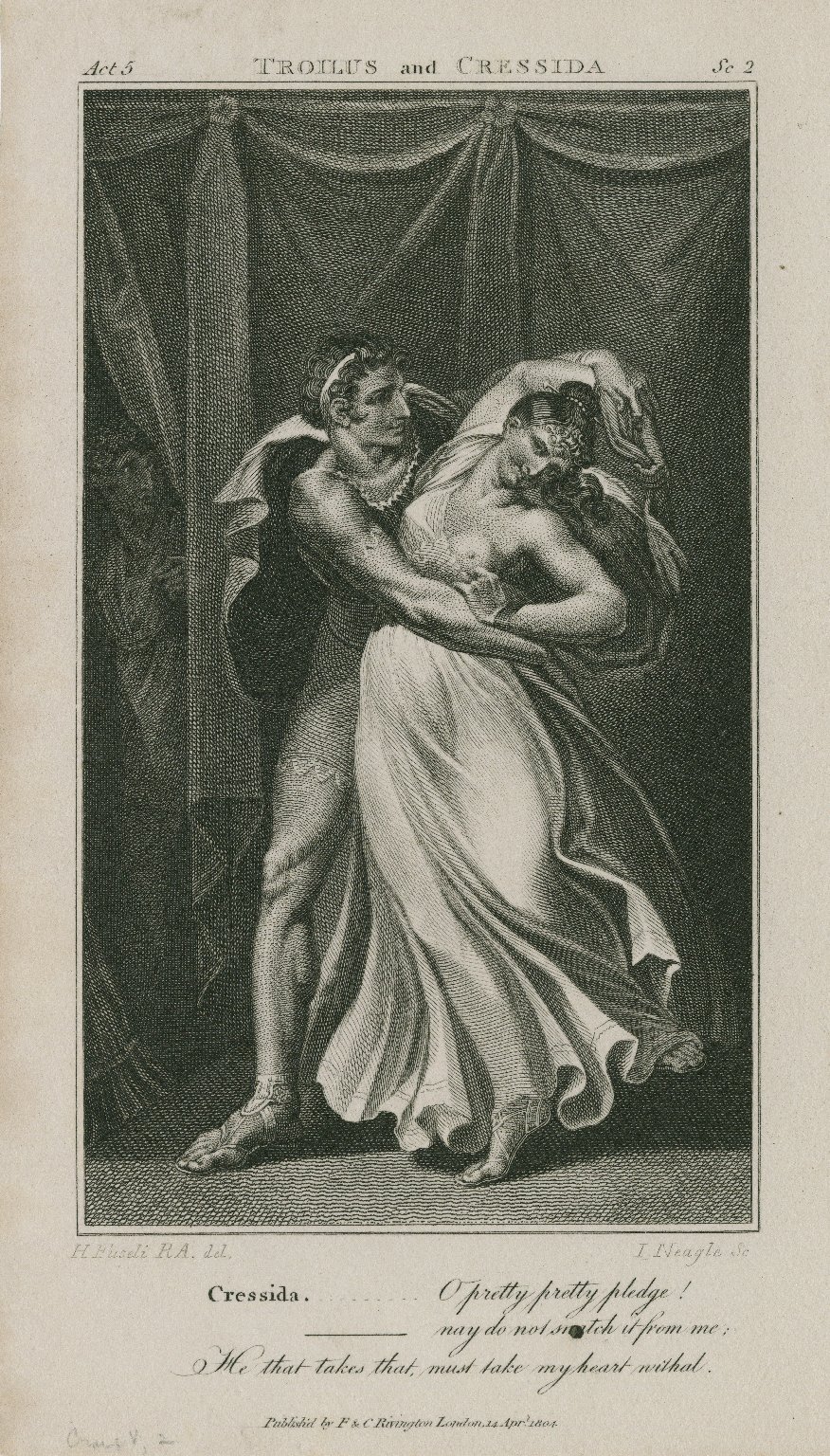
James Neagle (printmaker) · CC BY-SA 4.0
It is sometimes called The Tragedy (or History) of Troilus and Cressida.[1] William Shakespeare's play "Troilus and Cressida" was likely composed in 1602.[1]
Key facts and history
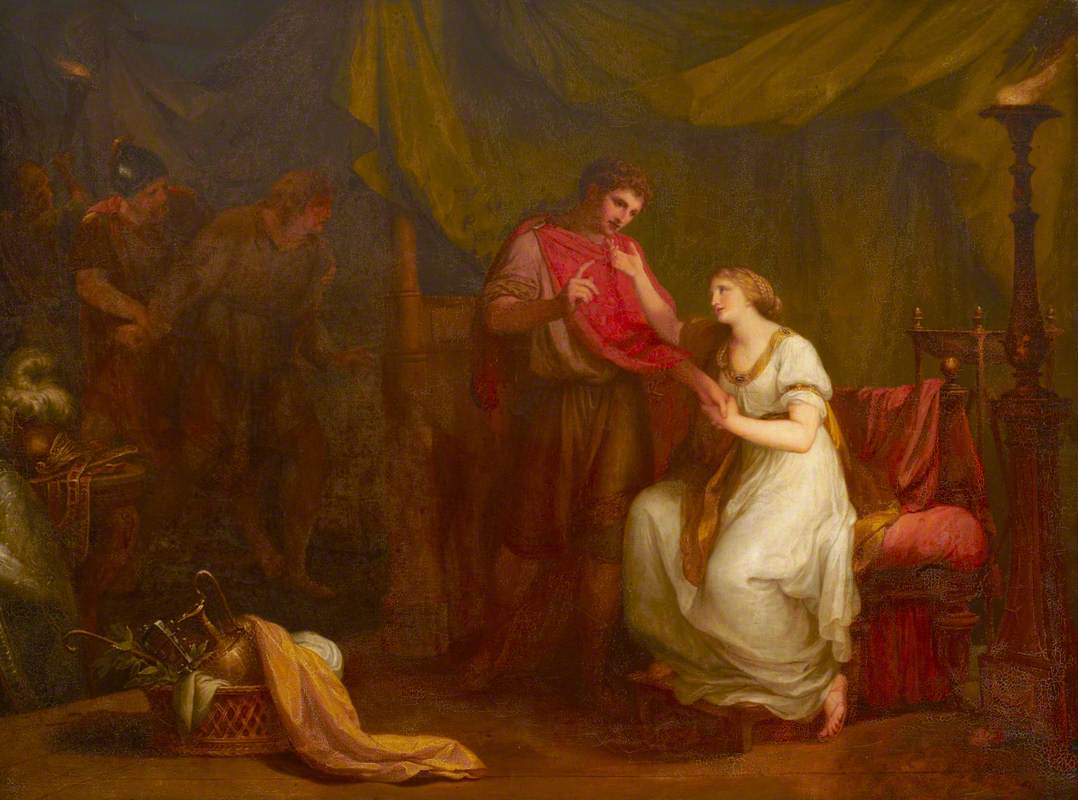
Pandarus helps Troilus pursue Cressida, and they eventually profess their love and pledge fidelity.[2] In the Greek camp, the commanders discuss a crisis because Achilles refuses to fight.[3] Diomedes brings Cressida to the Greek camp, where Ulysses declares her a loose woman.[4] Troilus witnesses Cressida give a love-token to Diomedes and pledges to kill him.[4]
Hector ignores warnings from his wife and sister and goes to battle, where he is killed.[2] Prince Troilus, located inside Troy, tells Pandarus he feels lovesick for Cressida, who is Pandarus's niece.[4] Agamemnon, the Greek commander, consents to swap the captive Antenor for Cressida, which allows her to be with her father Calchas again.[4] After ripping apart a letter that came from Cressida, Troilus goes to the battlefield with Hector.[2]
What the cited sources add
A 2005 edition of "The Yale Shakespeare" was published by Barnes and Noble.[5] The 1984 book "Playing Shakespeare" was published by Methuen in association with Channel Four Television Co..[6] The 1609 Oxford University Press record lists William Shakespeare as the author of "Troilus and Cressida".[7] A 1982 edition from Clarendon Press has 205 pages.[8]
References
- Wikipedia, "Troilus and Cressida" (CC BY-SA 4.0), which cites: Barton, "Playing Shakespeare", Methuen, 1984, p. 41; Nicola, "Playing the audience : the practical actor's guide to live performance", Applause Theatre & Cinema Books, 2002, p. 204 (we also read that source) en.wikipedia.org
- Wikipedia, "Troilus and Cressida" (CC BY-SA 4.0), which cites: "Troilus and Cressida: Entire Play", shakespeare.mit.edu; "SparkNotes: Troilus and Cressida", www.sparknotes.com (we also read that source) en.wikipedia.org
- Wikipedia, "Troilus and Cressida" (CC BY-SA 4.0), which cites: "Troilus and Cressida: Entire Play", shakespeare.mit.edu (we also read that source) en.wikipedia.org
- Wikipedia, "Troilus and Cressida" (CC BY-SA 4.0), which cites: "SparkNotes: Troilus and Cressida", www.sparknotes.com; "Troilus and Cressida: Entire Play", shakespeare.mit.edu (we also read that source) en.wikipedia.org
- Open Library record, ISBN 9780760759394 ("The Yale Shakespeare: The complete works"). CC0 (metadata); book content not read. openlibrary.org
- Open Library record, ISBN 9780413547903 ("Playing Shakespeare"). CC0 (metadata); book content not read. openlibrary.org
- William Shakespeare, "Troilus and Cressida", Oxford University Press eBooks (1609), doi:10.1093/oseo/instance.00027413. OpenAlex metadata CC0; paper not read. doi.org
- Open Library record, ISBN 9780198129035 ("Troilus and Cressida"). CC0 (metadata); book content not read. openlibrary.org
Each numbered sentence above was checked against the source it cites before publication. Sentences citing Wikipedia adapt text from the English Wikipedia article Troilus and Cressida (contributors), used under CC BY-SA 4.0; this entry is available under the same licence. Other sources were used for facts only; no text or images are copied from them.
More in Plays & Drama
Sources
Compiled from Wikipedia and the sources listed below. Text from Wikipedia is available under CC BY-SA 4.0; this entry is adapted from it.
- Wikipedia: Troilus and Cressida (CC BY-SA 4.0).
Spotted an error? Know more?
Reader corrections go straight into our review queue. Suggest an edit · How this site is sourced