Mars
The fourth planet from the Sun, a desert world with polar ice caps.
Last updated
Mars is the fourth planet from the Sun, known as the 'Red Planet' for its orange-red appearance. It is a desert-like rocky planet with a tenuous atmosphere primarily composed of carbon dioxide, and it retains water in the ground and atmosphere, forming clouds, frost, and polar ice caps, but no liquid surface water. Notable for its extreme temperatures, high cosmic radiation, and surface gravity about a third of Earth's, Mars has a mean diameter of 6,779 km and a surface area roughly equal to all of Earth's dry land.
Lore & Background
Mars formed approximately 4.5 billion years ago. Its geological history is divided into three primary periods: the Noachian (4.5 to 3.5 billion years ago), marked by impacts, valley formation, and possible water oceans; the Hesperian (3.5 to 3.3–2.9 billion years ago), dominated by volcanic activity and flooding; and the Amazonian (3.3–2.9 billion years ago to present), which continues today.
The planet experiences seasons due to its axial tilt of 25 degrees, similar to Earth's 23.5 degrees. Mars has two small, irregular natural satellites: Phobos and Deimos. A 2023 study suggests Mars may have had a ring system 3.5 to 4 billion years ago, possibly formed from a moon 20 times more massive than Phobos, with Phobos as a remnant.
Geological Wonders Beyond the Classical Planets
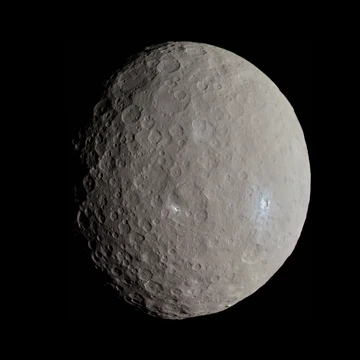
For decades, dwarf planets were dismissed as inert rocks drifting through space. That assumption shattered in 2015, when two separate spacecraft campaigns revealed a startling truth: these small worlds can be geologically alive. NASA's Dawn mission, orbiting Ceres, and the New Horizons flyby of Pluto both confirmed that processes once thought exclusive to the eight major planets—internal differentiation, possible cryovolcanism, complex surface geology—were at work on bodies a fraction of Earth's size. This finding transformed how planetary geologists view the outer Solar System.
Where astronomers might catalog a dwarf planet as a data point in an orbital table, geologists see a laboratory for understanding how small bodies evolve, retain heat, and reshape their surfaces over billions of years. The expectation of geological activity is now a baseline assumption rather than a surprise, and it has made dwarf planets one of the most compelling targets in planetary science. The implication is profound: the boundary between planet and not-a-planet does not correspond to a boundary between geologically interesting and geologically boring.
Reader's Guide
Mars has been observed throughout history as a red wandering star visible to the naked eye, acquiring diverse cultural associations. The first flight to Mars was Mars 1 in 1963, but communication was lost. The first successful flyby was Mariner 4 in 1965, and Mariner 9 became the first spacecraft to orbit another body in 1971, the same year as the first uncontrolled impact (Mars 2) and first successful landing (Mars 3).
Probes have been active on Mars continuously since 1997, and at times more than ten probes have simultaneously operated in orbit or on the surface—more than at any other planet beyond Earth. The possibility of past or present life on Mars remains an active area of scientific investigation, with some possible traces needing further examination. Mars is an often proposed target for future crewed missions, though none are currently planned.
Did You Know?
- Mars has the tallest volcano in the Solar System, Olympus Mons, at 21.9 km (13.6 mi) tall.
- Valles Marineris is one of the largest canyons in the Solar System, 4,000 km (2,500 mi) long.
- The Martian surface is red-orange due to iron(III) oxide and goethite.
Frequently Asked Questions
Where does Mars sit in the solar system's story?
Mars occupies the fourth orbital slot from the Sun, nestled between Earth and the asteroid belt. One complete lap around the Sun takes about 687 Earth days (1.88 Earth years), and its 25-degree axial tilt produces seasons that echo our own.
What is Mars's environment like?
Mars is a barren, desert-like world bathed in high cosmic radiation, with no stable liquid water on the surface. Despite the harshness, it does form thin clouds, ground frost, and maintains ice caps at both poles under its tenuous CO₂ atmosphere.
More in Planets and Dwarf Planets
Sources
Compiled from Wikipedia and the sources listed below. Text from Wikipedia is available under CC BY-SA 4.0; this entry is adapted from it.
- Wikipedia: Mars (CC BY-SA 4.0).
Spotted an error? Know more?
Reader corrections go straight into our review queue. Suggest an edit · How this site is sourced